Louis Vuitton bags are crafted from coated canvases (Monogram, Damier), a range of leathers (Epi, Taurillon, Vachetta, calfskin), and upcycled limited-edition materials; prices depend on model, material, size and rarity, while discontinued pieces often retain or increase resale value, making LV a resilient luxury buy and secondary-market asset.
What materials are Louis Vuitton bags made of?
Answer: Louis Vuitton uses coated canvases (Monogram, Damier Ebene, Damier Azur), several leathers (Epi, Taurillon, Vachetta, calfskin), and occasional upcycled/limited-edition materials; each has distinct feel, durability and effect on price and resale.
Coated canvas: a cotton or linen base finished with PVC (polyvinyl chloride) or similar coating to create a water-resistant, low-maintenance surface.
Epi leather: a textured, durable calfskin with horizontal grain introduced by Louis Vuitton in the 1980s.
Vachetta: untreated, vegetable-tanned cowhide that develops a honey patina over time.
Below are the primary materials, tactile notes and commercial considerations, with examples and practical advice for buyers and sellers.
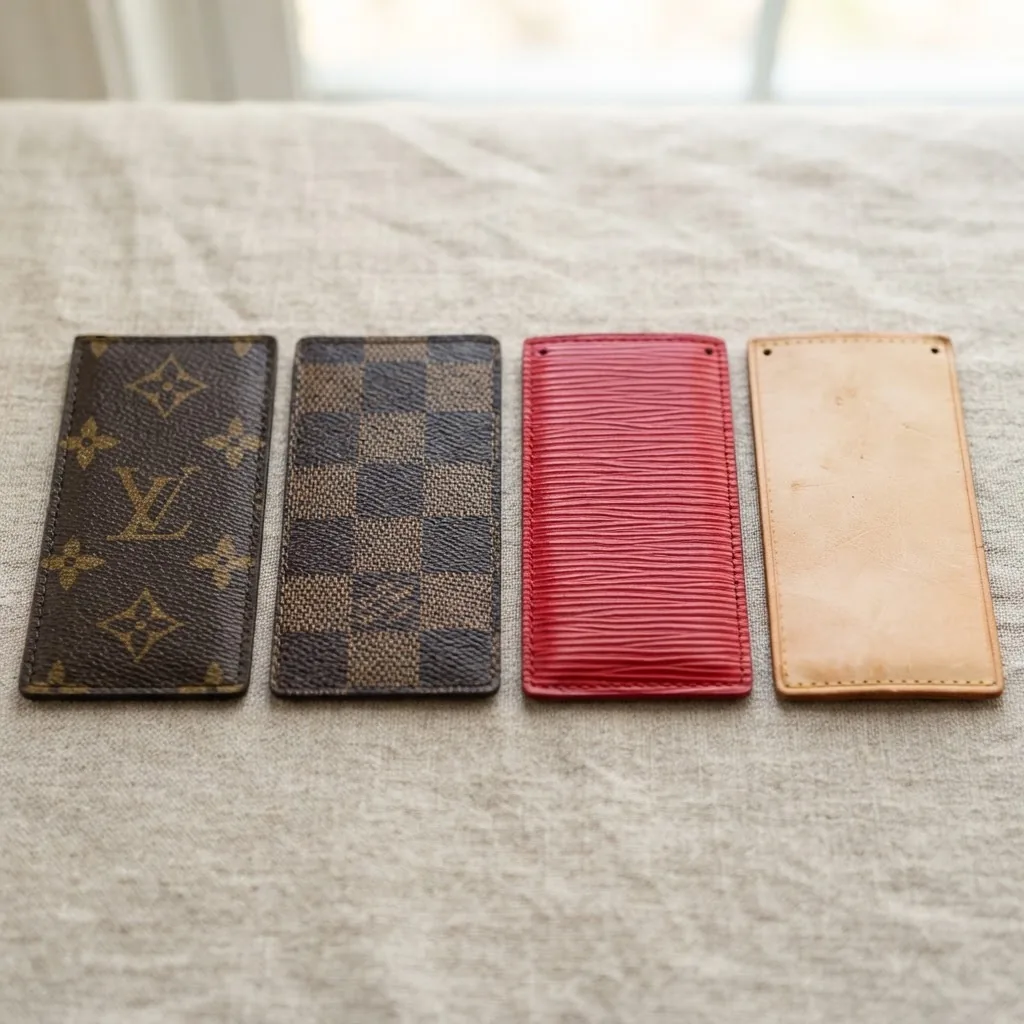
Signature Canvases: Monogram, Damier Ebene, Damier Azur
Answer: Monogram and Damier are coated canvases—highly durable, low-maintenance, and among the brand’s most recognized, while Damier Azur is a lighter canvas finish intended for spring/summer wear.
- Monogram Canvas — Classic LV coated canvas printed with LV initials and floral motifs; smooth, slightly textured surface; resists water and abrasion better than untreated leather; favours consistent resale demand due to iconic status.
- Damier Ebene — Checkerboard coated canvas in dark brown tones; hides wear and dirt; often used on portfolios and structured bags.
- Damier Azur — Pale checkerboard canvas with a summery aesthetic; shows dirt more easily and can impact resale condition grading if heavily used.
Commercial notes: canvases are typically lower in retail price than leather variants for the same model, and they tend to hold up well in resale because of their durability and brand recognition.
Leather Varieties: Epi, Taurillon, Vachetta, Calfskin
Answer: Louis Vuitton uses multiple leathers with different textures and treatments—Epi (textured calfskin), Taurillon (soft grained calfskin), Vachetta (untreated veg-tanned cowhide), and smooth calfskin—each affecting price, patina behavior and longevity.
- Epi leather — Firm, ridged texture; highly scratch-resistant and often used for structured bags; resells well when color is classic (black, navy).
- Taurillon leather — Also called “taurillon” or “grained calfskin,” soft with fine grain, used in NeoNoe and many Capucines styles; tends to age gracefully with fewer visible scratches than smooth leather.
- Vachetta leather — Untreated edge leather used mainly on handles and trim of classic models (e.g., Speedy); it darkens (patina) with oils and light exposure; small stains or darkening lower resale grade if uneven.
- Calfskin (smooth) — Luxurious handfeel; scratches show more easily and careful maintenance is required to sustain resale value.
Practical identification tip: run fingers gently across grains—the Epi’s ridges are obvious, Taurillon feels pebbled, and Vachetta is smooth and dry to the touch when new.
Upcycled and Limited Edition Materials
Answer: Upcycled and limited-edition LV pieces (e.g., LV Crafty, NFTs-linked drops, New Classics) combine recycled materials, bold prints, or artist collaborations; these often command higher initial prices and volatile resale values driven by scarcity and hype.
- Upcycled lines reuse canvas and leather elements; construction may include patchwork or mixed-media textiles.
- Artist collaborations (e.g., Takashi Murakami, Virgil Abloh) introduce unique finishes—many such pieces become collector items and can climb in resale value.
- “New Classics” and experimental finishes may be made in limited runs; check production year and edition number when valuing.
Case note: limited editions can appreciate quickly after discontinuation, but their long-term value depends on collector interest and condition.
Material Durability and Aesthetic Differences
Answer: Coated canvases generally outperform untreated leathers for daily wear and resale durability; leathers age differently—Vachetta patinas, Epi resists scuffs, and Taurillon balances softness with resilience.
| Material | Durability | Resale Impact |
|---|---|---|
| Monogram Canvas | Very high | Strong demand, steady value |
| Damier Ebene/Azur | High (Azurt shows dirt) | Ebene stable; Azur conditional on cleanliness |
| Epi Leather | High (scratch-resistant) | Good retention, color-dependent |
| Vachetta | Moderate (patinas & stains) | Patina desirable but uneven wear lowers price |
| Calfskin/Taurillon | Moderate-high | Resale good if unscathed |
For comparison with other house materials, readers may find the Chanel Bags Guide: Materials, Features, and Common Questions useful.
For context about replicas and faux options, see Replica and Faux Louis Vuitton Bags Guide: Styles and Tips.
What does the Louis Vuitton bag price guide look like in 2024?
Answer: 2024 Louis Vuitton prices range from approximately $600–$1,500 for small accessories to $1,200–$6,000+ for core handbags; materials, size, limited editions and region influence retail and resale pricing.
Below is a practical breakdown of retail price ranges (US retail 2024) and typical resale band estimates, plus where discounts are most common.
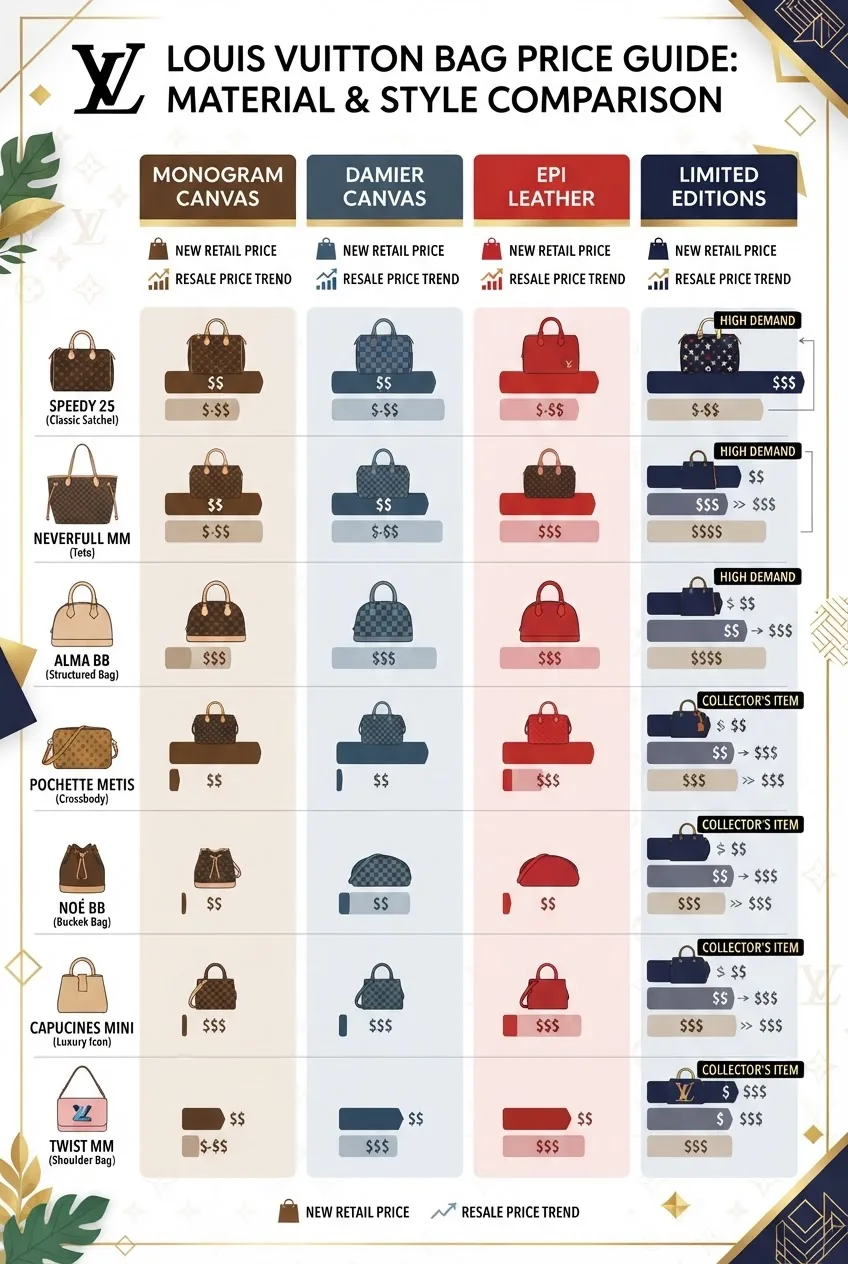
Starting Prices for Popular Louis Vuitton Bags
Answer: Entry retail points vary by model—small leather goods start near $400–$800, classic canvas handbags typically $1,200–$2,000, and leather or couture editions range $2,000–$6,000+.
| Model | Typical Retail (2024) | Typical Resale Range (2024 data) |
|---|---|---|
| Neverfull MM (Monogram) | $1,600–$2,000 | $900–$1,600 |
| Speedy 30 (Monogram) | $1,400–$1,700 | $700–$1,300 |
| Pochette Accessoires | $600–$800 | $300–$600 |
| Capucines (Calfskin) | $4,000–$6,500+ | $3,000–$5,500 |
| New Classics / Limited Editions | $2,000–$8,000+ | Highly variable — often premium |
Sources: retail pricing referenced from the official brand site (Official Louis Vuitton) and resale bands estimated from leading platforms’ 2024 sales reports (The RealReal, Vestiaire Collective).
Price Variations by Material and Size
Answer: Leathers (Capucines, Calfskin) add substantial retail premium vs coated canvas; larger sizes and special finishes (hardware, straps) further increase price and often preserve resale value more than small accessories.
- Material premium: leather > coated canvas; Epi adds a mid-range leather premium, Taurillon and calfskin add higher premiums.
- Size premium: MM > PM in Neverfull line; monogram canvas smaller models are proportionally cheaper but sometimes stronger on resale due to collectibility.
- Hardware and special closures (S-lock, padlock) increment retail and attract collectors.
How Seasonal Collections and Limited Editions Affect Prices
Answer: Seasonal and limited-edition releases can sell above retail on launch and appreciated pieces often outpace classic models on resale, but theorem depends on hype, collaboration pedigree and production volume.
According to a 2024 industry report from resale marketplaces, limited-colorway drops and artist collaborations produced average resale premiums of 15–40% in year-one selling windows; long-term appreciation varies.
Where to Find Louis Vuitton Bags on Sale
Answer: Louis Vuitton rarely discounts on the official site or boutiques; meaningful savings appear on authorized department store sales (rare), pre-owned platforms and select outlet partnership sales in different regions.
- Authorized retail sales: uncommon; official boutiques seldom discount.
- Secondary market: The RealReal, Vestiaire Collective, and local luxury consignments often offer 10–40% below retail depending on condition and rarity.
- Be cautious: clearance/discounts on unknown sites may signal replicas—use authentication and platform guarantees.
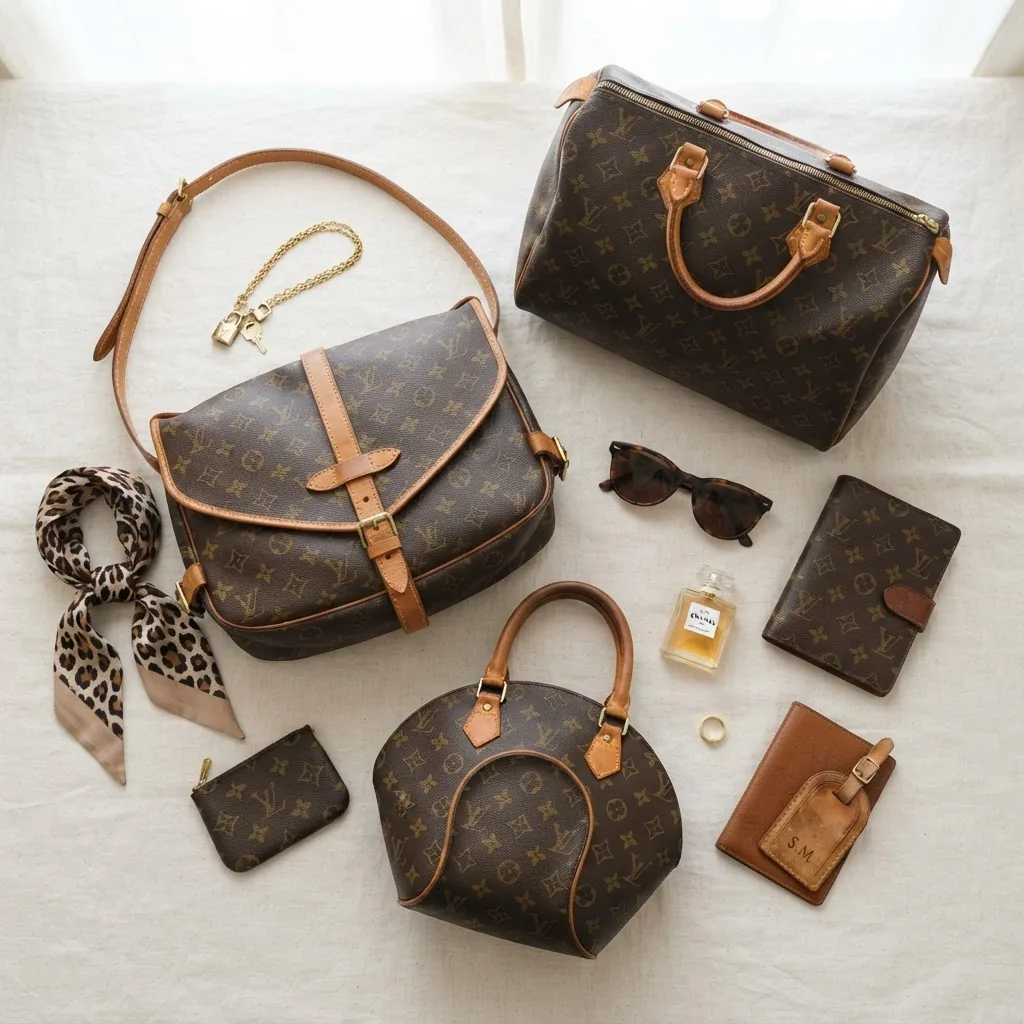
Which Louis Vuitton bags have been discontinued and why does that matter?
Answer: Louis Vuitton discontinues models for design refresh, low sales, or strategic scarcity; discontinued models (e.g., older Lockit versions, limited Murakami pieces) often become collectible and can see stable or rising resale prices.
Most Sought-After Discontinued Louis Vuitton Bags
Answer: High-demand discontinued items include certain Murakami collaborations, vintage Speedy variations, limited artist editions and special-lined Capucines; collectors value rarity, provenance and condition.
- Takashi Murakami collaboration pieces — strong collector premiums post-discontinuation.
- Limited Monogram Multicolore (Marc Jacobs era) — high demand for certain colorways.
- Older Speedy/Keepall versions with original zips and leatherwork — vintage interest.
Impacts of Discontinuation on Price and Resale
Answer: Discontinuation reduces future supply; if demand persists or grows, resale value rises—condition and documentation (dust bag, receipt) determine realized premium.
Example case study: a 2012 Monogram Multicolore Speedy sold at $1,800 retail and, due to discontinuation and collector demand, resold for $2,700 in 2024 in Very Good condition—an ~50% nominal gain. (According to 2024 resale listings on The RealReal and Vestiaire Collective.)
How Louis Vuitton Handles Product Line Changes
Answer: LV phases lines through runway show rotations, limited runs and regional exclusives; archival reissues happen but exact reproductions are rare, which preserves collector appeal for originals.
Caveat: while some discontinued items appreciate, others remain niche; verify provenance and production year when valuing a discontinued bag.
How does the resale market for Louis Vuitton bags work?
Answer: The resale market operates across vetted marketplaces, peer-to-peer platforms and local consignors; resale value depends on model, material, condition, documentation and market demand—authenticated pieces command higher prices and faster sales.
Best Online Platforms to Sell and Buy Resale Louis Vuitton Bags
Answer: Leading platforms include The RealReal and Vestiaire Collective for authenticated consignments, plus specialized dealers and auction houses for rare pieces; platform selection affects fees, buyer reach and authentication standards.
- The RealReal — authenticated consignments, steady buyer base (2024 sales data used for pricing bands).
- Vestiaire Collective — peer listings with authentication and escrow services.
- Specialist auction houses and Instagram dealers — useful for rare, high-end pieces but require due diligence and references.
- Local luxury consignment shops — faster payouts, variable commission.
Factors That Determine Resale Prices
Answer: Condition, rarity, completeness (box, papers), production year, material, and current fashion demand are primary determinants; authentication and professional cleaning also affect realized price.
- Condition grading (New with Tags, Excellent, Good, Fair) — primary multiplier.
- Rarity — limited editions and discontinued models often attract premiums.
- Documentation — original receipt and dust bag improve buyer trust and price.
- Seasonality and trend cycles — some models spike due to celebrity exposure or runway references.
How to Authenticate Before Selling or Buying Resale
Answer: Use platform authentication services, professional authenticators and thorough checks of stitching, materials, date codes and provenance; link below offers a full authentication walkthrough.
For a detailed, step-by-step authentication guide see Guide to Spotting Fake Louis Vuitton Bags.
Tips for Maximizing Your Bag’s Resale Value
Answer: Keep original packaging and receipts, maintain excellent condition with professional cleaning when needed, photograph thoroughly, list on vetted platforms, and price realistically using recent comparable sales as a guide.
- Retain receipts, dust bag, box and authenticity cards.
- Document wear with clear photos and disclose any repairs.
- Choose a platform aligned with your bag’s tier (mass-market vs collector market).
- Consider professional valuation for rare pieces before listing.
For resale strategies across brands, compare insights in Hermès Bags Guide: Cost, Buying Tips, and Selling Advice.
Are Louis Vuitton bags expensive compared to other designer brands?
Answer: Louis Vuitton’s prices are competitive within luxury—generally less than Hermès Hermès Birkin/Kelly, comparable to Chanel for some leather models, and often higher than entry-level Gucci/Prada pieces; LV’s strong resale retention improves perceived cost-effectiveness.
For a broader replica-brand comparison, see the pillar resource: Luxury Brand Replica Guide: Gucci, Chanel, Louis Vuitton & More.
Price vs Quality: Louis Vuitton vs Chanel, Gucci, Hermès
Answer: Hermès top-tier prices reflect extreme scarcity and artisanal labor; Chanel (especially classic flap, 2.55) and LV occupy adjacent tiers—Chanel leather often commands higher resale for flap classics; Gucci and Prada have lower entry points but variable resale.
| Brand | Entry Retail | Resale Strength |
|---|---|---|
| Louis Vuitton | $600–$6,000+ | High (classic models) |
| Chanel | $2,500–$10,000+ | Very high (classic flap) |
| Gucci, Prada | $900–$4,000 | Moderate |
| Hermès | $10,000–$200,000+ | Exceptional (Birkin/Kelly) |
Why Louis Vuitton Bags Maintain Value Well
Answer: Consistent demand for iconic silhouettes, durable materials like coated canvas, limited edition drops, and a strong secondary market infrastructure help LV retain value compared with many peers.
Entry Price Points for Designer Bags: Pros and Cons
Answer: LV offers accessible entry points for luxury (e.g., small leather goods, Pochette), giving an investment-like ladder where certain models can act similarly to collectible assets, but expect maintenance costs and potential price volatility for trend-led pieces.
For Hermès and other brand comparisons in replica contexts, consult Replica Hermès Bags Guide and Gucci, Prada & YSL Bags Guide.
How can you recognize real Louis Vuitton bags?
Answer: Look for precise stitching, evenly spaced monogram alignment, correct hardware engravings, appropriate materials (coated canvas vs leather behavior), and manufacturer codes; professional authentication is recommended for high-value transactions.
Key identification features and common fake indicators follow—use the full authentication guide linked below for an exhaustive checklist.
Key Authenticity Features to Check
- Stitching: consistent stitch counts and tight seams; poor stitching is a red flag.
- Monogram alignment: symmetrical placement across seams and centered motifs on panels.
- Hardware: weighty feel, clear engravings, correct font on locks and zippers.
- Date codes: present and consistent with production place/year convention (note: LV uses date codes, not certificates of authenticity).
- Materials: coated canvas vs genuine leather textures should match known examples; Vachetta should patina over time.
Common Fake Indicators to Avoid
- Incorrect font or spacing on logo stamps and hardware.
- Cheap-feeling hardware (lightweight, flaking plating).
- Mismatched patterns at seams and skewed monogram placement.
- Absence of date code or implausible production code format.
For further authentication resources see these comparative guides: How to Spot a Fake Chanel Bag, Fake Gucci Bag Guide, How to Spot Fake Hermès Bags, How to Spot a Fake Prada Bag, YSL Bag Guide: How to Spot Fake vs Real Saint Laurent Bags, and the core LV authentication resource Guide to Spotting Fake Louis Vuitton Bags.
How should you take care of your Louis Vuitton bag to preserve its value?
Answer: Regularly clean coated canvases with a damp cloth, treat leathers with recommended conditioners, store in dust bags upright, avoid direct sunlight and humidity, and perform professional repairs promptly to maximize resale value.
Daily Care and Cleaning Tips
Answer: Wipe canvases with a soft damp cloth, avoid alcohol-based cleaners, gently clean Vachetta with a soft eraser for small marks, and use leather conditioner sparingly on treated leathers.
- Empty and shake out debris after use; use a soft-bristled brush inside lining where appropriate.
- For canvas exteriors: damp microfiber wipe; avoid soaking and harsh chemicals.
- For Vachetta: minimal handling; avoid oils and makeup contact; patina is natural.
- For stained leather: consult a professional cleaner experienced with luxury leather.
Storing Louis Vuitton Bags Properly
Answer: Store in dust bags, upright with tissue paper to maintain shape, in a breathable environment (avoid plastic bags and damp basements), and rotate use to prevent creasing and color shift.
- Stuff with acid-free tissue to maintain structure.
- Keep away from extreme temperatures and prolonged sunlight.
- Use silica packets in humid climates but change regularly.
When and Where to Repair Your Bag
Answer: Seek repairs for hardware, stitching or lining at authorized Louis Vuitton service centers or reputable, specialized leather repairers; documented repairs maintain buyer confidence on resale listings.
If unsure, request an estimate from an LV boutique repair service—official repairs preserve parts authenticity and resale trust. For hands-on guidance, these care steps reflect years of leatherwork practice and recommendations from specialist restorers.
Summary: Louis Vuitton offers a range of durable coated canvases and premium leathers that influence retail pricing and resale. Understand material differences, account for discontinued models and platform selection when selling, and maintain documentation and care to maximize value. For deeper authentication procedures and cross-brand comparisons, follow the linked specialist guides above. Ready to buy or sell? Start by verifying condition, documentation and recent sales data on trusted resale platforms.