How to Spot a Fake Crossbody Bag (Gucci, Louis Vuitton) — by the end you’ll be able to perform a full hands-on authentication of a Gucci or Louis Vuitton crossbody in 20–45 minutes, using basic tools and intermediate observation skills. This guide assumes you can handle a loupe/magnifier, compare photos, and read small stamped codes.
Introduction to Spotting Fake Gucci and Louis Vuitton Crossbody Bags
This hands-on guide focuses only on Gucci crossbody bag authenticity markers and Louis Vuitton crossbody bag distinct features, not general tote or backpack checks. Expect step-by-step, tactile and visual tests covering logos, canvas and leather textures, stitching patterns, hardware engravings, zippers, linings, and serial/date code verification. Follow the numbered procedure below, run the verification checks in sequence, and document inconsistencies as you go.
If you want a broader view of how designer replicas compare across styles, see Replica Crossbody Bags Guide for Designer and Luxury Styles.
For readers interested in smaller styles beyond the brands covered here, consult our mini crossbody bags guide and the Crossbody Bag Basics Guide for background on styles and wear.
Before you start
- Tools: 10–20x loupe or jeweler’s loupe, soft lint-free cloth, calibrated digital scale (for weight check), measuring tape (mm), bright daylight LED lamp, white card for color comparison, UV light (optional).
- Accounts: access to current official brand images (Gucci, Louis Vuitton) and a secondary authentication tool such as Entrupy or a trusted third-party service.
- Time: plan 20–45 minutes per bag for the full sequence; allow extra if you need to use a mail-in authentication service.
- Documentation: take time-stamped photos of all details and preserve receipts and listing screenshots if buying secondhand.
Transition: With tools at hand, move into the brand-specific checks below. Each brand section is a numbered step set — follow in order for reliable results.
Key Indicators to Spot a Fake Gucci Crossbody Bag
-
Compare the GG monogram pattern and logo placement
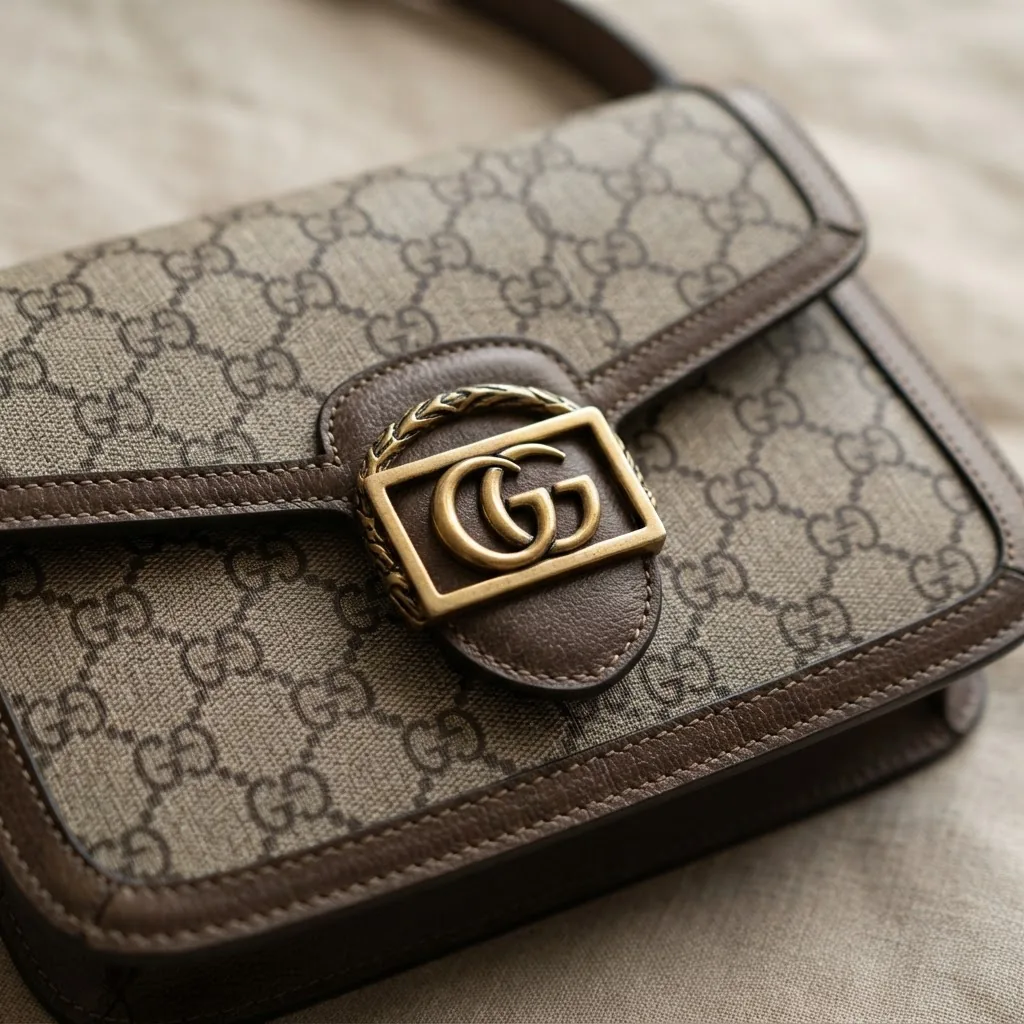
Start with a close visual match against verified Gucci crossbody reference photos. Authentic Gucci crossbody styles that use GG Supreme canvas (a coated microfiber with a printed GG) have precise pattern repeats: the diamond lattice spacing is consistent and the GG units are centered in panel sections, not cut off in odd places. Fakes often have uneven spacing, misaligned pairs, or a printed sheen that looks plasticky rather than textile-coated.
Look especially where panels meet: authentic Gucci crossbody bags align the GG motif symmetrically across seams; misalignment or mirrored GGs that don’t match pattern edges is a red flag. Also check the tone: authentic GG Supreme has a warm beige background with brown GGs; stark yellowish backgrounds or oversaturated browns are suspicious.
Case: I examined a seller photo where the central GG on the flap was noticeably pushed to the right—after inspecting the inside tag I found a stamped serial inconsistent with known formats (step 4), confirming a replica.
Fake Designer Crossbody Bags Guide for Gucci, Louis Vuitton, Prada
-
Inspect stitching, edges, and material hand-feel
Authentic Gucci crossbody bags display uniform stitching: stitches per inch (SPI) are consistent, backstitching is minimal, and thread color matches surrounding leather or canvas. Run your finger along seams: genuine leather edges are painted neatly and feel smooth; cheap fakes often leave rough painted edges or fraying threads.
GG Supreme canvas has a subtle textured feel and a soft matte coating—if the canvas feels like cheap vinyl (sticky or glossy) or peels at the corners, it’s likely a counterfeit. For leather trims, Gucci uses full-grain or high-quality calfskin (smooth or grained depending on the model). Fake leather often smells strongly of chemicals or plastic; genuine Gucci leather smells of treated but natural hide.
Quantitative thresholds: authentic SPI is typically 8–10 stitches per inch on visible seams; anything fewer than 6 SPI on a structured edge is concerning. Mis-stitched corners where stitches are uneven by ±2mm are common in lower-quality fakes.
-
Examine hardware type, weight and engravings
Gucci hardware is heavy, solid brass or nickel-plated brass finished to a muted sheen (antique brass, polished gold, or palladium). Test weight: a medium-sized clasp or buckle should feel notably heavier than cheap zinc alloy copies—approximately 10–25 grams for a typical belt buckle on a crossbody strap, while fakes often weigh under 8–10 grams when hollow. Authentic hardware engraving is crisp, shallow, and uses a specific font with even spacing; look for “GUCCI” or model-specific engravings that are centered and uniformly stamped.
Check rivets and screws: genuine Gucci uses flathead screws with clean slots; single-piece stamped rivets that are glued instead of properly set indicate poor construction. Color consistency matters — plating on hardware should not flake or show multi-tone patches within 6 months of normal wear.
-
Locate and read the serial number and interior tags
Gucci serial numbers (sometimes called style or control numbers) appear on a rectangular leather tab inside the bag. Typical modern Gucci serials are a two-line numeric format (e.g., 123456 789012), though older or model-specific codes vary. Steps:
- Find the leather tab inside the main compartment or a side pocket; feel for a stitched-in tab if photos hide it.
- Read the first line (style number) and second line (supplier/control number). Use a loupe if stamping is faint.
- Verify digits against known authentic examples for that model year; mismatched digit lengths or letters interspersed (Gucci generally uses numbers) are suspicious.
Official verification: Gucci doesn’t publish a public serial database—contacting Gucci customer service via their official site can confirm production details for some models. For visible discrepancies, use a trusted third-party authenticator or a service like Entrupy.
-
Check zippers, zipper brands and leather pulls
High-end Gucci crossbodies use premium zippers — often YKK, Lampo or Riri depending on model and year — with smooth pulls and engravings. Authentic zipper pulls are proportionate and have neat finishing: the metal should not show rough casting marks. If the zipper is sticky, loud, or the pull tag is poorly stitched or mismatched leather, treat it as suspect. Verify zipper brand stamps and the direction of teeth; some Gucci models used specific zipper suppliers—cross-reference with model photos.
-
Inspect lining fabric, pockets and labels
Gucci lining varies by model — canvas-lined, suede microfiber (alcantara), or patterned fabric. Authentic linings are precisely cut with seam allowances tucked; fake linings are frequently loose, glue-marked, or use cheap polyester. Pockets should be aligned and the gusset sewn evenly. Look for consistent font on leather tags, and that “Made in Italy” is centered and uses Gucci’s typeface.
-
Review packaging: dust bag, cards and authenticity materials
Authentic Gucci dust bags have a high-quality cotton or flannel feel with a centered logo and neat stitching. Beware of off-center logos, cheap drawstrings, or printed care cards with poor typography. Note: Gucci does not include a numbered certificate of authenticity in every retail sale; presence of cards alone isn’t proof—use them to corroborate other checks.
-
Price and market comparison
Compare asking price against typical retail and verified resale values. According to a 2024 market analysis report, authentic Gucci crossbodies retain 40–70% of retail value on average; prices significantly lower than prevailing resale averages (e.g., >40% discount for in-demand models) are a red flag. Use marketplaces and recent completed sales as benchmarks.
-
Run a final full-bag consistency sweep
Re-check logo alignment, stitch density, hardware engravings, serial tab, and lining. If multiple low-grade indicators (e.g., wrong zipper brand, pattern misalignment, faint serial stamping) appear together, mark the bag as likely fake. If in doubt, send photos and date code data to a pro authenticator.
Checking the Gucci Logo and Monogram Pattern
The Gucci logo on crossbody bags is rarely a simple printed badge — it’s integrated into hardware, embossing, or GG Supreme canvas. Authentic GG monogram units are perfectly mirrored pairs: the interlocking Gs face each other with consistent spacing. Measure visually: GG units are usually 25–30 mm apart in most crossbody scales; if units appear crowding (<22 mm) or excessively sparse (>35 mm), it signals a mismatch. On leather patches, the “GUCCI” wordmark uses a specific letter width and kerning; sloppier spacing or elongated “C”s occur on counterfeits.
Examine logos under magnification: genuine impressed or embossed logos have clear edges and even depth; heat-stamped or laser-etched fake logos often show fuzzy edges and uneven depth because counterfeit processes use cheaper tooling. For metal logo plates, the finish is uniform with a soft sheen; mirror-like flash plating that peels or chips quickly is typical of poor replicas.
Inspecting the Stitching and Material Quality
Think of stitching as the bag’s fingerprint. On Gucci crossbodies expect 8–10 SPI on visible seams, perfectly aligned topstitching, and reverse stitching used only at stress points. Look for thread color match; Gucci often uses thread that blends with trim tone rather than a stark contrast. Also examine seam allowances: authentic construction hides raw edges inside folded hems; exposed raw edge glue residue indicates mass-produced fakes.
For materials: GG Supreme canvas feels like coated microfiber with a slight fabric texture beneath a matte coat. Full-grain leathers used on trim should present natural grain variation, not perfectly uniform pebbles. Run a finger test: genuine leather warms slightly under touch; plastic-coated faux leather stays cooler and may leave a faint plastic residue on fingers.
Hardware and Zippers on Gucci Crossbody Bags
Gucci selects hardware finishes to match design intent — antiqued brass for vintage styles, polished gold for modern pieces. Hardware is usually brass-based and should not be magnetically lightweight. Test the hardware by gently tapping: a solid metallic ring produces a dull, dense sound while hollow alloys ring thinly. Check screws: genuine pieces use flush-fitting screws, not visible excess solder or glue.
Regarding zippers: authenticity typically means smooth action with no jerking. A quick test — operate the zipper 20 times; it should remain smooth and not catch. Check the zipper slider and pull for stamped supplier marks: YKK, Riri, and Lampo occur on certain Gucci lines. Incorrect supplier stamps or mismatched pull shapes between left and right are common counterfeit mistakes.
Verifying Gucci Serial Numbers and Tags
Find the leather tab—usually inside the main compartment or a pocket. Use a loupe and proper lighting to read faint stamps. Modern Gucci tabs show a two-line numeric sequence. If letters appear, confirm against the specific era/model documentation. When uncertain, photograph the tab, include a ruler in the shot for scale, and seek a second opinion from a known authenticator. Remember: Gucci customer service or a physical boutique can sometimes confirm model manufacture details; for advanced material testing, an Entrupy-style service can analyze materials scientifically.
Key Indicators to Spot a Fake Louis Vuitton Crossbody Bag
-
Authenticate the Monogram canvas pattern and texture
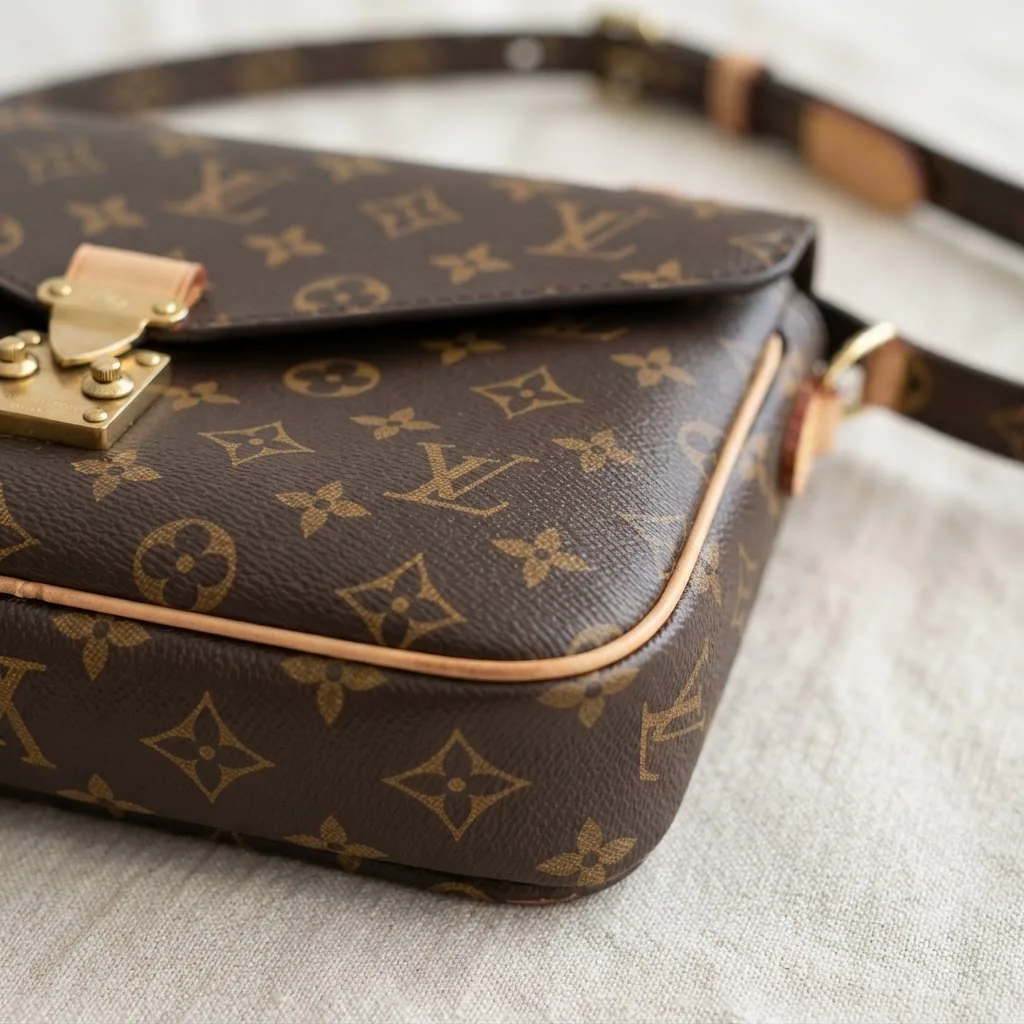
Louis Vuitton’s monogram canvas is a coated cotton canvas with a specific texture: slightly grainy, stiff yet flexible, and with a matte finish. Monogram placement for crossbody styles often avoids cutting key LV marks at obvious focal points (center flap, pocket seam). Authentic LV achieves perfect symmetry across panels and continuity where seams meet. Fakes often use thinner, slippery canvases with a shinier appearance and poor pattern registration.
-
Check stitch count, saddle stitching and vachetta leather trends
Louis Vuitton uses saddle-stitching and consistent stitch counts: count stitches on a straight seam — authentic rates are commonly 5–6 SPI on vachetta trims and 6–8 SPI on canvas topstitching depending on model. Vachetta (untreated vegetable-tanned cowhide) trims should develop a light honey patina over time; a starkly yellow or coated look indicates fake vachetta (often painted or sealed to mimic patina).
-
Examine hardware weight, color and stamped type
LV hardware is robust, typically brass with lacquered finish. The signature brass zipper pulls and D-rings have crisp “LOUIS VUITTON” or “LV” engraving in a precise font. On crossbody models with leather straps, rivets are neat with centered stamps. Cheap replicas use hollow cast metal and low-resolution laser engraving that blurs font edges.
-
Decode date codes and internal tags
Louis Vuitton date codes (not serial numbers) encode production location and date. Post-1990 formats vary: since early 2000s common format is two letters (factory) followed by four digits (week+year or month+year depending on era). For example, “AR1004” reads as France (AR) made in the 10th week of 2004. Steps:
- Locate the code — tucked in a seam, inside pocket, or on leather tab near interior lining.
- Interpret format against era-specific rules (use a reference table); mismatched formats for the claimed production year are suspicious.
- Cross-check factory letters against known LV factory codes (e.g., AR, MI, CA) — if the letters don’t match recognized codes, treat it as suspect.
For authoritative guidance see the Louis Vuitton official site or contact customer service for verification of production details; if you suspect manipulation, document the date code and consult a professional authenticator.
-
Verify lining, labels and interior stamp
Louis Vuitton crossbodies have linings specific to the model: microfibre (alcantara) for some, textile for others. Interior heat-stamps reading “LOUIS VUITTON Paris made in France” (or Spain/USA/etc.) should have even, sharp letters. Fonts and spacing are standardized; uneven spacing or the use of an inconsistent typeface indicates a counterfeit. Also check pocket construction and interior seams for glue marks.
-
Zippers and zipper pulls
Most LV pieces use unique zipper hardware with clear stamping (e.g., “LV” or “LOUIS VUITTON”) and sturdy sliders. Test smoothness over repeated cycles — persistent catching or a rattly slider is a sign of low-quality parts. Also confirm that zipper teeth align perfectly and that the pull shape matches authentic examples for that model and era.
-
Packaging and accessories
Original Louis Vuitton dust bags are a thick beige cotton with a centered “LOUIS VUITTON” in specific typography. Receipts, tags, and box quality can help, but counterfeiters often replicate packaging—use packaging as a supporting check, not proof alone.
-
Market price checks and provenance
Research recent retail and resale values. According to a 2024 resale market report, classic LV crossbody models retain roughly 60–80% of retail depending on condition. Sudden deep discounts, inconsistent seller history, or vague provenance are buyer risk flags. Keep screenshots of listings and seller communication as evidence.
-
Final tactile and visual sweep
Reassess all earlier points together: if canvas texture, monogram continuity, vachetta patina, hardware engravings, and date code all pass, the bag is likely authentic. If multiple major fail points exist, it’s likely counterfeit. When uncertain, escalate to a professional authentication service.
Authenticating Louis Vuitton Monogram and Canvas Material
Compare texture: authentic Louis Vuitton monogram canvas has a tightly woven base with a consistent grain; counterfeit canvas is often thinner and more plasticky. Under raking light, authentic canvas shows a matte surface with very slight sheen, not mirror-like gloss. Pattern continuity across seams is critical — genuine LV engineers pattern placement to avoid cutting monogram icons in focal places. Use a loupe to check printing edges: original printing has razor-sharp edges and no ink bleeding.
For black monogram designs (example: black-on-black Empreinte or coated canvases), verify contrast under even light: genuine blacked-out canvases show subtle contrast where the monogram is debossed or printed with slightly different finish levels. If the “black” pattern is only visible at certain angles or appears to be an adhesive decal, it’s likely fake.
Stitching and Craftsmanship on Louis Vuitton Bags
LV uses exacting stitch counts and uniform saddle-stitching. On vachetta trims, the thread color is often a light yellow-gold that matches across similar production runs; thread that is too pale or bright indicates inconsistency. Count stitches on a straight seam and compare with reference photos—deviation by ±2 SPI on multiple seams suggests non-authentic construction. Also inspect edge finishing: genuine vachetta edge paint is even and resilient; painted-over raw edges that crack or flake are typical counterfeit faults.
Louis Vuitton Hardware and Zippers Explained
LV hardware carries precise engraving: look for sharpness, letter-spacing and centering. Zippers on monogram canvas pieces feel robust — the slider moves consistently across teeth with minimal audible noise. For sliders and pull stamps, the font used on authentic LV hardware is slightly condensed; mass-produced replicas often use a wider, shallower engraving. Also check rivets and D-rings for factory code alignment; authentic pieces show consistent factory stamping.
Decoding Louis Vuitton Date Codes and Tags
Locate the date code inside pockets, seams, or on leather tags. Interpret the code with era rules: pre-1980s codes differ; 1980–early 1990s used three or four digits; mid-1990s–2006 used two letters + four digits indicating factory and year/week. Post-2007 formats changed again (two letters + four digits for week and year, etc.). If the code format doesn’t match the bag’s claimed decade or if the factory letters are invalid (not matching known codes), the bag is suspect. Always photograph codes and compare with authoritative reference charts or consult official brand resources.
Comparative Analysis: Gucci vs Louis Vuitton Fakes
Below is a focused comparison of the top seven difference markers between Gucci and Louis Vuitton crossbody fakes to help you quickly prioritize checks.
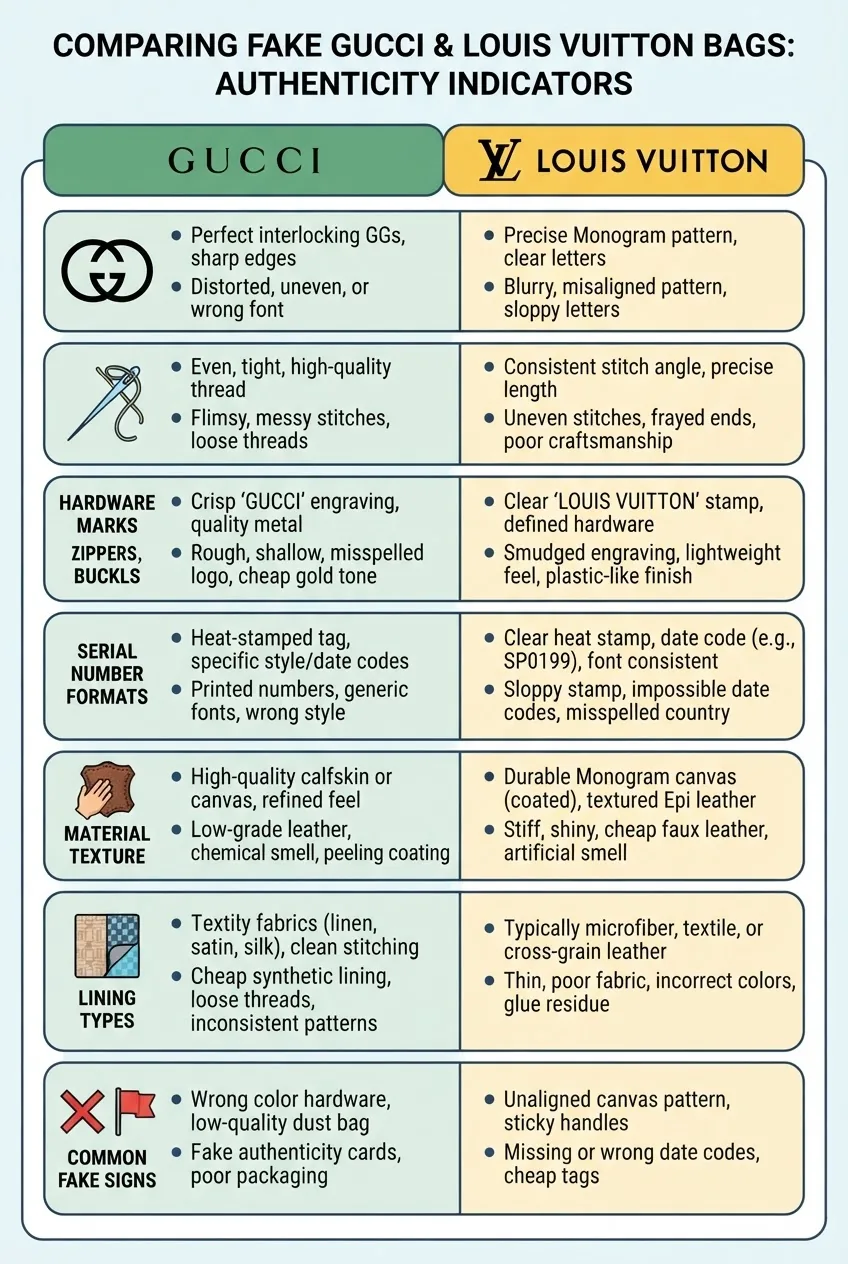
| Feature | Gucci (real vs fake) | Louis Vuitton (real vs fake) |
|---|---|---|
| Logo / Monogram | Precise GG repeats; alignment at seams; warm beige background vs oversaturated or misprinted patterns. | Monogram continuity engineered; deboss/print crispness; fakes show bleed or off-center prints. |
| Stitching | 8–10 SPI, concealed seam allowances; uneven SPI common on fakes. | Consistent saddle stitching; vachetta edge paint uniform; fakes have inconsistent SPI and rough edges. |
| Hardware | Solid brass feel; specific engraved GUCCI fonts; light, hollow metals indicate replicas. | Robust brass with precise LV engraving; hollow/zinc alloys show blurred engraving on fakes. |
| Serial / Date Code | Two-line numeric serial on leather tab; inconsistent formats are suspect. | Factory code + digits; must match era rules (letters for factory, digits for week/year). |
| Material | GG Supreme coated microfiber has warm tone; fakes are often glossy vinyl. | Monogram canvas grainy and stiff; fakes are thinner, shinier and flimsy. |
| Lining | Suede microfibre or canvas; poor fit or glue marks indicate fake. | Model-specific linings (alcantara/textile); mismatched textures or loose seams indicate counterfeits. |
| Common Fake Signs | Wrong serial format, glossy canvas, lightweight hardware, poor stitching. | Incorrect date code format, fake vachetta, blurred engravings, pattern misalignments. |
Transition: After identifying brand-specific red flags above, use detection tools and services to validate your findings with objective tests.
Tools and Techniques for Authenticity Verification
Use the following stepwise verification methods and recommended resources to corroborate your visual and tactile findings.
-
Capture high-quality reference photos
Shoot full bag, close-ups of logos, serial tabs, hardware engravings, lining, zippers, and seams. Use a daylight LED (5,000–6,500K), white card background for color accuracy, and include a ruler in at least one shot to prove scale.
-
Run a visual checklist comparison
Compare photos against authentic reference images from the brand site or trusted resale platforms. Note 10–15 comparison points: logo alignment, stitch density, zipper brand, hardware engravings, serial/date code format, lining type, vachetta patina, dust bag typography, and packaging quality.
Chain Crossbody Bags Guide is useful for verifying strap hardware and clasps when crossbody chains are present.
-
Use material analysis tools
Services like Entrupy analyze microscopic images and return probabilistic authenticity scores. For a DIY step, inspect materials under 10–20x magnification for print edges, weave structure, and coating irregularities. According to a 2024 industry report on authentication tech, machine-assisted tools improve detection rates but should be combined with human expertise.
-
Assess provenance and seller history
Request original receipts, proof of purchase, and full provenance. Cross-check seller usernames across marketplaces for repeat complaints. If seller refuses close photos or a live video inspection, treat it as a risk sign. Keep copies of all communications and screenshots.
-
Request live video authentication
Ask the seller for a real-time unedited video showing serial tabs, inside pockets, and hardware operation. This eliminates many common photo-manipulation tactics. Insist on the seller showing the bag in motion and under natural light for 60–120 seconds.
-
Use official brand channels when possible
Contact Gucci or Louis Vuitton customer service for guidance or to confirm production details. For legal context and reporting counterfeit activity, consult consumer protection resources such as U.S. Customs & Border Protection — IPR.
Replica Crossbody Bags Guide for Designer and Luxury Styles provides complementary knowledge on common replica characteristics.
-
Send to a professional authenticator
When a bag is high-value (retail > $1,200) or uncertainty remains after visual checks, use a trusted authentication service. Typical professional authentication fees range from $25–$100 for photo-only reviews and $75–$300 for in-person or lab analysis depending on the service and turnaround time (according to 2024 marketplace pricing averages).
Common Mistakes Buyers Make When Spotting Fake Crossbody Bags
Below I list mistakes I’ve seen frequently and how to avoid them.
- Relying only on photos: I’ve accepted listings before and later found inconsistencies visible only in hands-on inspection—always insist on close-ups and a live video if buying remotely.
- Trusting packaging as proof: Once I saw perfect dust bags with poor interior stitching; packaging can be replicated, so treat it as supporting evidence, not confirmation.
- Ignoring price signals: I once ignored a 70% discount on a limited-release Gucci crossbody and later discovered pattern misalignment—use price benchmarks from completed sales as reality checks. See our Mini Crossbody Bag Prices Guide for benchmarks.
- Misreading codes: I misinterpreted a LV date code until checking era-format rules—use reference charts and official resources to decode date codes correctly.
- Over-relying on one indicator: One plausible feature (e.g., correct zipper stamp) doesn’t make a bag authentic; require at least 8–10 matching checks for high-value items.
Conclusion and Best Practices for Buying Authentic Gucci and Louis Vuitton Crossbody Bags
To reliably determine authenticity: combine visual pattern checks, stitch counts, hardware weight and engraving inspection, serial/date code reading, and material texture testing. Keep documented evidence: photos, receipts, and listing records. If you are buying remotely, insist on live video and use authenticated escrow or protected payment methods. For further product comparisons suited to daily use, explore the Best Small Crossbody Bags Guide and, for larger messenger styles, see the Best Crossbody Messenger Bags Guide.
Final CTA: If you’re about to purchase a high-value crossbody, complete the checklist below and, when in doubt, pay for a professional authentication service for certainty.
Common mistakes and how to avoid them
From my experience, the worst errors come from taking the seller at face value—especially when photos are staged. I once accepted a listing with good packaging but the bag failed zipper and serial checks. Always run the full process below and insist on irrefutable close-ups.
Quick verification checklist
- Logo alignment: GG/LV continuity across seams — pass/fail
- Stitch count: 6–10 SPI on visible seams — pass/fail
- Hardware weight & engraving: solid feel, crisp font — pass/fail
- Serial/date code: correct format and location — pass/fail
- Canvas/leather texture: correct hand-feel and patina — pass/fail
- Zipper brands and smooth action after 20 cycles — pass/fail
- Packaging and dust bag typography matches authentic examples — pass/fail
When to call in a professional
Use professional authentication when the bag’s retail value exceeds $1,200, if date/serial codes are partially illegible, or if documented provenance is missing. For legal or refund disputes, request a written authentication report with photos and method notes from the service.