How to Spot a Fake Prada Bag: Real vs Fake Guide — by the end of this hands-on guide you’ll be able to perform a complete, model-specific authentication check on a Prada bag in 20–60 minutes depending on depth. This guide assumes basic comfort handling handbags, a phone camera, and access to the bag’s interior and hardware.
Before you start, gather the tools and learn the quick key checks. The steps below are practical, repeatable, and geared for real-world resellers, buyers and collectors who need fast, reliable decisions.
Before you start
- Bright, diffuse lighting (daylight or 5,000K LED lamp)
- Macro-capable smartphone camera or loupe (10–30x)
- Soft, lint-free gloves to avoid transferring oils
- Small ruler or measuring tape (mm scale preferred)
- Access to the bag’s interior, hardware, dust bag and any cards/labels
- Authentication app subscription (optional) or contact info for a pro authenticator
Introduction to Prada Bag Authentication
This section explains designer handbag authentication essentials and the specific markers that distinguish authentic Prada pieces from modern counterfeits. Counterfeit Prada prevalence has risen as manufacturing quality improves; according to a 2024 industry report, high-grade replicas now mimic hardware engraving depth and nylon textures more convincingly than in prior years, so single-factor checks are no longer enough.
Start by understanding what makes a real Prada bag: consistent craftsmanship, factory-controlled hardware markings, interior linings with precise fonts, and materials that match model specifications. Authentication is a synthesis of tactile checks (feel the nylon or leather), visual verification (logo placement, stamp fonts), and documentation (cards, serials, and tags). For important purchases, combine hands-on checks with digital verification tools and expert services.
We assume you want targeted, model-aware checks rather than brand history. This guide focuses on practical verification for common Prada models — nylon totes, Saffiano leather purses, and the distinct Prada Tri-Colored pieces — and explains why certain markers are decisive.
Move on to the concrete differences you should verify first; these are prioritized so a quick inspection targets the most reliable signs.
Key Differences Between Real and Fake Prada Bags
-
Stitching quality and patterns:
Real Prada bags have even, dense stitches — typically 2.5–3.0 mm spacing on visible panels and reinforced bar tacks at stress points. Fake Prada bags often show variable stitch length, skipped stitches, or loose thread endings. Compare stitch color: authentic stitching matches the material or contrasts intentionally and cleanly; mismatched thread is a red flag.
-
Logo placement and font:
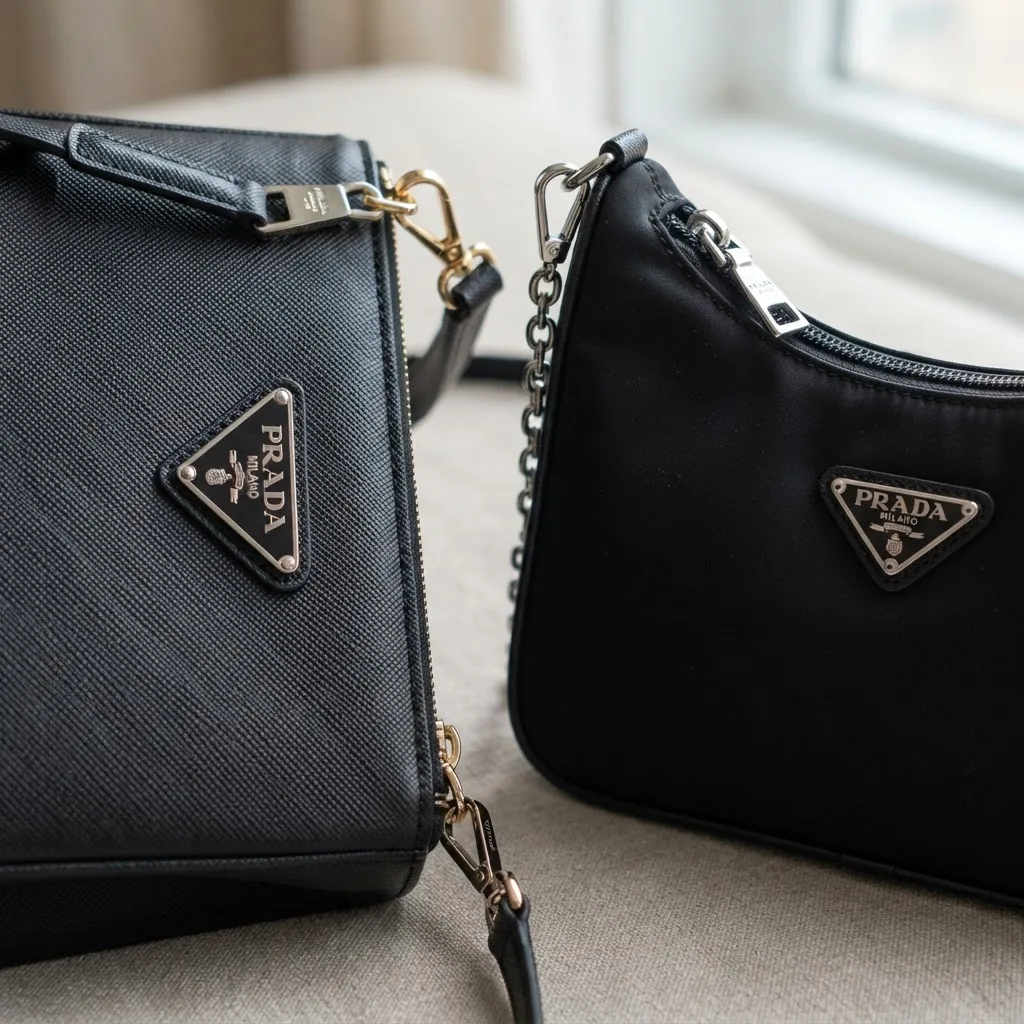
Prada uses a specific triangular plaque or enamel logo with exact kerning and letter spacing. On leather goods the heat-stamped logo should be crisp, centered, and proportioned; on the triangle plaque the rivets are evenly spaced and the enamel surface is glossy with a fine grain. Fake logos often show shallow stamping, uneven letter thickness, or off-center triangles.
-
Hardware (zippers, clasps, inscriptions):
Authentic Prada hardware is substantial (nickel-plated or palladium finishes), operates smoothly, and bears precise engravings: look for “PRADA” in consistent font, often with “Made in Italy” or a part code. Cheap plating, light-weight pulls, and sloppy laser etching indicate counterfeit. Also check zipper brands: Prada commonly uses YKK, Riri or Lampo depending on era — irregular brands or poor zip action are suspicious.
-
Material and fabric authenticity:
Prada’s nylon is densely woven with a satiny finish; Saffiano leather shows a crosshatch pressed texture and a stiff hand. Feel matters: authentic nylon should resist quick creasing and revert to shape; counterfeit nylon can feel plasticky or overly soft. For Saffiano, check the edge coating and smell — genuine leather emits a subtle rich leather scent, while fakes may smell of chemicals or varnish.
-
Interior lining and labels:
Real Prada linings often use branded jacquard fabric with repeated “PRADA” motifs aligned perfectly at seams. Look for a small rectangular leather tag inside with a heat stamp or a sewn label; font, spacing and alignment must match Prada’s known samples. Counterfeits sometimes glue labels, use plain fabric lining, or misalign motifs at seams.
-
Serial numbers and authenticity cards:
Modern Prada bags may include authenticity cards with model/production codes, but not all models have serial numbers visible. An authenticity card with correct fonts and a matching internal label is supportive but not decisive — many counterfeit operations include forged cards. Authenticity numbers are best paired with hardware and material checks.
-
Dust bag and packaging:
Genuine Prada dust bags use specific fabric weights, drawstrings, and printed fonts. Packaging should feel premium; cheap or lightweight dust bags, incorrect logo fonts, or unexpected colorways (bright orange dust bags are NOT Prada) indicate fakes.
-
Model-specific construction details:
Each Prada model has signature build cues — strap widths, rivet counts, and interior pocket placement. Research the exact model code or compare to a verified reference photo. Small deviations often reveal replicas, especially when combined with other inconsistencies.
-
Weight and balance:
Authentic Prada uses heavy, dense hardware that gives bags a noticeable weight. If a bag feels unusually light for its size, investigate hardware and lining to spot substitution with cheaper materials.
-
Overall finish and edge work:
Real Prada edge painting (on leather trims) is smooth, even and shows a sealed finish. Frayed edges, uneven paint, or sticky residue at edges typically indicate poor-quality replicas.
Comparative note: Many counterfeiters focus on reproducing visible logos first, so always layer checks (hardware + lining + materials) rather than relying solely on the logo.
Gucci, Prada & YSL Bags Guide is useful for understanding how Prada quality compares to similar brands.
How to Spot a Fake Chanel Bag Guide explains parallel logo, stitching and hardware checks used for Chanel.
Next we’ll walk step-by-step through identifying the most commonly counterfeited Prada category: nylon bags.
How to Spot a Fake Prada Nylon Bag: Step-by-Step Guide
-
1. Inspect the nylon texture and hand-feel
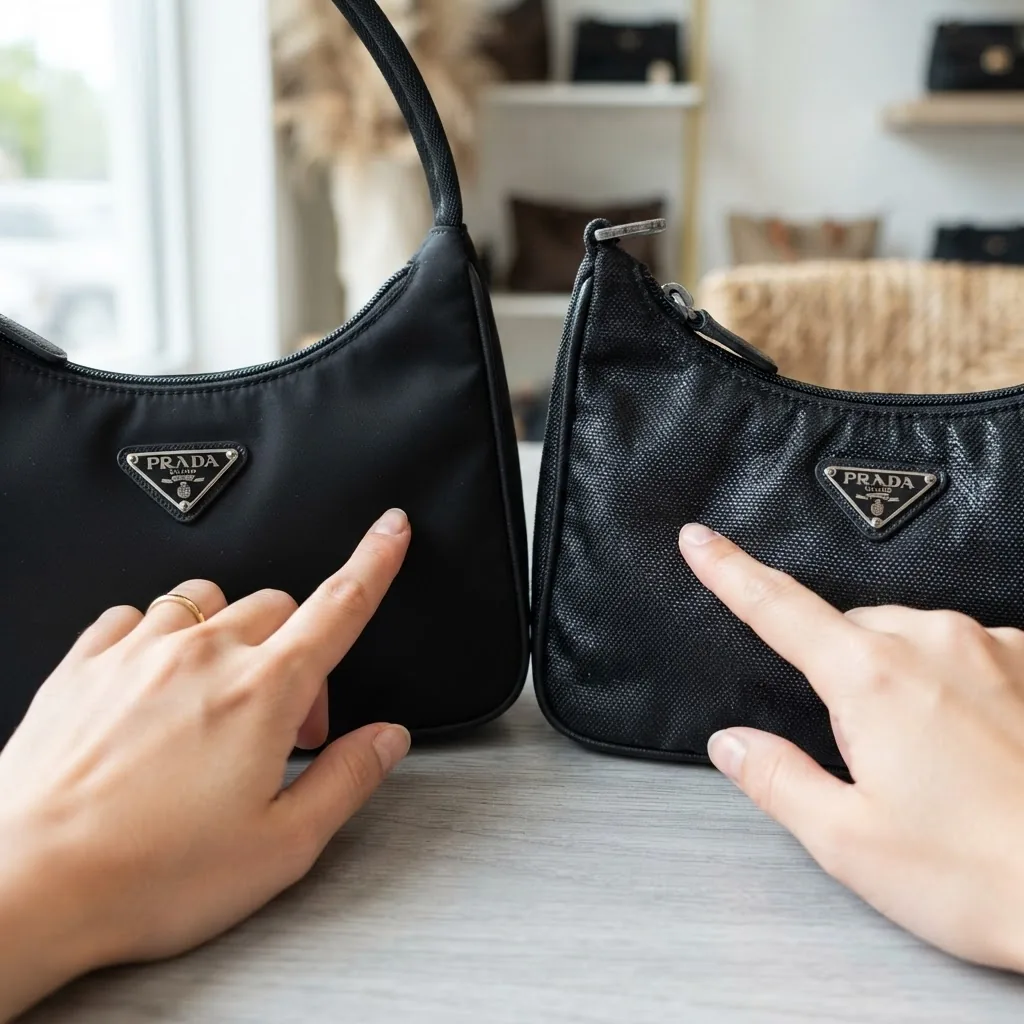
Authentic Prada nylon is tightly woven with a subtle sheen and slight grain. Hold the fabric, pinch lightly: real nylon resists creasing and springs back within 2–4 seconds. If the material wrinkles easily or feels thin and plasticky, that indicates a replica.
-
2. Check the triangular logo plaque
Look at the triangle’s enamel: authentic triangles have a deep, consistent enamel with clear, sharp lettering and perfectly aligned rivets. Measure rivet spacing: roughly 6–8 mm from the triangle edge on authentic models; inconsistent spacing or flimsy rivets suggests counterfeit.
-
3. Test zippers and slider markings
Open and close each zipper 5–10 times. Real zippers run smoothly without catching. Inspect inscriptions on zipper pulls under magnification: stamped or engraved “PRADA” or designer zipper brands should be clean. If the engraving looks sandblasted or shallow, treat it as suspect.
-
4. Inspect interior lining pattern
Prada nylon bags often use jacquard lining with repeating “PRADA” motif in neat rows. Check seam alignment: motifs should meet evenly at the seam. Plain or cheaply printed lining is a common fake sign.
-
5. Examine the strap attachments and stitching
Straps on authentic Prada nylon bags are reinforced with tidy cross-stitching and clean edge finishing. Count reinforcement stitches: you should see consistent bar-tacks occupying roughly 10–12 mm width at anchor points. Sloppy, single-line attachment stitches are red flags.
-
6. Verify any tags, cards, or serials
Some Prada nylon bags include a small tag with model code. Verify model code format against Prada’s published references or a trusted database. Cards that look thin, with misaligned fonts, or different paper stock than known examples are often reproduced by counterfeiters.
-
7. Smell and color check
New authentic Prada nylon has a neutral to faintly chemical-free factory scent; overpowering chemical smells or bright, inconsistent colors (e.g., neon finishes not marketed by Prada) are suspect. Use a color sample comparison with official product images.
-
8. Cross-reference known counterfeit mistakes
High-quality replicas often copy the triangle but ignore internal labels, or use incorrect corner rivet counts. Cross-check multiple features: a correct triangle with incorrect lining is still a counterfeit.
-
9. Use a magnifier and photo documentation
Capture macro photos of logos, hardware inscriptions and stitch patterns for comparison and authentication app upload. Take at least 8 photos: front, back, interior, close-up of triangle, zipper pull, strap attachment, serial tag, dust bag label.
-
10. When unsure, escalate to a pro
If checks are mixed (some pass, some fail), use a professional authentication service or book an in-person inspection before paying over $500. According to a 2023 authentication report, combining human expert review with microscopic inspection raised reliability to over 95% on high-grade replicas.
Fake Gucci Bag Guide provides authentication tips for comparable nylon constructions.
With nylon covered, tri-colored Prada bags require targeted color and stitching checks because color consistency and trim joins are common failure points for counterfeiters.
Identifying Fake Prada Tri-Colored Bags from Real Ones
The Prada Tri-Colored line combines distinct panels and contrasting trims; counterfeiters often struggle to match dye lots and seam precision. The table below compares typical real vs fake indicators side-by-side for quick scanning.
| Feature | Real Prada Tri-Colored | Common Fake Indicators |
|---|---|---|
| Color consistency | Panels show matched dye lots; contrast edges have clean transitions and no bleeding. | Uneven color saturation, slight bleeding at seams, mismatched panels under close light. |
| Stitching at color joins | Precise multi-thread joins with even stitch length and reinforced seam allowances. | Thick, loose stitching visible; stitch rows that don’t follow the panel curve. |
| Trim and piping | Trim uses Saffiano or smooth leather with consistent edge paint and sealed piping. | Thin faux-leather piping, flaking edge paint, visible glue at trim joints. |
| Logo and hardware contrast | Hardware finish complements colorway; triangle plaque centered on panel with even spacing. | Hardware tone clashes or is matte where original is polished; plaque placement slightly off-center. |
| Interior coordination | Lining color matches design spec; interior tags use correct font and placement. | Plain black lining used instead of branded lining; tag fonts differ or are glued not sewn. |
| Overall finish | Edges are clean; seams align; structural integrity is balanced and retains shape when set down. | Warped panels, asymmetry, and poor balance when placed on flat surface. |
YSL Bag Guide: How to Spot Fake vs Real offers color-contrast verification techniques useful for tri-colored Prada pieces.
Having gone through model-specific checks, next is a consolidated list of features to inspect on any Prada bag you handle — useful for quick screening or in-depth authentication.
Common Features to Check on Any Prada Bag (Including Purses)
This section gives a step-by-step checklist for every Prada bag purchase — whether purse, tote, or crossbody. Use these checks in order: visual, tactile, hardware, documentation, then external validation.
-
Exterior stitching and panel joins
- Check visible panels for 2.5–3.0 mm stitch spacing on major seams.
- Look for identical stitch lengths on both sides of symmetrical panels.
-
Logo treatments
- Triangle plaque: check rivet count (commonly two rivets) and enamel depth.
- Heat stamps on leather: letters should be equally indented; spacing is even.
-
Hardware weight and markings
- Weigh hardware mentally: heavy, solid pulls are expected. Test closure actions 5–10 times.
- Engravings should be crisp: “PRADA” in correct type (compare to official images).
-
Zippers
- Zipper brands (YKK, Riri, Lampo) are model-dependent; verify via official photos.
- Slider lag or rough movement: immediate rejection unless proven otherwise by service history.
-
Inner lining authenticity
- Branded jacquard: motifs should align and be sewn into the seam, not printed over seam lines.
- Interior pockets: placement and dimensions should match official specs.
-
Serial codes and authenticity cards
- Match card codes with internal tags when present; check paper stock and print quality.
- Do not accept cards as sole proof — used in combination with physical checks only.
-
Material-specific checks
- Nylon: spring-back test (2–4 seconds recovery).
- Saffiano leather: consistent crosshatch depth and sealed edge paint.
-
Edge finishing and adhesives
- Inspect seams for glue residue; visible glue lines = counterfeit or poor repair.
- Edge paint should be uniform and not flake when lightly rubbed with a damp cloth.
-
Packaging and dust bag
- Dust bag font, tie quality and fabric weight should match model era; see dedicated section below.
- Box labels: verify SKU and product codes match bag details (color, material).
-
Seller history and provenance
- Ask for original receipt, purchase location, and any repair records.
- Trusted resellers provide documented provenance; private sellers may not — weigh risk accordingly.
Use the checklist above for rapid screening; for any single failing marker, escalate to the in-depth steps in this guide.
Dust bags and packaging are often overlooked but highly telling — the next section breaks down the dust bag checks.
Authentic Prada Dust Bag vs Fake – What to Look For
Prada dust bags are not merely protective—they’re part of the product identity. Genuine dust bags use specific fabric weights, drawstring finishes, and consistent logo fonts. Counterfeit dust bags are frequently made from cheaper cotton blends, use incorrect fonts, or contain extra decorative elements that Prada does not use.
Visual and tactile points to verify:
- Fabric texture: Prada dust bags often use soft cotton with a tight weave or brushed microfibre; they feel substantial when compared side-by-side to lightweight, gauzy fakes.
- Logo font and placement: The printed or woven “PRADA” should use the exact brand typeface and sit centered with consistent margins. Counterfeits may use similar but slightly different letter spacing or thickness.
- Drawstring and stitching: Authentic drawstrings are robust and finished with neat knots; stitching is even and uses matching thread. Uneven hems or raw edges suggest fake production.
- Color and dye consistency: Prada dust bag colors are muted neutrals — bright colors or satin finishes are uncommon for standard Prada dust bags and often signal replicas.
- Label tags: Some dust bags include small sewn labels indicating country of origin; check that tags match typical Prada formats (e.g., “Made in Italy”).
Photograph the dust bag and compare it to official unboxing photos from Prada or trusted resellers. A dust bag that matches all other bag features but is slightly off in fabric weight can still be original if the bag is older or from a limited production, so use dust bag checks together with physical bag checks.
Now that you can inspect the bag and dust bag, here are tools, services and practical tips to boost confidence and evidence quality for a final decision.
Tools and Tips for Verifying Prada Bag Authenticity
Use a mix of low-tech and high-tech approaches. Below are numbered, practical tools and resources, followed by recommended internal and external reference links for deeper validation.
-
Use magnification:
10–30x loupe or macro phone lens to inspect micro-stitching and laser engravings. Look for crisp edges on stamped letters and consistent stitch tails. Take photos at 10x, 20x and 30x magnification for expert review.
-
Photograph systematically:
Capture 8–12 images: front, back, base, interior, hardware close-ups, logo plaque, zipper housing, strap attachment, dust bag and authenticity card. Keep lighting even; use a neutral background for color fidelity.
-
Authentication apps and AI tools:
Services like Entrupy use microscopic imaging and trained models to evaluate materials and construction. According to Entrupy’s case studies, combining imaging with human review raises detection rates substantially. Use app results as one input, not final proof.
-
Third-party professional authentication:
Use specialist services (photo or in-person). A pro can perform microscopic scans, compare serial codes to databases and review hardware with specialist tools. Expect 24–72 hours turnaround for photo authentication; in-person can take a few hours. According to a 2023 industry survey, professional reviews resolved over 90% of ambiguous cases.
-
Microscopic stitching analysis:
Inspect cross-stitches and bar-tacks at 20–30x to confirm machine vs hand-finishing patterns. High-end Prada uses consistent factory machine patterns — microscopically regular rows and thread compression are normal; inconsistent thread compression suggests aftermarket stitching.
-
Check seller reputation and receipts:
Request original receipt, store name, and any warranty information. Verify a receipt’s store address and format; forged receipts often have typos, mismatched logos, or incorrect tax numbers.
-
Cross-check on brand or marketplace databases:
Use official Prada customer service for serial verification where possible and cross-reference SKU codes on Prada’s site or trusted resale platforms.
-
Join community forums and groups:
Post high-resolution photos to trusted collector forums for community vetting; experienced collectors often spot micro-variations missed by casual buyers.
-
Use chemical and tactile tests sparingly:
Edge paint rub tests and scent checks can help but avoid solvents or aggressive rubbing that can damage the item. A damp cotton swab dab can show edge paint opacity; if paint flakes, note it and stop testing.
-
Document everything for evidence:
Keep dated photos, app reports, receipts and communication. If you need to open a dispute with a platform or payment provider, a clear paper trail reduces resolution time.
Replica Hermès Bags Guide, How to Spot Fake Hermès Bags, and Replica Prada Bags Guide: Identification and Quality Insights are useful cross-references when checking construction vs replicas.
Replica and Chanel-Inspired Bags Guide: Styles and Features, Guide to Replica and Fake YSL Bags: Identification and Insights, Replica and Faux Louis Vuitton Bags Guide: Styles and Tips, and Replica and Gucci-Inspired Bags Guide: Features and Identification provide model-specific comparisons.
For hands-on authentication, I recommend starting with macro photos and an Entrupy scan (if available), then escalating to a human authenticator for borderline cases. For high-value purchases, arrange in-person inspection with a certified appraiser.
Before the final checklist, I’ll share recurring mistakes I’ve seen so you can avoid them during inspections.
Common mistakes and how to avoid them
1. Relying on a single marker: I once rejected a bag solely because the dust bag felt lighter; its hardware and stitching matched official specs and the seller provided a verified receipt. I should have cross-checked other features first. Always use layered verification.
2. Over-trusting authenticity cards: Fake cards can be manufactured to look identical. I had a client buy a bag with a card that later proved counterfeit when the interior tag font didn’t match. Verify card paper, print quality and matching internal tags.
3. Ignoring small asymmetries: I once overlooked a 2 mm off-center triangle plaque on a busy listing; that tiny shift turned out to be a reliable counterfeit indicator once other signs were rechecked.
4. Using only app results: An authentication app flagged a bag as likely authentic, but the app missed a replaced zipper brand. Apps are helpful but not infallible — combine digital reports with physical inspection.
Now use the final checklist below to confirm your conclusion quickly.
Summary and Final Checklist for Spotting Fake Prada Bags
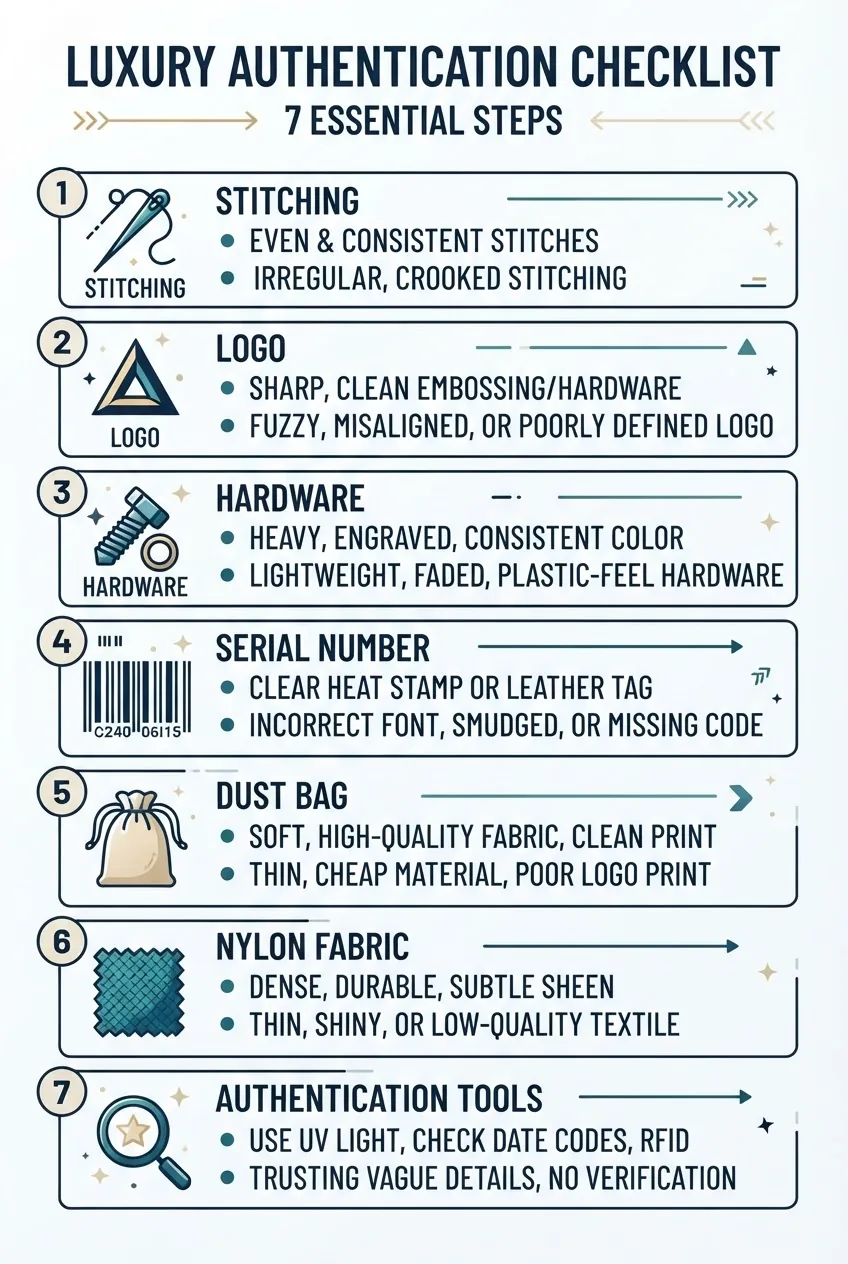
- Stitching: Even 2.5–3.0 mm spacing, no loose threads.
- Logo: Crisp font on plaque or heat stamp, centered and aligned.
- Hardware: Heavy, smooth action; clean engravings (PRADA, model codes).
- Serial/Authenticity card: Matching codes and correct paper stock; not sole proof.
- Dust bag: Correct fabric weight and font; drawstring quality.
- Material: Nylon spring-back test (2–4 seconds) or Saffiano crosshatch depth consistent.
- Verification tools: Macro photos, magnifier, and professional authentication when in doubt.
Compare your findings against this checklist and flag any two or more mismatches as high risk. If only one minor mismatch exists, document and seek a professional photo authentication.
When to call a professional
Engage a certified authenticator if: the bag costs over $1,000 and shows mixed results; if you observe signs of repair or replacement parts; or when resale platforms require certified clearance. Professional services typically take 24–72 hours for photo-authentication and 1–7 days for deeper physical analysis.
Finally, here are recommended resources and where to get help, including official and industry contacts.
Additional Resources and Where to Get Help with Prada Bag Authentication
Use these resources for further verification, dispute support, and cross-brand replica research.
- Official Prada materials and product pages for SKU and specification checks: Prada official site
- Entrupy — microscopic imaging and AI-assisted authentication service: Entrupy
- International Trademark Association (trademark protection, counterfeit resources): INTA
- Luxury Brand Replica Guide: Gucci, Chanel, Louis Vuitton & More — pillar page covering cross-brand replica strategies.
- Hermès Bags Guide — includes buying and selling tips relevant to high-value Prada transactions.
- Replica Hermès Bags Guide
- How to Spot Fake Hermès Bags
- Replica and Chanel-Inspired Bags Guide: Styles and Features
- Guide to Replica and Fake YSL Bags: Identification and Insights
- Replica and Faux Louis Vuitton Bags Guide: Styles and Tips
- Replica and Gucci-Inspired Bags Guide: Features and Identification
If you need a hands-on authentication, start with a photo submission to a trusted service, then arrange in-person inspection only if the photo review is inconclusive. Keep documentation of all correspondence and reports for resale or disputes.
Conclusion — key takeaways and CTA: Use layered verification: inspect stitching, logo, hardware, lining and dust bag together. For high-value or ambiguous items, get professional authentication. If you’d like expert review, gather high-resolution macro photos (front, interior, hardware, dust bag, authenticity card) and contact a pro service for a certified report.