How to Spot a Fake Hermès Bag — by the end of this hands-on guide you will be able to perform a step-by-step visual and tactile authentication of Birkin, Kelly, Evelyne, Constance and Garden Party models. Expect to spend 60–90 minutes per bag for a thorough check; this assumes a beginner-to-intermediate skill level and access to basic tools listed below.
Introduction to Spotting Fake Hermès Bags
This guide focuses strictly on practical identification techniques for Hermès bag authenticity verification — no brand history or pricing advice. You will follow structured checks for leather, stitching, hardware, blind stamps, packaging and more, with model-specific steps for Birkin, Kelly, Evelyne, Constance and Garden Party items. These checks reflect methods used by professional authenticators and documented counterfeit trends.
Counterfeiting of luxury handbags remains significant: According to a 2023 industry report, counterfeit luxury goods represent billions in lost revenue and drive sophisticated replica production techniques. Use multiple checks—visual, tactile, and tool-assisted—and always combine with a professional report when high value is involved. For broader replica information, see Luxury Brand Replica Guide: Gucci, Chanel, Louis Vuitton & More.
For model background and replica-specific variants, cross-reference our companion piece: Replica Hermès Bags Guide.
Before you start
- Tools: jeweller’s loupe (10x), white LED torch, small mirror, calibrated kitchen scale (g ±1g), UV flashlight, magnifying glass, soft microfiber cloth, soft-bristle brush.
- Workspace: clean table, natural daylight or 5500K LED, neutral background, camera or phone for close-up photos.
- Documents to have: any receipts, original tags, provenance emails, prior authentication reports if available.
Key Features to Inspect on All Hermès Bags
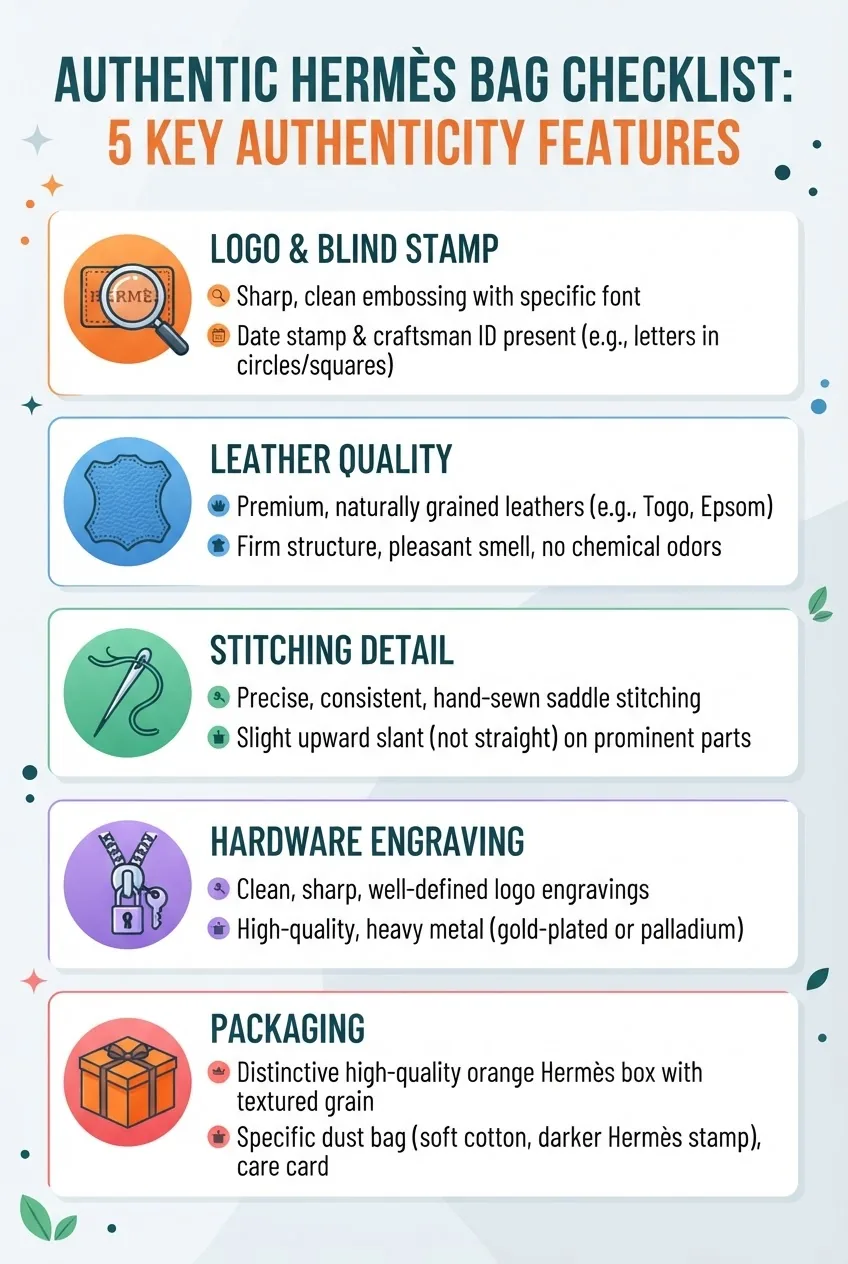
- Check the logo and blind stamp. Hermès blind stamps are small, precise, and placed inside pockets or under flaps. Look for a crisp letter (year code), a small shape indicating workshop, and perfect alignment with interior seams. Fake blind stamps often have uneven impression depth, wrong letter shapes, or are located in incorrect areas.
- Evaluate leather type and texture. Hermès uses specific leathers (Togo, Clemence, Epsom, Box, Swift, etc.). Learn the expected grain: Togo has raised pebble grain, Clemence has larger grain and softer feel, Epsom is pressed with a crosshatch, and Box leather is smooth and develops patina. Counterfeits often simulate grain with mechanical embossing that feels flat or plasticky.
- Inspect stitching and craftsmanship. Authentic Hermès uses saddle stitching by hand with waxed linen thread: uniform stitch length, slightly angled diagonal stitches, and tight tension. Count stitches where possible: Birkin top handles often have identical stitch counts across examples of the same size. Loose threads, inconsistent spacing, or machine-like straight stitches are red flags.
- Assess hardware, plating, and engravings. Hermès hardware (gold, palladium, brushed) is heavy, evenly plated, and edges are rounded. Engravings on turnlocks, clou de selle screws and padlock faces are sharp and centered. Fakes can be lighter, flake plating, show uneven tone between pieces, or have misspelled/poorly-formed engravings.
- Verify serial/date codes and paperwork. Hermès blind stamps indicate year and workshop; codes must match production era and leather type. Receipts, original tags, and provenance emails help. Remember: codes can be forged, so use them as one check among many.
- Examine overall structure and weight. Authentic Hermès bags have a defined internal structure and feel substantial for their size due to full-grain leathers and hardware. Replicas may be floppy, underfilled, or oddly light; weigh against brand-typical ranges where known.
- Review packaging and dust bag authenticity. Genuine dust bags are heavyweight cotton flannel with neat stitching and a printed Hermès logo with specific font weight. Box quality, tissue paper stamps, and authenticity cards vary by region, but poor printing, flimsy dust bags, and wrong box construction are common counterfeit giveaways.
- Look for common counterfeit techniques. Watch for glued edges, printed leather grain, aftermarket hardware replacements, over-deep blind stamps, or irregular lacquering. Many counterfeiters mix authentic parts with fake bodies—inspect each component closely.
- Use sensory checks like UV and scent. Leather scent is subtle, slightly sweet or natural; strong chemical or plastic smells suggest synthetic materials. UV can reveal modern adhesives or non-leather linings; however, UV results are supportive, not definitive.
- Document everything with photos. Take close-ups of stamps, hardware engravings, interior labels, and seams. These photos help when consulting professional authenticators and serve as a baseline if you submit for external verification.
Transition: With the universal checks covered, use the model-specific walkthroughs below as sequential procedures to apply those checks to each iconic Hermès bag.
How to Spot a Fake Hermès Birkin Bag
The Birkin requires the most exhaustive check because counterfeits range from obvious to nearly perfect. Below is a step-by-step authentication routine used by professional graders. Expect to spend 45–90 minutes for a complete Birkin assessment.
-
Inspect the overall shape and proportion.
Compare silhouette to authentic references for the listed size (25, 30, 35, 40 cm). Count these checks: handle drop (distance from top of bag to handle mid-point should match Hermes spec within ±5 mm), flap width relative to body, and gusset shape. Fake Birkins often show uneven gusset bulge or disproportionate flap height.
-
Check the leather type and grain under natural light.
Using a loupe and daylight, verify Togo/Swift/Clemence/Box characteristics. Rub the leather gently for 10–15 seconds to see if it develops expected patina or softens; Box leather should show light surface scratches that blend with polish. If grain looks stamped repeatedly in a repeating mechanical pattern, suspect embossing.
-
Examine saddle stitching closely.
Look for angled, consistent stitches roughly 2.5–3.5 mm apart; thread should be waxed and slightly glossy. Pull a single stitch gently (low force) to check tension — it should not move easily. Machine-lock stitches will appear perfectly straight and identical; Hermès saddle stitching has subtle hand-made variance.
-
Inspect the lock, clochette, and padlock.
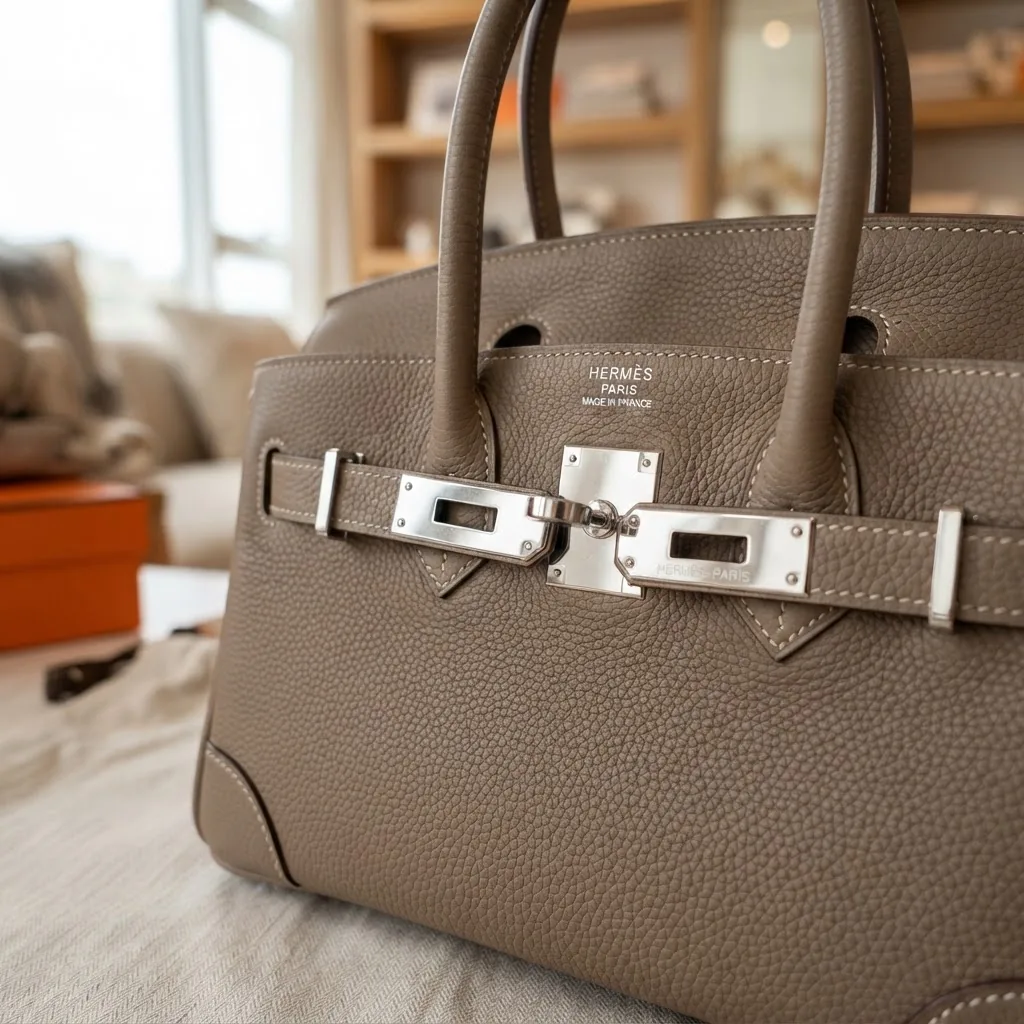
Hardware weight is key: a genuine Birkin padlock and keys feel solid and heavy. Check for consistent plating between lock, keys, and hardware; plating mismatch (e.g., warmer tone on lock, cooler on strap studs) is suspicious. Engravings on padlock face and keys should be perfectly centered and deeply engraved.
-
Verify the turnlock and hardware engravings.
Hermès engraves “Hermès Paris” or similar markings with a defined serif and spacing. Use 10x loupe: letters should be crisp; counterfeits often show softer, shallow engraving or incorrect typeface spacing. Check the back of the turnlock plate for consistent finishing and serial marks.
-
Locate and interpret the blind stamp.
Common Birkin blind stamps are on the interior under the flap or near the inner pocket. Expect a round/rectangular mark with a single letter (year) and a small symbol for the workshop. Compare letter font and size to known-era examples; misalignment, over-deep impressions or wrong symbol shapes are counterfeit indicators.
-
Check interior lining, pocket placement and seams.
Authentic Birkin interiors use full-grain leather linings with neat stitched pocket edges. Pocket placement is measured from the top seam; measure distance and compare to spec or known authentic examples. Uneven pocket seams, sloppy glue residue, or a synthetic-feeling lining are red flags.
-
Weigh the bag.
Use a kitchen scale. A genuine 30 cm Birkin with leather and hardware typically weighs 900–1,200 g (varies with leather and hardware). If the bag is under ~700 g or over 2 kg for smaller sizes, investigate—lightweight often means cheaper hardware or thin materials.
-
Smell and UV check.
Smell briefly: natural leather scents are faint; strong chemical or plastic odors suggest synthetic or badly treated leather. Use UV light across seams and glue lines—fluorescence in areas that should be non-reactive indicates modern adhesives or finishes not used historically by Hermès.
-
Cross-check provenance and paperwork.
Match date and workshop codes (blind stamp) to provided receipt dates and region. Discrepancies in dates vs. code or missing paperwork reduce confidence—use as one factor among many.
Transition: After the Birkin, use similar tactics adapted to the Kelly’s closure and structured silhouette.
How to Spot a Fake Hermès Kelly Bag
The Kelly’s signature kiss-lock closure and single-handle silhouette change the emphasis of checks: closure alignment, strap finishing and neat interior construction are critical. Expect 45–75 minutes for a thorough Kelly check.
-
Assess closure alignment and strap fit.
Open and close the Kelly several times: the flap should align perfectly with the body and lock without catching. The strap should feed through the belting holes smoothly with minimal slack. Misaligned closures or oversized holes indicate poor manufacturing or aftermarket modification.
-
Inspect the Kelly turnlock and hardware engravings.
Hermès engraves the button face and lock body with consistent typefaces. Look at the edges of the clasp: authentic metals have polished, rounded edges. Under 10x, engraving edges are crisp; fuzziness or inconsistent depth is suspect.
-
Examine the leather and edge-painting.
Kellys often use Box leather or Epsom for popular models; edge paint should be smooth and even with no runs. Scrub gently with a damp cloth — genuine edge paint remains intact; cheap edge finishing chips easily.
-
Read the blind stamp and serials.
Kelly blind stamps may sit on the interior or under the flap; check shape, letter, and workshop symbol. Ensure the year letter matches the claimed production year. Overly deep or sloppy stamps are common fake traits.
-
Test the handle attachment and stitching.
Lift the bag by the handle and feel for secure anchors: Hermès uses internal reinforcement and clean saddle stitching at attachment points. Any creak, loose thread, or uneven stitch counts around the handle connection is concerning.
-
Check interior pocket labels and seams.
Kelly interiors are tidy with well-placed pockets and neat edge finishing. If the pocket lining material differs dramatically from the exterior type or shows visible glue, it’s likely fake.
Transition: The Evelyne’s perforation and casual construction require different focal points—particularly the perforated ‘H’ and strap finishing.
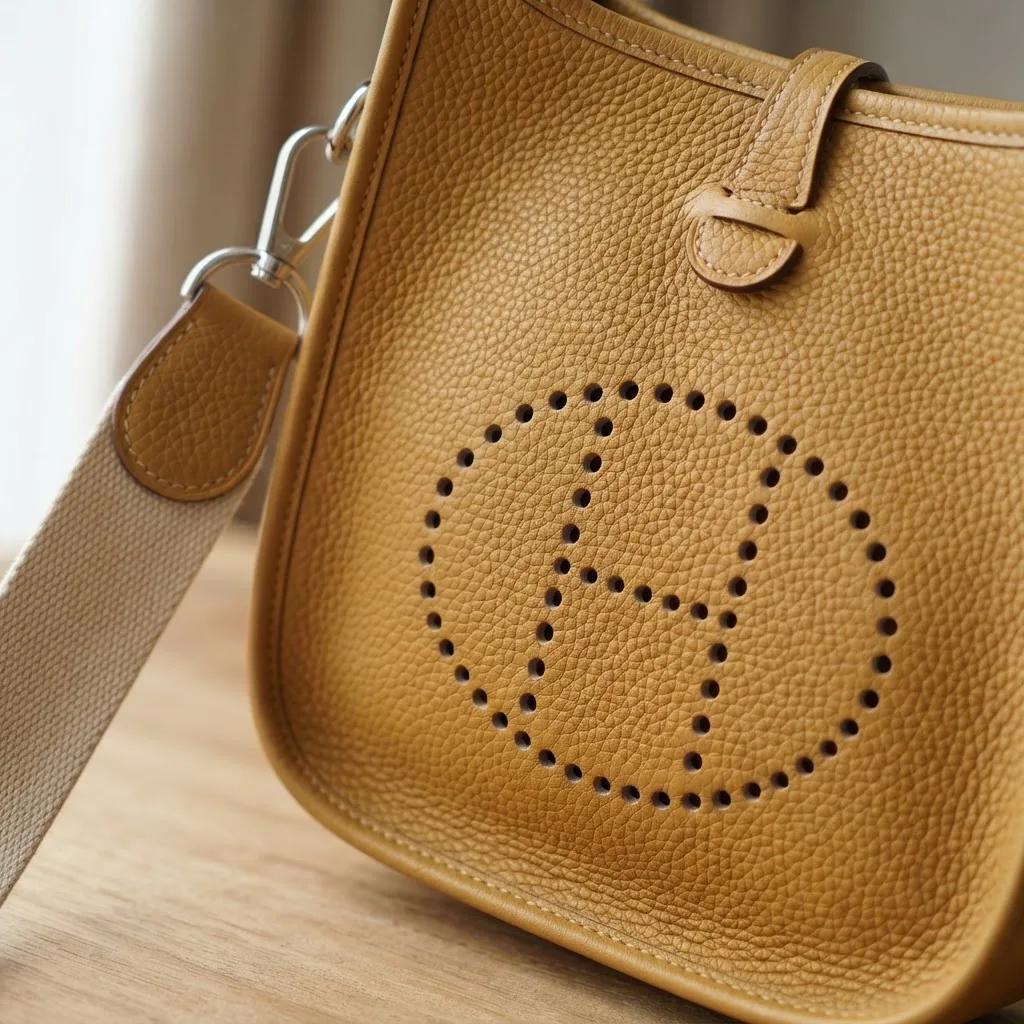
How to Spot a Fake Hermès Evelyne Bag
The Evelyne is often replicated in casual styles. Focus on the perforated ‘H’, the leather grain, and the crossbody strap hardware. Plan 30–60 minutes for a full check.
-
Inspect the perforated ‘H’ logo precision.
The Evelyne’s perforated ‘H’ should be centered, with even hole spacing and clean cut edges. Under magnification, holes should be circular and burnished; torn or uneven hole rims indicate mechanical cutting or poor finishing common in fakes.
-
Check the leather grain and flexibility.
Hold the bag and compress the leather for 5–10 seconds: Clemence or Taurillon used on Evelyne should recover without creasing permanently. Faux leathers often crease and do not spring back uniformly.
-
Examine strap stitching and hardware rivets.
Strap stitching should match body stitch color and stitch length; rivets used on strap attachments are small and neatly flush. Bulging rivets, mismatched thread, or uneven rivet placement are signs of replicas.
-
Confirm blind stamp and inside pocket details.
Look for a clear blind stamp near the inner seam; Evelyne stamps can be more subtle but remain crisp. Interior pockets, if present, should be aligned and sewn with the same thread type as the exterior.
Transition: The Constance’s H clasp is the single most telling feature; verify clasp geometry and finishing carefully.
How to Spot a Fake Hermès Constance Bag
Constance authentication centers on the H clasp, plating consistency, and internal finishing. Allow 30–60 minutes for these checks.
-
Test the H clasp mechanics and symmetry.
Press the H clasp and observe movement: the bar should move smoothly with no wobble and snap securely into the receiver. Check left-right symmetry — authentic H hardware is perfectly centered and balanced.
-
Examine plating and metal edges.
Plating thickness is visible by tone uniformity; inspect edges where plating meets leather — authentic pieces have consistent edge finishing. Also check screw heads and their placement behind the H plate.
-
Inspect leather seams and lining.
Interior lining should be tidy and match expected materials. For Constance, seams are often painted cleanly with no visible adhesive. Irregular paint edges or exposed glue indicate poor manufacturing.
Transition: Garden Party is simpler in construction but still shows telltale signs when counterfeiters cut corners on leather and stitching.
How to Spot a Fake Hermès Garden Party Bag
Garden Party authenticity checks focus on leather softness, handle finishing, and logo embossing. This is a quicker check—allow 20–40 minutes.
-
Check leather softness and board structure.
Garden Party uses thick leather panels and sometimes canvas; feel panel stiffness and edge thickness. Genuine Garden Party has consistent panel density; floppy or very thin panels suggest cheaper construction.
-
Inspect the logo embossing and font.
Embossed logos on the front should use Hermès’s precise typeface and spacing. Blurry embossing or fonts that appear too bold/too thin are suspect. Compare to an authenticated reference photo if available.
-
Look at handle finishing and interior stitching.
Handles attach cleanly with matching thread and folded leather edges. Interior seams should be straight, without puckering. Any glue residue or inconsistent thread color is a common fake sign.
Transition: Beyond these model checks, use auxiliary tools and verification channels described below to increase confidence.
Additional Tips and Tools to Authenticate Hermès Bags
Use these supplemental methods to support your visual and tactile checks. They are not definitive alone but strengthen a multi-factor assessment.
- UV light test: Shine a UV flashlight along seams and adhesives for 5–10 seconds. Modern synthetic adhesives often fluoresce. A subtle fluorescence in small amounts can be expected in some repairs—document and weigh against other defects.
- Scent check: Smell leather and lining for 3–5 seconds. Genuine full‑grain leather has a faint natural scent; strong chemical or petroleum odors suggest synthetic or heavily treated materials.
- Professional photo comparison: Photograph stamps, hardware, and stitching at 10x magnification. Compare against authenticated examples. Many authentication services request photos at specific angles—keep them consistent.
- Use third-party authentication services: For high-value bags, send photos or the bag to a reputable service. Entrupy and other services use machine learning and lab tests; consider them when doubt remains. External resource: Entrupy.
- Document provenance: Originals, purchase receipts, and owner history increase confidence but can be forged—verify with the seller and cross-check invoice details.
- Cross-brand authentication reading: Learn from how other brands’ authentication differs. For Chanel-specific techniques see Chanel Bags Guide. Other brand guides: Gucci, Prada & YSL Bags Guide, How to Spot a Fake Chanel Bag, Fake Gucci Bag Guide, Guide to Spotting Fake Louis Vuitton Bags, How to Spot a Fake Prada Bag, YSL Bag Guide: How to Spot Fake vs Real.
- Reference official craftsmanship guidance: Review Hermès’ own statements on techniques and materials to align expectations. External resource: Hermès craftsmanship overview.
- Know current counterfeiting trends: According to a 2024 industry report, counterfeiters increasingly mix authentic components with replica bodies to fool casual inspections; document anomalies across all components. External resource: European Union IP Observatory.
- For legal or consumer issues: Report suspected counterfeits to local consumer protection agencies or intellectual property offices. External resource: OECD publications on counterfeit trade.
- Use weighted scoring: Create a 0–10 score for each factor (leather, stitching, hardware, stamp, packaging). A cumulative score under 30/50 suggests high risk of forgery.
Transition: The next section summarizes common mistakes I see when people attempt self-authentication and provides immediate fixes.
Common mistakes and how to avoid them
I have mistaken a repaired strap for original because I didn’t check underside stitching closely—now I always photograph and inspect inside seams first. I once relied only on packaging; counterfeiters now replicate boxes and dust bags well. I also misread a blind stamp because I used poor lighting—always use 5500K daylight and a loupe for stamps.
Avoid these mistakes: don’t rely on a single indicator (stamp or dust bag), always inspect hardware tone across components for consistency, and document everything with high-resolution close-ups to consult experts if needed.
Summary and Final Reminders When Buying Hermès Bags
Key takeaways: use a multi-factor approach—leather, stitching, hardware, blind stamp, packaging, weight and sensory checks. No single test guarantees authenticity. If any single major element fails (poor stitching, wrong hardware engraving, bad blind stamp), treat the bag as suspicious.
Before finalizing a purchase, run this concise checklist:
| Check | Pass / Fail |
|---|---|
| Blind stamp consistency (letter, symbol, depth) | ____ |
| Saddle stitching uniformity & tension | ____ |
| Hardware engraving, weight & plating uniformity | ____ |
| Leather grain & scent | ____ |
| Packaging and dust bag authenticity | ____ |
| Provenance and receipt match blind stamp | ____ |
When to call a professional: if the bag is high value (> $5,000), if one or more major indicators fail, or if you find mismatched components (mix of real/fake parts). Professional authenticators can provide a lab-backed report within 48–72 hours depending on the service.
For additional buying and selling guidance after authentication, refer to Hermès Bags Guide: Cost, Buying Tips, and Selling Advice. For comparative resale and pricing context, see Louis Vuitton Bags Guide.
Final CTA: Use this checklist on your next inspection and, when in doubt, capture high-resolution photos of stamps, hardware, and stitching and submit them to a trusted authentication service for a second opinion.