Travelling With or Importing Fake Designer Bags: Customs & Airline Rules — Short answer: you may physically carry replica or counterfeit bags on flights, but many jurisdictions and airlines treat them as illegal counterfeit goods subject to seizure, fines or criminal action; Australia and the UK enforce these rules actively.
Understanding Fake Designer Bags in the Context of Travel
Answer: A “fake designer bag” is typically a copy or imitation of a protected brand that violates trademarks or copyrights; when travelling, customs and airlines evaluate such items against intellectual property and import laws, which can result in seizure or penalties.
Counterfeit: a product intentionally bearing unauthorized use of a trademark, logo or design to mimic an authentic brand.
Defining terms early helps: a replica may be presented as similar but not identical, while a counterfeit attempts to pass as the genuine article. Customs authorities focus on trademark infringement and consumer protection rather than fashion authenticity per se.
How this matters to travellers:
- Customs: border agencies inspect goods entering a country for illegal importation of counterfeit goods and can seize items, levy fines, or refer cases for prosecution.
- Airlines/security: aviation and security screening may flag suspicious goods for secondary inspection but typically defer legal action to customs authorities.
- Intent: whether you intended to sell, import commercially, or merely carry a personal replica affects enforcement severity.
For background on legitimate designer options and differences readers often compare, see the foundational guide linked below.
Designer Bags Ultimate Guide: Brands, Prices, and Buying Tips
If you want to compare authentic product options and rankings for non-counterfeit alternatives, consider our review resource.
best designer bag rankings and reviews
For quick familiarity with popular brands that are often counterfeited, see our brands list.
Customs Regulations for Fake Designer Bags: An Overview
Answer: Customs agencies worldwide treat counterfeit designer goods as prohibited or restricted imports; travellers must declare items as required, and undeclared counterfeit goods risk seizure, fines, or referral to law enforcement.

Key principles applied by most customs authorities:
- Prohibition vs restriction: Some countries prohibit import of counterfeit goods outright; others treat them as restricted items subject to seizure and disposal.
- Commercial intent: Items intended for resale or commercial gain attract stricter penalties than single personal-use items.
- Declaration obligations: Customs declarations require truthful disclosure of dutiable or controlled goods; failure to declare can be an offense.
- Seizure and disposition: Seized counterfeit goods may be retained, destroyed, or used as evidence; owners often have limited recourse without legal proceedings.
- Intellectual property enforcement: Customs coordinate with rights holders (brands) and IP enforcement units to identify and act on counterfeit shipments.
Common legal references and agencies:
- National customs and border agencies (examples below) administer seizure and penalty procedures.
- Intellectual property law (trademark and copyright statutes) underpin actions against counterfeit goods.
- International agreements and trade rules shape cross-border enforcement and cooperation among agencies.
Practical rules travellers should note:
- Always declare goods if a customs form asks about dutiable or restricted items — omission can escalate penalties.
- Carry receipts for genuine purchases to prove authenticity and lawful purchase if questioned.
- Expect cooperation between airport security, airline staff and customs if a suspicious item is identified during screening.
- Know that possession of a single replica for personal use may still result in seizure depending on jurisdiction and visible branding.
Authoritative resources: For country-specific enforcement, consult national customs guidance directly; for example, see the Australian Border Force and UK Border Force pages below when planning travel.
Australian Border Force guidance — As of 2024 the ABF publishes enforcement information on counterfeit imports.
UK Border Force — Official page describing border enforcement for counterfeit goods.
Country-Specific Customs Rules: Australia
Answer: In Australia, the Australian Border Force (ABF) treats counterfeit designer goods as illegal imports; travellers can have replica bags seized and face fines or prosecution when goods infringe trademarks or are intended for commercial use.
Key points about Australian enforcement (numbered):
- As of 2024, the ABF enforces trademark and copyright laws at the border and has powers to detain, examine and seize suspected counterfeit goods — see Australian Border Force for official guidance.
- Personal use vs commercial: a single replica for obvious personal use may still be seized if it bears counterfeit branding; multiple items or evidence of resale increases enforcement likelihood.
- Customs declaration: travellers completing an incoming passenger card must truthfully answer questions about dutiable or restricted goods; failing to declare valued or restricted items can lead to penalties.
- Penalties: consequences range from seizure and destruction of goods to fines; serious commercial importation can result in criminal charges and higher penalties under IP law.
- Disposal and appeals: seized goods may be destroyed; owners may appeal through administrative processes but legal costs and outcomes vary.
- Advice: if unsure, declare the item and be prepared to surrender it; getting upfront legal advice is wise for valuable disputed cases.
Where to buy legitimately in Australia: for lawful retail options consult our Australia buying guide.
where to buy designer bags in Australia
Country-Specific Customs Rules: United Kingdom
Answer: The UK Border Force enforces laws against counterfeit goods; carrying replica designer bags into or through the UK can lead to seizure and possible prosecution, especially if there is evidence of intent to sell or distribute.
Practical bullets and tips for the UK:
- UK enforcement: the UK Border Force and Trading Standards work to intercept counterfeit goods at the border and within the marketplace.
- Personal import: a single carry-on replica may be treated less severely than commercial consignments, but visible branding that misleads consumers is actionable.
- Declaration: answer any customs questions honestly; if asked, state the item is a replica rather than claiming authenticity.
- Confiscation: seized items are typically detained and may be destroyed; owners may receive a seizure notice outlining review procedures.
- Practical tip: avoid transporting multiple replicas or packaging indicating commercial intent (invoices, bulk packaging, price lists).
- When in doubt: consult the UK Border Force pages and consider legal advice before contesting a seizure.
External reference: official UK guidance on border enforcement is available here:
UK Border Force.
Airline Rules and Policies Regarding Fake Designer Bags
Answer: Airlines and security agencies do not typically police trademark law, but they enforce baggage rules, dangerous goods and security screening; they may detain or notify customs about suspicious counterfeit items but final legal decisions rest with border authorities and intellectual property holders.
Key airline and industry considerations:
- Security screening: TSA-style and equivalent security checks assess safety — suspicious items can trigger secondary inspections and referral to customs or police.
- Carry-on vs checked: Whether a bag is in carry-on or checked luggage does not immunize it from customs seizure; however, carry-on increases the chance of airline or security staff encountering it directly.
- IATA guidance: The International Air Transport Association (IATA) provides standards for carriage and screening, but not enforcement of counterfeit laws; see IATA for industry policy references.
- Airline liability: Airlines generally are not responsible for legal outcomes of seized goods but will comply with authorities and may retain items as evidence.
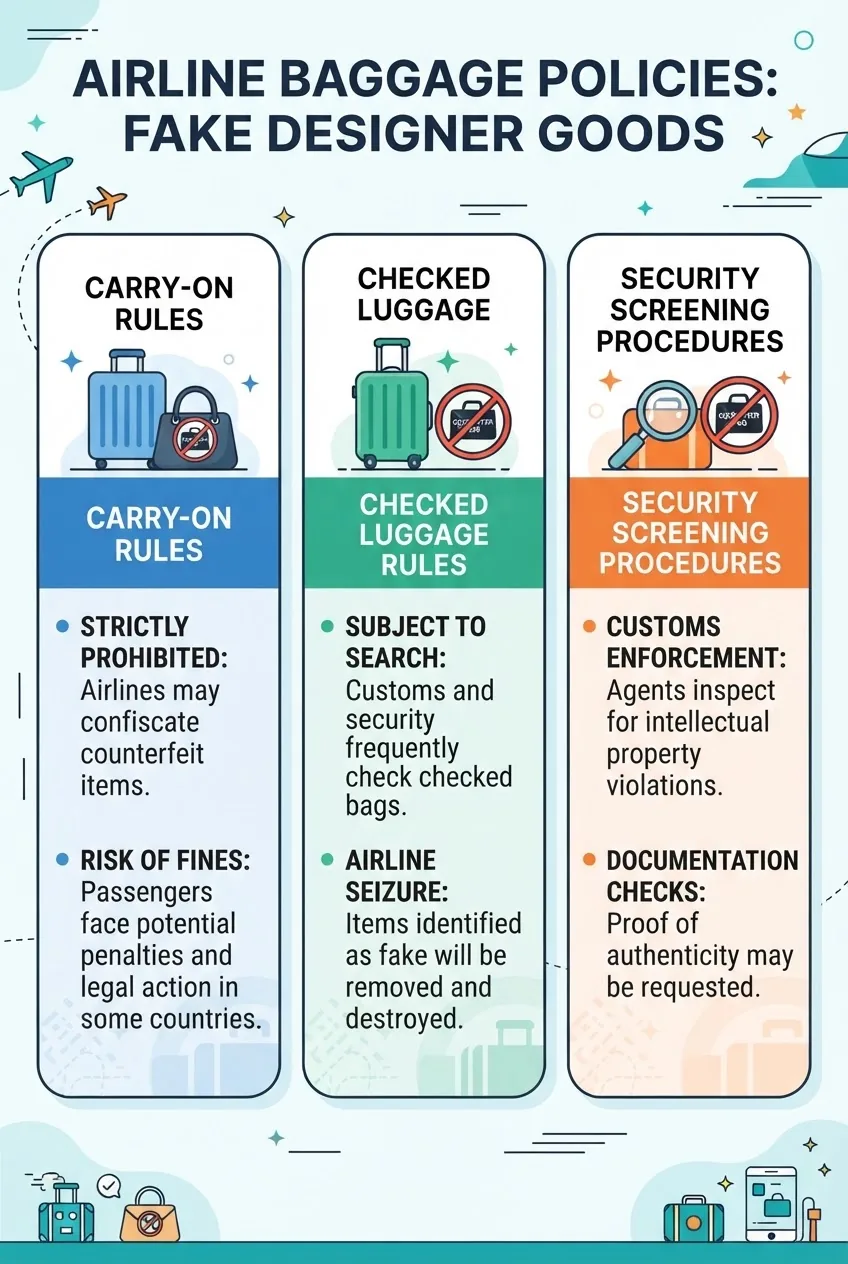
Generalized policy comparison (table):
| Airline Type | Carry-on | Checked Baggage | Screening & Liability |
|---|---|---|---|
| Full-Service International | Higher scrutiny; crew/security report suspicious items | Checked items screened; customs action possible on arrival | Comply with authorities; airline not liable for seizures |
| Low-Cost/Regional | Less onboard service but security screening still applies | Baggage scanning high; suspicious items flagged | Often quicker handoffs to authorities |
| Cargo & Courier | N/A | Commercial shipments face strict IP checks and seizures | Higher likelihood of legal action for commercial-scale counterfeits |
Note: airline policies vary; consult your carrier’s baggage and prohibited items pages before travel. For industry standards, see IATA.
Flying with Fake Designer Bags: Practical Tips
Answer: Minimize risk by declaring questionable items when required, avoiding commercial transport of replicas, keeping evidence of purchase for authentic items, and packing transparently to avoid creating appearance of concealment; follow the steps below.

- Assess intent: decide if the item is truly for personal use; do not travel with multiple identical replicas or packaging suggesting resale.
- Declare when required: if a customs form asks about dutiable/restricted items, disclose the replica to avoid aggravated penalties for non-declaration.
- Carry documentation: if the bag is a legitimate purchase, keep receipts, authenticity cards and proof of origin; if it’s a replica, be prepared to acknowledge that honestly.
- Pack openly: placing items where they are easily inspectable reduces suspicion; hiding a replica to evade discovery increases risk if found.
- Avoid advertising resale intent: remove bulk labels, invoices, price lists and multiple packing materials that suggest commercial activity.
- Know point-of-entry rules: if transiting, understand both the country you’re entering and your final destination’s laws to avoid cross-border exposure.
- Get local advice: for contested seizures of high-value items, seek a local lawyer experienced in IP or customs law.
Legal Risks and Potential Consequences of Travelling with Fake Bags
Answer: Legal consequences range from seizure and fines to criminal charges and detention depending on jurisdiction, value, quantity and intent; brands and customs authorities can pursue administrative or criminal enforcement under trademark and import laws.
Overview of possible outcomes:
- Seizure and destruction of goods.
- Civil actions by rights holders (brands) seeking damages.
- Administrative fines and forfeiture under customs law.
- Criminal prosecution for commercial-scale counterfeiting or repeat offenses.
- Travel disruption, including delays and questioning by enforcement officers.
Legal frameworks often cited:
- National trademark and consumer protection statutes describing prohibited acts (registered trademark infringement, false designation of origin).
- Customs and border legislation providing seizure powers at ports and airports.
- International conventions and bilateral agreements that facilitate cross-border IP enforcement.
Anonymized illustrative case examples:
- Case A — Transit seizure (anonymized): A traveller transiting through Country X carried three replica bags in checked luggage with invoices indicating resale. Customs seized all items; traveller faced administrative fines and goods were forfeited. (Based on multiple anonymized traveller reports compiled 2022–2024.)
- Case B — Personal-use confusion (anonymized): A traveller arriving into Country Y carried one clearly labeled replica but refused to declare it; customs seized the bag and issued a warning with no further charges after the traveller cooperated. (Anonymized border incident reported 2023.)
- Case C — Commercial prosecution (anonymized): A courier importing multiple boxes of counterfeit goods was prosecuted under national IP statutes; penalties included fines and a criminal record. (Reported in a 2021 enforcement roundup.)
Legal nuances travellers should understand:
- Value thresholds and quantity influence whether an action is treated administratively or criminally.
- Intent to profit or distribute is a critical legal factor; personal possession alone is less likely to result in criminal charges but still can lead to seizure.
- Brand owners often pursue civil remedies independent of customs actions.
- Jurisdictional variations: what is tolerated or treated leniently in one country may be strictly enforced in another.
For readers comparing counterfeit risk to legitimate secondhand purchasing, our resale guide explains how to obtain authentic secondhand items safely and legally.
To understand value gaps that influence enforcement and incentives for counterfeit markets, review our pricing analysis.
designer bag prices and most expensive bags
If you plan to sell designer bags (legally), consult regulated marketplaces and best-practice guides rather than transporting potential counterfeits.
How to Comply and Avoid Issues When Travelling with Replica Bags
Answer: To avoid problems, declare when required, avoid transporting multiple replicas or merchandise-like packaging, carry receipts for authentic items, and seek local legal advice if a seizure occurs; follow the checklist below before travel.
Step-by-step compliance steps:
- Research destination and transit-country customs rules about counterfeit goods.
- If an item is counterfeit or of uncertain authenticity, consider leaving it at home or shipping via lawful channels with full disclosure and appropriate permits if needed.
- Fill out arrival cards and declarations accurately; declare all dutiable or restricted items.
- Pack proof of purchase and authenticity documents for genuine items to expedite inspections.
- Avoid packing multiple replicas, commercial paperwork, or labels indicating resale intent.
- If faced with seizure, request a written seizure notice and instructions on how to appeal or retrieve items.
- Contact consular services or a local IP lawyer for high-value contested seizures.
Compliance checklist:
- Declare items when forms request dutiable or restricted goods.
- Carry receipts/authentication for genuine purchases.
- Remove commercial-looking packaging and multiple identical items.
- Photograph items and packaging before travel for records.
- Keep contact details for the airline and local legal counsel handy.
For care and post-travel maintenance of your bags (authentic or replicas), see our care guide to avoid damage and make handling easier after inspections.
Frequently Asked Questions About Travelling with Fake Designer Bags
Answer: Below are concise answers to common traveller questions about customs and airline rules for fake designer bags, each optimized for quick reference and featured-snippet use.