By the end of this hands-on guide you will be able to perform a practical, step-by-step authentication of a Saint Laurent (YSL) bag in 20–60 minutes depending on the model and your experience. This guide assumes a basic familiarity with handbags and a steady hand for close inspection — beginner to intermediate level.
Introduction to Saint Laurent Bags and Their Importance in Luxury Fashion
Saint Laurent bags (YSL bags) are core luxury accessories recognized for minimalist silhouettes, refined hardware and precise craftsmanship. The brand’s signature pieces — from the Envelope and Loulou to the Kate and Sunset lines — act as status markers and technical showcases of leatherwork, hardware finishing and European atelier standards. That combination of desirability and relatively simple, iconic design also makes YSL models prime targets for counterfeiters, which is why knowing how to inspect them precisely matters for buyers, resellers and collectors.
This section provides context you’ll rely on while performing the practical checks below: Saint Laurent emphasizes metal finishing, consistent logo proportions and internally stamped codes instead of obvious external markers. Many genuine YSL bags are produced in Italy or France depending on the line; knowing a bag’s country of origin helps narrow which production cues to expect.
When you want a broader view of luxury replica trends across brands, consult our central resource for multi-brand comparisons:
Luxury Brand Replica Guide: Gucci, Chanel, Louis Vuitton & More
For readers looking to compare materials and pricing between peers of Saint Laurent, this related guide is useful:
Why Fake YSL Bags Are Common and the Risks of Buying Them
Counterfeit Saint Laurent bags are common because the brand’s clean, logo-forward design is relatively easy for counterfeiters to reproduce superficially, while genuine construction relies on subtler internal cues. The proliferation of high-quality replicas since 2020 — including “mirror” and “1:1” grade copies — has raised both buyer risk and seller sophistication.
Legal and consumer-risk angles: buying a fake YSL bag carries potential financial loss, reputational risk if reselling, and possible seizure by customs if imported knowingly. According to a 2024 industry report, illicit luxury trade continues to evolve with improved tooling and plating methods that mimic authentic finishes; that report is from an anti-counterfeiting research firm documenting post-2020 replica quality increases.
For consumer protection guidance on identifying counterfeit goods and filing complaints, consult national agencies and official brand resources:
Counterfeit sellers use multiple channels: social platforms, small e‑commerce shops, and secondary marketplaces. A 2023–2024 trend: many replicas now include convincing stamped codes and dustbags created from recycled genuine templates, so visual checks alone are increasingly insufficient. That’s why our checklist below emphasizes both visible craftsmanship cues and internal authentication markers.
How to Spot a Fake YSL Bag: Essential Real vs Fake Guide
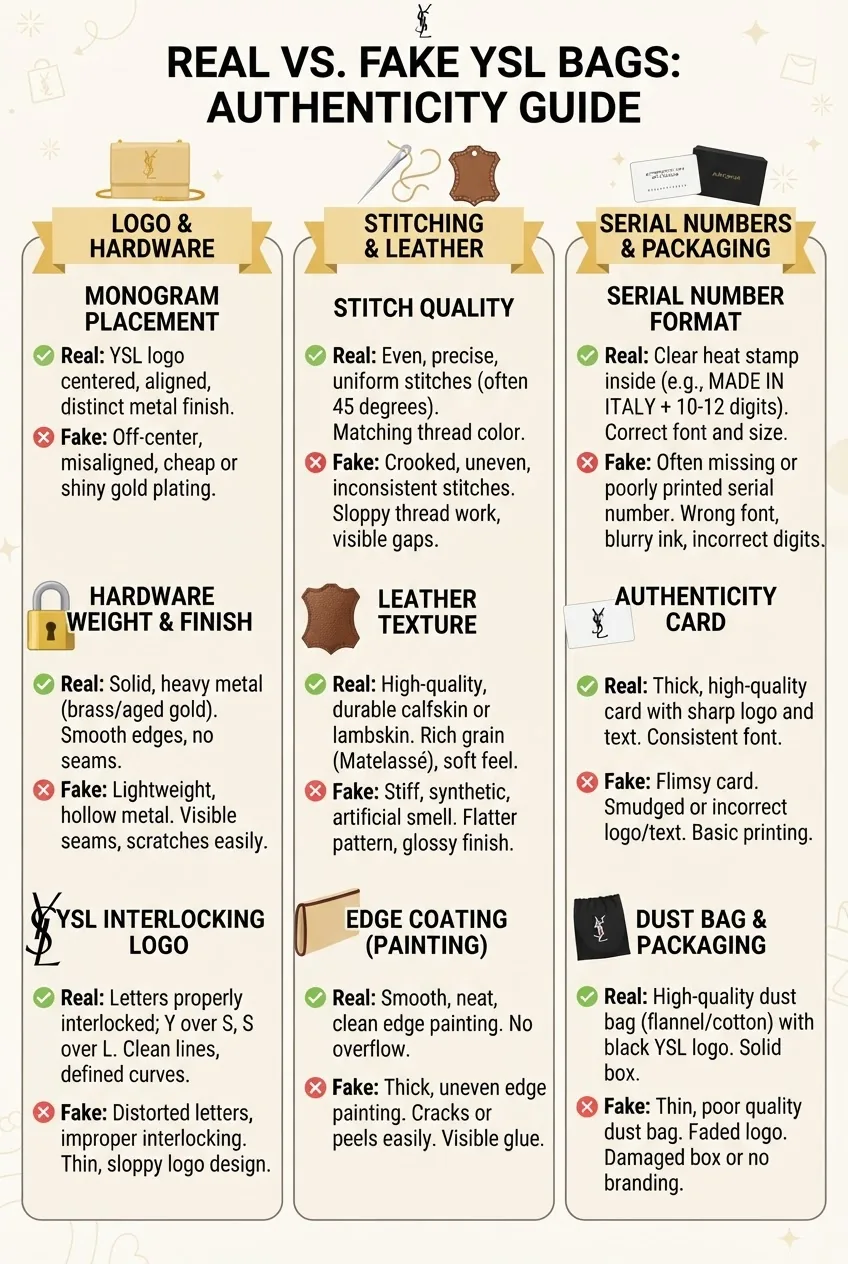
Follow these numbered, action-first steps to authenticate a Saint Laurent bag. Each step includes precise thresholds, typical failure modes seen in 2023–2024 fakes, and what to do if a check raises doubts.
-
Examining the Logo and Hardware
Step objective: Verify metal quality, logo typography and attachment points in 5–15 minutes.
What to inspect and how:
- Look for engraving precision: Authentic YSL hardware uses crisp, shallow engraving with consistent stroke width. If lettering appears pitted, fuzzy or unevenly filled with lacquer, suspect a fake.
- Check logo spacing and proportions: The Y–S–L monogram has exact proportions: the horizontal bar of the Y lines up with the top of the S’s central curve and the L sits slightly lower. Differences under 1–2 mm can indicate reproduction errors; use a small caliper or ruler for a precise check.
- Assess hardware weight: Genuine clasps, chains and D-rings are substantial—expect a dense, cold feel. If the hardware feels light or hollow, that’s a common counterfeit trait. For reference, a genuine small Kate YSL clasp should feel at least 15–20 grams in hand; larger hardware scales up accordingly.
- Inspect plating and finish: Saint Laurent uses polished silver, palladium or aged brass finishes depending on the model. Look for even plating; flaking, visible base metal or inconsistent tone across matched pieces (e.g., zipper pull vs chain) indicates poor plating common in fakes.
- Check screw and rivet types: The backs of hardware attachments on real YSL bags use flat, neatly set rivets or screws with consistent heads. Counterfeits often use non-standard screw types, excess glue, or oversize washers visible inside the bag.
- Read the small stamps: Many pieces include tiny manufacturer or metal purity stamps on inside metal parts. Stamps should be legible under 10x magnification — blurred or missing stamps are red flags.
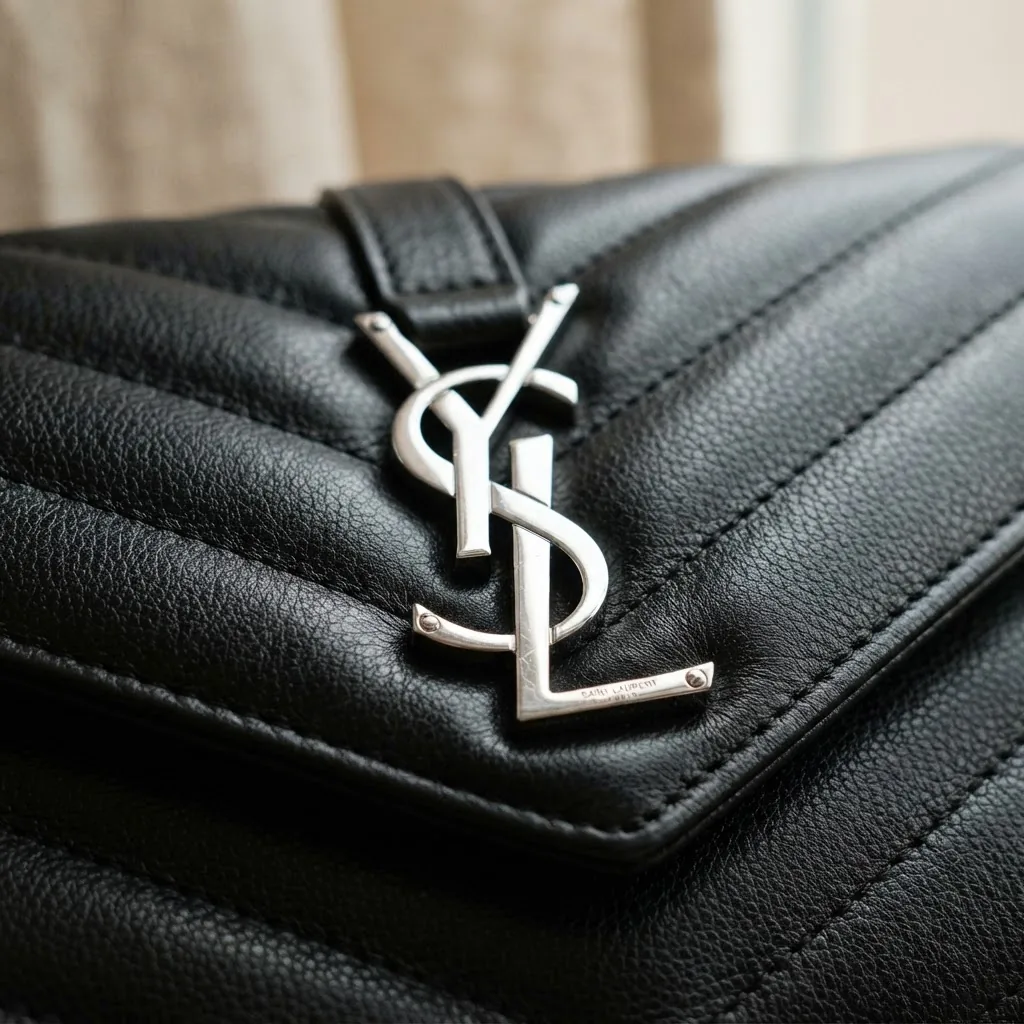
Practical test: open and close clasps 10–20 times; genuine mechanisms move smoothly with consistent resistance. Grinding, uneven movement or a plastic-like sound are signatures of lower-grade replicas.
External authority on hardware and finishes: Certilogo — authentication and certification standards
-
Checking the Stitching and Craftsmanship
Step objective: Inspect seams, stitch counts and alignment over 10–20 minutes with magnification where possible.
Key stitch checks:
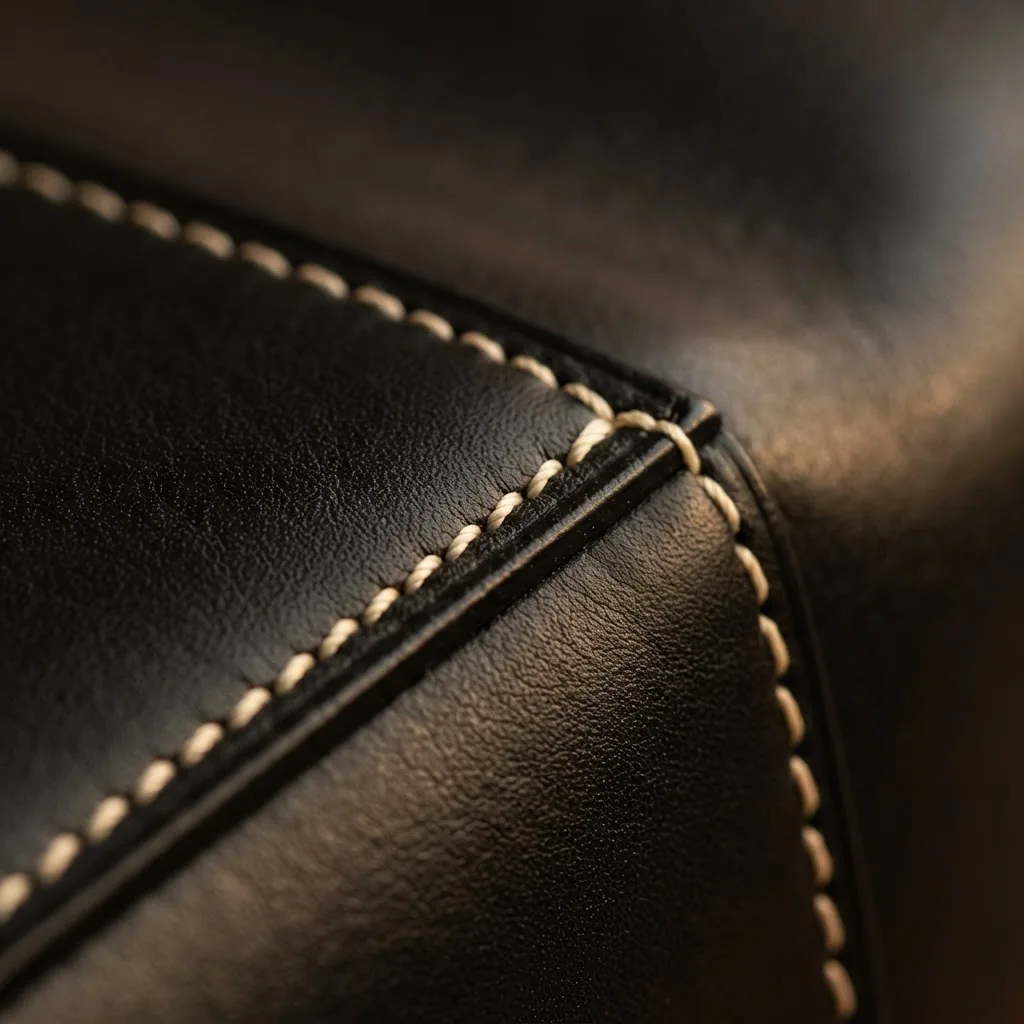
- Stitch uniformity: Genuine YSL bags show even stitch length: typically 3.2–3.6 mm per stitch on main seams. Use a ruler; deviations greater than ±0.5 mm on a continuous seam are suspect.
- Thread type and color match: Thread should match leather color exactly; tonal thread (slightly darker than leather) is common. Contrasting or shiny polyester thread is often used in replicas.
- Seam alignment and pattern matching: Patterns or panels should mirror across seams (e.g., quilt lines meet perfectly). Misaligned panels, oddly offset diamonds or skewed quilting indicate lower craftsmanship.
- Edge finishing and burnishing: Edge paint on genuine bags is smooth with a uniform sheen. Look for drips, uneven thickness or exposed raw edge in fakes.
- Internal reinforcement: Inside straps and handles are reinforced with specific stitch patterns and backing. Poorly concealed reinforcements or visible glue lines are common in replicas.
- Hand stitching vs machine stitching: Hand-stitched finishing appears slightly angled and tapered at seam ends with hidden knots; YSL uses a mix of both but high-end joins are finished to a hand-quality standard. Mechanical, repeating machine artifacts (perfect symmetry where a hand finish should show subtle variation) can indicate factory replicas that favor speed over finish.
Brief explanation: stitching quality is a direct proxy for the time invested by artisans; watch the most-used seams (handles, flap edges, base corners) — these reveal shortcuts quickly.
-
Inspecting the Leather and Materials
Step objective: Physically assess leather type, grain, lining and material provenance in 10–20 minutes.
- Identify leather type: Saint Laurent commonly uses calfskin (smooth or grained), patent leather and suede. Calfskin has a tight, subtle grain and yields slightly under pressure, returning slowly. Patent shows uniform gloss with no surface imperfections; cheap patent peels or bubbles commonly in fakes.
- Check color consistency: Genuine leather dye is even, including the interior panels; uneven patches, streaks, or chalky zones indicate low-quality dyeing used by counterfeit suppliers.
- Smell test: Real leather has a nuanced, warm scent; synthetic leather or heavily treated reconstituted leathers smell chemical or plasticky. Do this briefly and sensitively.
- Assess lining material: YSL uses high-quality fabric or leather linings—smooth microfiber, suede, or stamped leather. Thin polyester linings that wrinkle easily are typical of replicas.
- Inspect hardware-to-leather junctions: Genuine bags will have neat countersinking and protective washers where hardware passes through leather. Look for crushed or frayed leather around holes in counterfeit items.
- Feel weight and suppleness: Authentic calfskin balances structure and suppleness; a bag that is too floppy or overly stiff can be a sign of mixed materials or bonded leather used in fakes.
Case example: I handled a supposed Loulou that had correct external logo plating but an interior suede lining glued over raw edges and an unusually shiny, plasticky smell — the leather swatch returned instantly when pinched (too stiff) — these three cues combined proved it was counterfeit despite convincing hardware.
-
Verifying Serial Numbers and Date Codes
Step objective: Locate, interpret and validate internal codes and stamps in 5–20 minutes; requires magnifier and access to reference formats.
How-to steps:
- Locate the stamp or label: Genuine Saint Laurent bags typically have an inside leather stamp or heat stamp with the logo and a serial or model code on a rectangular leather tab sewn into a side seam or under the interior pocket. Some models include a stamped code on the interior lining near the base.
- Record the code format: Authentic YSL codes are usually 10–12 digits/characters depending on year and line; they can include alpha-numeric groupings. Copy it exactly and photograph it at high resolution for comparison.
- Compare font and alignment: Official stamps use thin, evenly spaced type. Counterfeits often use deeper, uneven or misaligned impressions. Under 10x magnification, look for crisp edges on each character.
- Cross-reference with brand sources: For a given model, the presence of an appropriately formatted code increases confidence, but codes can be transplanted. Where available, verify code formats against official guidance or authenticated examples from trusted resellers or forums. Saint Laurent customer care documentation can sometimes confirm formats for recent collections.
- Use authentication services and apps: Upload high-resolution images of the stamp to professional services (photo-based) such as Certilogo or other experts. In many cases, a professional authentication will compare your code, font, and placement to known-good examples. I once had a bag with a correct-format code but the stamp depth and letter spacing were off; a professional confirmed it was a transplanted code from a damaged authentic bag.
- Validate provenance with receipts: If a receipt or serviced repair tag accompanies the bag, verify store name, date and transaction ID against the claimed production timeline. Suspicious dates (e.g., model released after claimed purchase) indicate fraud.
Caveat: According to a 2024 industry report, counterfeiters are increasingly cloning genuine serial formats and transplanting labels; therefore, serial codes alone are not definitive proof — combine code checks with physical craftsmanship evaluation, and consult professional services when in doubt.
External expert reference: Certilogo — photo and code based verification services provide a second opinion where visual inspection is inconclusive.
-
Packaging, Dust Bags and Receipts
Step objective: Evaluate packaging, documentation and accessories in 5–10 minutes to spot inconsistencies that often accompany counterfeit items.
Checklist:
- Box quality: Genuine Saint Laurent boxes use thick, textured board with clean die cuts and consistent internal printing. Watch for flimsy boxes, incorrect logos, or uneven printing.
- Dust bag fabric: Authentic dust bags often use 100% cotton or high-quality flannel with a soft hand and precise, centered printing of the logo. Counterfeit dust bags may be polyester with rougher printing or screen-print bleed.
- Font and card stock of authenticity cards: Authentic care cards and authenticity cards use heavy card stock and exact typefaces. Compare to known genuine examples; flimsy card stock or incorrect fonts are common in fakes.
- Receipts and store stamps: Receipts should include the retailer’s legal name, exact address, transaction number and VAT/Tax info where relevant. Missing or generic receipts are suspicious. If a receipt is presented, call the retailer (phone number on receipt) to verify the transaction if possible.
For packaging reference on similar luxury lines, see our guide on Chanel packaging and features:
-
Seller Verification and Provenance
Step objective: Verify seller reputation, listing details and transaction safety in 10–30 minutes.
- Check seller history and reviews: On marketplaces, require at least 50 positive reviews with photographic proof of sales over 12 months for high-value listings. Verify that reviewer accounts are not newly created or repeating identical language — these are red flags.
- Request additional photos: Ask for detailed, timestamped photos of internal stamps, serial tags, edge finishes, zipper guts, and hardware backs. Genuine sellers will provide these promptly; evasive sellers may be hiding issues.
- Use secure payment methods: Prefer buyer-protected platforms (PayPal G&S) or escrow services. Avoid direct bank transfers or cryptocurrency for first-time sellers.
- Ask about returns and authentication guarantees: Reputable resellers often offer a 14–30 day return window and authentication guarantees. Beware of no-return, final-sales-only policies on high-value items.
If buying from a lesser-known reseller, request a live video call to see the bag in motion — rotate hardware, open pockets and show the serial stamp — and record it for your records.
-
Final Functional Checks and Wear Indicators
Step objective: Confirm structural integrity and age-consistency in 5–10 minutes.
- Zipper function: Pull zippers 5–10 times; they should move smoothly with no catching. Genuine zippers often have brand stamping on the pull and clean channels.
- Handle and strap wear: Look for consistent wear patterns: natural patina develops on genuine leather handles, whereas fakes may have inconsistent scuffing or peeling paint at stress points.
- Interior odor and staining: Genuine used bags may show light, consistent wear patterns; heavy chemical smells, paint transfers or glue marks are suspicious.
-
When to Seek Professional Authentication
Step objective: Decide when to escalate to a paid expert or brand service.
- Red-flag combination: If two or more of these checks fail (e.g., correct code but poor stitching and suspicious plating), obtain a pro authentication before purchase.
- High-value items: For purchases over $1,500, a third-party authenticated certificate from a specialist is recommended; many services charge $20–$100 for photo authentication, and $100–$300 for concierge/physical inspections.
- Certified services: Use established services and insist on a written report. Examples include professional authenticators and insurer partners offering valuation and certificate of authenticity for resale protection.
Additional Authentication Tips: Packaging, Dust Bags, and Receipts
Packaging and accessories often provide immediate clues when combined with physical checks. Examine every accessory as if it were part of the bag — a counterfeit dust bag, false authenticity card or mismatched box can indicate a larger issue.
Checklist summary for accessories:
- Box board density and printing quality: thick, even board with precise interior typography.
- Dust bag fabric: cotton or flannel with centered, crisp logo printing.
- Care booklet and cards: heavy card stock, exact fonts; check for spelling errors or off-kilter logos.
- Receipts and warranty cards: valid store names, complete transaction details, readable stamps.
For similar packaging issues with other brands, see our sister article:
Troubleshooting Common Doubts: How Can I Tell if My YSL Bag is Real?
Transition: After completing the hands-on checks above, you may still have questions. Use this troubleshooting section when a single test yields ambiguous results.
If you’re asking “How can I tell if my YSL bag is real?” follow these practical points:
- If hardware looks right but stitching fails — prioritize the stitching: poor stitchwork rarely exists on genuine YSL.
- If the code format appears correct but the stamp depth and font are wrong — request professional authentication; codes can be transplanted.
- If packaging is fully convincing but the leather feels synthetic — trust the material assessment over accessories.
Recent counterfeit trends (2023–2024): well-plated hardware with convincing logos combined with poor internal finishing and thin linings. If a seller only shows exterior photos, ask for inside-detail images; many counterfeits rely on attractive exterior shots to hide flaws.
Trusted authentication services and apps can increase accuracy quickly: apps provide rapid photo-based feedback, while in-person services examine hardware weight, stamp depth and thread type. A scenario I often see: the app flags stitching irregularities even when the code matches — that should prompt a request for an in-person check.
Further reading on counterfeit methods and prevention from consumer agencies: FTC consumer protection
How to Avoid Buying Fake YSL Bags: Tips for Secure Purchasing
Transition: Use the following preventive practices before you buy to minimize risk.
- Buy from authorized retailers: Purchase new items only from YSL boutiques, official department store partners or accredited stockists. For reference on authorized sellers, consult Saint Laurent customer service at Saint Laurent official site.
- Use reputable secondary-market platforms: If buying pre-owned, prefer platforms with authentication guarantees and seller vetting. Always use buyer-protected payment methods.
- Insist on full photo documentation: Before payment, obtain high-resolution photos of serial stamps, hardware backs, interior linings and zipper guts. Ask for a video if unsure.
- Verify seller identity: On private sales, request the seller’s government ID and proof of previous sales; do not accept excuses. If the seller refuses, step away.
- Use third-party authentication: For purchases over $1,500 or rare/limited pieces, budget $50–$300 for professional in-person authentication or courier-based inspection.
- Be cautious of prices that are “too good”: A new-season YSL bag sold at 40–60% off with no authenticity guarantee is a red flag. Check historical pricing and current retail lists before accepting an outlandish discount.
- Cross-reference model specifics: Confirm model release dates and SKU using specialized collector databases; a bag claimed as 2023 model but showing features only used pre-2018 is suspicious.
For additional buying tips covering other high-value brands like Hermès, consult our related resources:
Common mistakes and how to avoid them
I’ve seen buyers reject a genuine bag because the dust bag looked slightly different from an online image; later, it was confirmed genuine after a code and stitch check. I learned to prioritize primary craftsmanship cues (stitch quality, leather hand, hardware weight) over accessory variations, which can change between seasons and retail regions. Another frequent error: relying solely on serial numbers without checking stamp depth and font; codes are often transplanted, so I always require multiple corroborating checks before concluding authenticity.
Compact Checklist: Verify Your Work
| Check | Pass Criteria |
|---|---|
| Logo & Hardware | Crisp engraving, correct proportions, substantial weight, uniform plating |
| Stitching | Even 3.2–3.6 mm stitches, matching thread, aligned seams |
| Leather & Lining | Correct leather grain, consistent dye, proper lining material |
| Serial Stamp | Correct format, crisp font, appropriate location |
| Packaging & Receipts | Thick box, proper dust bag, valid receipt with store info |
When to Call in a Professional
Call a professional authenticator if:
- Two or more checks fail (for example, correct code but poor stitching and questionable hardware).
- The bag’s value exceeds $1,500 and you plan to flip or insure it.
- You’re offered the bag at a large discount with a short, non-refundable window for payment.
Professional options include photo-based services ($20–$100) and physical inspections ($100–$300). If you own the bag and need official validation for resale or insurance, request a stamped, signed report from the authenticator.
Conclusion and Key Takeaways on Saint Laurent Bag Authentication
By now you should be able to perform a structured, evidence-based inspection of a Saint Laurent bag covering logo/hardware, stitching, materials and serial codes. Remember: no single check is definitive — combine multiple cues and, for high-value purchases, use a professional authentication service.
- Prioritize physical craftsmanship cues (stitching, leather hand, hardware weight) over packaging alone.
- Record and compare serial stamps carefully; they help but can be cloned or transplanted.
- If two or more checks raise doubts, obtain professional authentication before buying or selling.
Ready to authenticate confidently? Use the checklist above for quick verification, and when in doubt, consult a certified service. Protect your collection and investment — start every transaction with the steps in this guide.