Crossbody Bag Basics: How to Wear, Measure, Types and Trends — By the end of this hands-on guide you’ll know the defining features of a crossbody bag, how to measure strap length and bag capacity precisely, which style fits each occasion, and up-to-the-minute trend cues. Expect 60–90 minutes to read and practice; skill level: beginner to confident shopper.
Before you start
- Tools: retractable tape measure (cm/in), ruler, pen, paper, and a partner for fit checks.
- Materials: the bag you own or a model you’re evaluating; wearable clothes for testing (jacket, T-shirt, dress).
- Knowledge: basic awareness of your daily carry items (phone, wallet, keys, charger, small notebook).
- Time: 15–30 minutes for hands-on measuring and fit tests per bag; 60–90 minutes to read this full guide and try recommended positions.
Proceed through the numbered steps below. Each step opens with the action first so you can jump to the task you need.
-
Define the object and its core features.
What Is a Crossbody Bag? Definition and Features
Crossbody bag — sometimes called a shoulder or sling bag when worn on one shoulder — is a hands-free bag designed to be carried across the torso with a long strap. The defining functional features are a single long strap that either sits diagonally across the chest or loops over one shoulder, and a size and closure system appropriate for everyday carry. Crossbody bags range from compact phone holders to roomy messenger-style models.
Key functional attributes to recognize:
- Strap length: Typically long enough to sit the bag at hip or waist level when worn across the body (see measuring section for exact numbers).
- Closure type: Zips, flaps, magnetic snaps, or buckles — each impacts security and speed of access.
- Shape and structure: Structured bags keep their silhouette (boxy, rectangular), while unstructured or slouch styles conform to contents.
- Capacity: Expressed in internal dimensions — height, width, depth — and practical item fit (phone, cardholder, keys, small water bottle).
- Attachment points: Fixed or adjustable straps, removable crossbody strap, and hardware quality determine versatility and durability.
The term covers multiple fashion and utility subtypes: mini crossbodies, structured pieces, flap designs, messenger crossbodies and chain-strap options. Later sections summarize each type so you can match function with style.
Note on language: I’ll use “crossbody” to describe the general category and specify “belt bag” when contrasting a wearable that sits at the waist. Expect practical, hands-on explanations rather than deep niche design histories.
-
Survey the family of styles and their defining trade-offs.
Types of Crossbody Bags: Overview and Characteristics
This numbered list describes main crossbody types, their typical use cases, and the functional trade-offs you should consider as a beginner. For deeper dives into a subtype, follow the linked guides below.
-
Structured crossbody — A boxy, firm-sided bag that maintains shape. Structured styles are ideal when you want a polished silhouette: they protect delicate contents, sit neatly under outerwear, and photograph well. Trade-off: less compressible and typically slightly heavier due to reinforced panels. Examples: small rectangular leather crossbody, camera bags.
-
Flap crossbody — Characterized by a front flap that covers the opening, often secured with magnetic closures or turn locks. Flaps add security and a classic aesthetic; they’re common in dressier styles that balance accessibility with protection. Trade-off: slightly slower access than zipper tops and can bulk at the flap area.
-
Messenger / courier-style crossbody — Wide, rectangular bags with a long flap and larger capacity, inspired by mail and bike couriers. They prioritize utility: multiple pockets, larger straps for weight distribution, and quick access. Trade-off: they read casual and may appear oversized for formal settings.
-
Mini crossbody — Compact, often single-compartment bags sized for phone, cards, and keys. They’re the lightest, most travel-friendly choice but have very limited capacity. Trade-off: can’t carry bulkier daily items.
-
Chain-strap crossbody — Feature metal chain straps or chain-leather combinations. They elevate an outfit and work well for evening or dress occasions; chains can be lightweight or heavy depending on metal gauge. Trade-off: metal can bite into bare skin if narrow — choose wider leather interwoven chains for comfort.
- Convertible crossbody (removable or adjustable straps) — Designed to switch between shoulder, crossbody and clutch shapes with detachable straps. Trade-off: extra hardware may add weight; complexity can affect longevity.
- Belt-style crossbody and sling — Smaller crossbody variants worn higher on the torso or around the waist; this includes hybrid models that convert to belt bags. Trade-off: less capacity but superior hands-free convenience for active use.
- Phone and camera crossbodies — Slim designs tailored to a single device; they prioritize accessibility and protection for electronics with padded interiors or card slots.
- Soft / slouch crossbody — Unstructured leather or fabric bags that conform to their contents. Great for casual wear and flexible packing; the trade-off is less protection for delicate items and a less formal appearance.
-
Monogram and logo styles — Designer-inspired pieces focusing on branding and pattern; if you’re exploring replicas or monogram aesthetics, note durability differences and authenticity caveats.
Replicas of many popular styles are covered in our pillar replica guide when you want designer looks that mimic functionality and form.
Replica Crossbody Bags Guide for Designer and Luxury Styles
For structured and mini replica comparisons see the replica styles guide linked above; for chain options see the chain crossbody guide, and for messenger specifics see the messenger guide. Each subtype trades off capacity, security, and formalness — choose based on your daily carry and the occasions you attend.
-
Structured crossbody — A boxy, firm-sided bag that maintains shape. Structured styles are ideal when you want a polished silhouette: they protect delicate contents, sit neatly under outerwear, and photograph well. Trade-off: less compressible and typically slightly heavier due to reinforced panels. Examples: small rectangular leather crossbody, camera bags.
-
Measure strap and bag size using a tape and standard body references.
How to Measure a Crossbody Bag: Strap, Size, and Fit
This step gives precise, repeatable instructions for measuring strap length, bag dimensions, and checking fit against your body. Follow each bullet and record values; I provide example numbers for reference.

-
Measure the strap’s full length (unstretched):
- Lay the strap flat on a table and measure end-to-end using a retractable tape. Record in both centimeters and inches. Example: common long-strap lengths range 100–130 cm (39–51 in).
- If the strap is removable, measure from the strap clip to clip. If non-removable, measure stitched ends where the strap meets hardware.
-
Measure the drop length (single-shoulder reference):
- The drop is measured from the top of the bag (where strap joins) to the top of the bag when hanging. Fold the strap in half and measure from the midpoint to the top of the bag. Typical drop lengths: 45–60 cm (18–24 in) for crossbody-worn bags that sit at hip level.
- Why it matters: drop determines where the bag sits on your body and whether it hits hip, waist, or chest.
-
Measure the bag dimensions (for capacity):
- Height: top to bottom. Width: side to side. Depth: front to back at the base. Example measurement for a medium everyday crossbody: 21 cm H x 28 cm W x 8 cm D (8.3 x 11 x 3.2 in).
- Calculate approximate volume: height x width x depth = cm^3 (e.g., 21 x 28 x 8 = 4,704 cm^3 ≈ 4.7 liters). Use liters to compare capacity quickly.
-
Test fit on the body:
- Wear the bag across your body with typical outfit layers and a phone in your pocket. Note where the bag rests: mid-hip, low hip, high hip, or at waist. Aim for mid-to-high hip for daily ease, 40–50 cm drop for most adults.
- If possible, have a partner measure the distance from collarbone to bag top while you stand relaxed; this helps when shopping online to request strap length specifics.
-
Check strap adjustability and hardware:
- Identify whether the strap has fixed notches, a sliding buckle, or removable clasps. Sliding buckles allow micoadjustments (2–3 cm increments), while stamped notches alter length in visibly discrete steps (often 5 cm or larger).
- For chain straps, measure the chain and any leather shoulder pad separately; leather pads add 3–6 cm of comfort contact area.
-
Compare measured values to your needs:
- Daily commuter: aim for 4–6 L capacity (e.g., medium structured crossbody 20–26 cm H, 25–30 cm W, 7–10 cm D) so you can carry a phone, wallet, small umbrella, and charger.
- Evening/dress: 0.5–1.5 L capacity with smaller drops (35–45 cm) and compact dimensions (10–18 cm W).
- Travel day bag: prioritize 6–10 L and padded compartments for electronics; ensure strap width ≥2.5 cm for better weight distribution.
-
Document and label:
- Record strap length, drop, dimensions and approximate liters on a card you keep with the bag or in your phone notes. This avoids repeated measuring and helps when comparing options online.
Ergonomic context: for comfort guidelines and carrying ergonomics, consult occupational ergonomics resources. According to a 2024 ergonomics guidance summary from a national occupational safety source, even distribution and avoiding one-sided loads reduce shoulder strain — see authoritative ergonomic guidance for more detail.
CDC NIOSH ergonomics guidance provides general advice on load distribution and posture when carrying items.
Remember: personal proportions vary. Use the measurement method above and compare to your recorded body points rather than assuming one-size-fits-all strap numbers.
-
Measure the strap’s full length (unstretched):
-
Practice wearing positions and adjust for comfort and look.
How to Wear a Crossbody Bag Properly: Style Tips and Comfort

This section shows step-by-step wearing techniques, adjustments for body types, and visual styling rules you can use immediately. I include practical scenarios (commuting, travel, evening) so you can test each position and note comfort thresholds.
-
Wear it across the chest for security and balance:
Action: sling the strap over your dominant shoulder and pull the bag so it rests near your opposite hip or just below your ribcage. Typical drop: 40–50 cm on average adults.
Why: across-the-chest placement reduces slippage and keeps the bag visible, deterring pickpocketing. This position distributes weight evenly and provides quick access to zippers.
Scenario: city commute with crowded transit — use diagonal crossbody at mid-hip and tuck strap under a light coat to reduce snagging.
-
Wear it high on the torso for active days:
Action: shorten strap to a 30–40 cm drop so the bag sits high on the chest (almost a sling). This keeps contents steady while walking or biking.
Why: higher placement reduces bouncing. Use a wider strap (≥2.5 cm) or crossbody with padded section for extra comfort.
Scenario: cycling or crowded festival — compact crossbody or convertible styles work best.
-
Wear it on one shoulder for style or quick access:
Action: lengthen the strap to let the bag hang at hip or just above, worn on one shoulder. Keep the bag close to the body and avoid carrying heavy loads this way (limit to 1–2 kg).
Why: shoulder wear changes silhouette and reads more casual; it’s quick to remove but less secure than crossbody wear.
-
Convert to belt bag or hip carry when appropriate:
Action: if the strap allows, thread it through belt loops or wrap it around the waist, securing with a buckle. Ensure the bag rests centrally on the front or just to the side for balance.
Why: belt-style carry can provide faster access to items and keeps hands free for parenting, running, or travel check-ins. Watch capacity limits — belt carry works best with compact items.
Scenario: airport or theme-park days.
-
Match strap width to load:
Action: when pack weight exceeds 1–1.5 kg (phone, wallet, portable battery), choose a strap ≥2.5 cm wide with padding. For <1 kg, a 1.5–2 cm strap is usually comfortable.
Why: narrow straps create pressure points; padded/wide straps distribute weight better.
-
Adjust for body shape and height:
- Short torsos: aim for a 35–45 cm drop so the bag sits at the higher hip; keep strap shorter for proportion.
- Long torsos or taller individuals: go 50–60 cm drop to avoid the bag hitting mid-thigh and looking disproportionate.
- Curvier bodies: wider strap and structured bag shapes create cleaner lines and avoid the bag tucking into curves uncomfortably.
-
Coordinate with outfit silhouettes:
Action: pair structured crossbodies with tailored coats or blazers; pair soft slouch styles with relaxed denim and knits. For evening, use chain-straps or small flap crossbodies.
Why: proportion and texture matter. A large, slouchy bag off a formal dress will undercut polish; a tiny boxy crossbody on a bulky knit may look dwarfed.
For dedicated flap styling tips, see the flap bag guide linked below.
-
Test daily scenarios and record comfort thresholds:
Action: try each wearing position for 15 minutes with your typical load and note any shoulder pain, chafing, or bag bounce. Acceptable thresholds: no discomfort under 30 minutes; mild awareness acceptable up to 90 minutes; stop if pins-and-needles or sharp pain appears.
Why: repeated brief tests reveal issues you won’t notice in a quick mirror check.
Ergonomics and safety: For guidance on reducing musculoskeletal strain while carrying loads, consult national occupational ergonomics resources. According to a 2024 ergonomics summary by a national occupational safety source, limiting unilateral loads and using wider straps reduces shoulder and neck strain.
Style note: like the perfect pair of shoes, the right crossbody bag balances style and comfort. Test strap widths, adjust drops, and try wearing across the chest for security unless you’re in a formal setting where shoulder wear may be more appropriate.
-
Wear it across the chest for security and balance:
-
Compare use cases side-by-side to decide which wearable suits your day.
Belt Bag vs Crossbody Bag: Key Differences and Use Cases
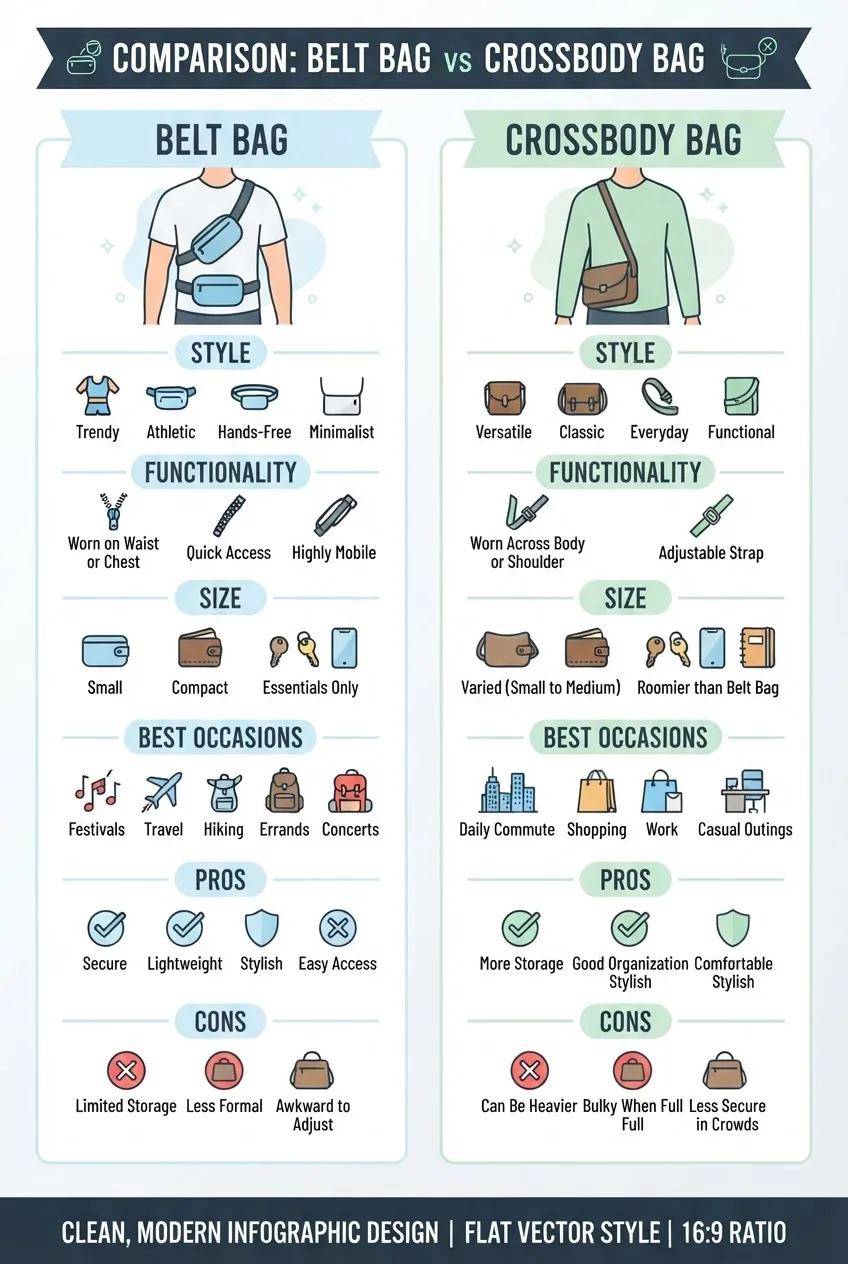
Feature Crossbody Bag Belt Bag Primary wear Diagonal across torso or shoulder Around waist or high on hips Capacity 0.5–10 L 0.5–3 L Security High when worn across chest High when worn front-facing Best occasions Everyday, travel, office (small to medium) Active travel, festivals, quick errands Style read Versatile: casual to dressy Sporty to streetwear Pros Hands-free, balance, visibility Ultra-hands-free, fast access, compact Cons Can swing if too long; may rest at awkward heights Limited capacity and fewer formal styling options Prose explanation:
Use a crossbody when you need balance between capacity and security: it suits daily commuting, travel, and work when you carry more than just essentials. A belt bag (or hip bag) is ideal for short outings and active days where fast access and stability matter most. If you want convertible use, choose a bag with strap adjustability that supports both styles; that way you get the utility of a crossbody and the quick-access benefits of a belt bag.
Functional trade-offs to consider:
- Capacity vs. access: crossbodies generally hold more but require unhooking or leaning to access; belt bags are easier to reach while standing.
- Security: both can be highly secure if worn front-facing; crossbody across the chest provides continuous visibility.
- Style: crossbody spans casual to formal; belt bags skew casual/streetwear.
When to pick which: For travel with multiple items and a need for posture-friendly wear, prefer a crossbody with a padded strap. For concerts, short errands, or when carrying minimal items, a belt bag is the faster, hands-free option.
-
Scan trend signals and translate them into shopping criteria.
Latest Trends in Crossbody Bags for 2026
Fashion trend reports and market analysis for 2024–2026 show evolving priorities: sustainability, functionality blended with elevated details, and playful proportions. According to a 2024 industry report from a major fashion research firm, consumers continue preferring durable materials and modular designs in 2026 while gravitating to both nostalgia-driven shapes and new minimalist forms.
According to a 2024 industry report from McKinsey’s State of Fashion, resale, durability, and craft-forward details are driving accessory purchases.
Key trend bullets for 2026:
- Sustainable materials and longevity: Recycled nylon, vegetable-tanned leathers, and certified microfibers are popular. Shoppers prioritize materials with traceability and repairability notes on tags. Expect more repair-service offerings linked to higher-value pieces.
- Versatile strap systems: Multi-length straps and modular add-ons (pouches, clips) are trending for functionality — they let one bag serve multiple uses across the week.
- Protective interiors: Padded compartments for phones and small electronics are now mainstream, reflecting continued tech carry needs.
- Color directions: Neutral core palettes (stone, mocha, black) remain staples; seasonal accents in saturated saffron, deep teal, and warm red appear as statement options for 2026.
- Shape innovation: Expect architectural mini-structures (boxy camera shapes) and elongated rectangular silhouettes that read modern and tailored.
- Hardware as detail: Brushed brass, matte black metal, and ethically sourced chain finishes are used to elevate basic shapes.
- Heritage motifs: Monogram reinventions and signature patterns are being reissued with cleaner lines and smaller logos — a nod to heritage without overpowering minimal outfits.
Practical shopping takeaways based on trend signals:
- Prioritize bags with removable or replaceable straps to extend lifecycle and adapt style.
- Choose neutral base colors if you want year-round utility; add a seasonal pop color if your wardrobe tolerates statement pieces.
- For sustainability, request material sourcing details and repair policies from sellers; brands increasingly publish this information.
Industry sources and forecasting: for forecasted color palettes and consumer behavior trends, see fashion forecasting and industry analysis sources. According to a 2024 trade publication summary, marketplace demand for durable, repairable accessories rose 12% year-over-year in core markets.
Business of Fashion trend analysis provides market-level write-ups and editorial snapshots on accessory trends (subscription may be required).
Note: trends shift season to season; use the above criteria to choose a bag that aligns with both current looks and your long-term needs.
-
Identify the universally most popular crossbody style and why it works.
What Is the Most Popular Crossbody Bag Style and Why?
Across street style and retail best-seller lists, the most popular crossbody bag is the medium structured rectangular crossbody — think a camera bag or small flap with a moderate strap. It’s popular because it hits the sweet spot between capacity, polish, and versatility.
Reasons for its popularity:
- Versatility: Works with both casual and semi-formal outfits; one structured silhouette can suit work, travel, and evenings.
- Proportion: Medium size (approx. 18–26 cm width, 14–22 cm height) sits well on varied body types and fits essentials (phone, wallet, small cosmetics).
- Photogenic and durable: Structured materials keep the bag looking fresh, and protected internal shapes reduce device movement.
- Celebrity and influencer uptake: Frequent visibility in social media and street style photography keeps this shape desirable.
Examples of use cases:
- Daily office carry: fits a phone, slim wallet, compact charger, and small notebook.
- Weekend city visits: keeps essentials secure while allowing light purchases.
- Evening dinners: choose a polished structured piece with minimal hardware.
If you’re comparing prices or thinking about designer or replica options, check our mini crossbody pricing guide for market averages on compact and medium structured pieces.
mini crossbody bag pricing guide
Practical buying tip: when a medium structured crossbody lists a removable strap and inner divider pockets, you’ve found a model that will likely adapt to most of your needs. That adaptability is the primary reason this style dominates popular lists.
-
List and explain functional benefits so you can match features to needs.
Practical Benefits of Crossbody Bags: Security, Convenience, and More
Crossbody bags combine utility and style, offering multiple practical benefits you can count on daily.
- Hands-free convenience: Crossbody bags free your hands for commuting, carrying kids, or handling purchases — the core functional promise.
- Improved security: Worn across the chest, the bag stays in your line of sight, reducing pickpocket risk. For authenticity checks and replica concerns, consult our spotting guide.
- Weight distribution: A properly fitted strap distributes weight across the torso rather than focusing on one shoulder.
- Organization: Multiple pockets and dividers make it easy to separate small essentials, reducing time spent digging for items.
- Adaptability: Convertible straps and detachable pouches let one bag serve office, travel and evening roles.
- Travel efficiency: Many crossbodies are sized to keep passports, boarding passes and phones handy and secure.
spotting fake Gucci and Louis Vuitton crossbody bags
For small, travel-optimized options specifically chosen for daily convenience and light packing, consult our small crossbody guide.
best small crossbody bags for travel and everyday
Replica note: replicas can emulate the look and function of popular models, but quality, hardware, and material longevity vary. If considering replicas of top brands, review our replica guide for evaluations and caveats.
fake designer crossbody bags for top brands
Consumer safety and durability: when assessing materials and construction, refer to product safety standards and consumer reports. For material safety and consumer guidance, see consumer product safety resources.
U.S. Consumer Product Safety Commission provides product safety and recall information relevant to materials and hardware failures.
-
Choose materials, testing durability, and plan maintenance.
Crossbody Bag Materials and Durability Basics
Material choice determines weight, water resistance, longevity and how the bag wears over time. I recommend testing small things yourself: water drop tests, hardware checks, and seam inspection.
Common materials and what to expect:
- Full-grain leather: Highest durability, develops a patina; heavier and requires conditioning (3–6 months depending on climate).
- Top-grain / corrected-grain leather: Lighter and more uniform in appearance; slightly less durable than full-grain.
- Synthetic leathers (PU): More affordable and water-resistant but prone to cracking over time; expect ~2–5 years of life depending on usage.
- Recycled nylon / Cordura: Extremely durable, lightweight, and often water-resistant. Ideal for travel crossbodies and sporty designs.
- Canvas (waxed or treated): Breathable and repairable; waxed canvas adds water resistance but requires reproofing.
- Metal hardware: Look for solid metal rings and buckles (avoid hollow or poorly plated hardware). Solid brass or stainless steel plating resists corrosion best.
Durability test checklist (do these before purchase or when inspecting a bag):
- Zip test: open/close zipper 10 times to check smoothness and how easily teeth align.
- Seam tug test: gently tug internal seams and pocket edges to spot loose stitching.
- Hardware stress test: apply moderate pull (2–5 kg force) near strap attachments to feel for creaks or movement.
- Water bead test: drizzle a small amount of water; observe beading vs absorption (especially on canvas and leather). If it absorbs quickly, expect staining in wet weather.
Maintenance and repair: condition leather every 6–12 months with a pH-balanced leather balm; for synthetic materials wipe with a damp cloth and mild soap. Keep a record of repairs and consider professional leather services for significant stitching or hardware replacement.
-
Master outfit coordination and proportion rules for polished looks.
Styling Tips and Outfit Coordination
Crossbody styling is about proportions, texture, and context. Below are pragmatic, testable rules you can use.
-
Match scale to body and outfit:
Rule: small bags with delicate outfits, medium structured with tailoring, and large slouch with casual layers. Example: a 22 cm wide structured crossbody complements a blazer, while a 28–30 cm messenger reads casual with denim.
-
Coordinate metals and hardware:
Match bag hardware to other visible accessories (belt buckle, watch). Brushed metals pair well with matte hardware on shoes; polished metals read dressier.
-
Use strap material to connect looks:
Leather straps pair with leather boots or belts; canvas straps work with sneakers and casual jackets. Chain straps elevate evening looks — pair with minimal jewelry to avoid competing shine.
-
Balance colors:
Neutral bags support bold outfit pieces. If your clothes have strong patterns, choose a neutral bag; if your outfit is neutral, use a color bag for a focal point.
-
Layering and outerwear:
Overcoats: wear crossbody over the coat for practicality, but for formal events consider shoulder carry under coat when seated. Bulky puffer jackets need shorter drops to avoid the bag resting on the jacket’s lower volume.
-
Try asymmetry for visual interest:
Wearing a bag diagonally across the chest offsets symmetrical outfits and adds a modern edge — especially effective with monochrome or tonal dressing.
Practical dressing scenario: For a workday where you move between meetings and outdoor travel, choose a medium structured crossbody in a neutral color, set the drop around 45 cm, and secure a padded strap for comfort. For an evening dinner, swap to a small flap with chain strap, wear on one shoulder or across the chest depending on formality.
-
Match scale to body and outfit:
-
Estimate sizing and real-world capacity so you don’t overbuy.
Sizing Guidelines and Bag Capacity
Translate dimensions into practical capacity so you can pick the right bag for intended use.
Quick sizing rules:
- Micro / coin wallets / phone-only (≤0.8 L): 10–15 cm width; fits phone and cards only.
- Small (1–3 L): 15–22 cm width; fits phone, small wallet, keys, compact powder.
- Medium (4–6 L): 23–28 cm width; fits phone, wallet, small water bottle, charger, sunglasses.
- Large (7–10 L): 29+ cm width; can hold tablet, compact umbrella, larger water bottle.
Use the following checklist when you measure a bag physically or read specs online:
- Confirm internal pocket depth for phone and power bank.
- Check width across the base for bulky items like small water bottles (minimum base width 7–8 cm for a narrow bottle).
- Look for divider panels if you carry small tech; they prevent items from rattling and improve organization.
Real-life packing examples:
- Daily commuter medium: 1 phone + slim wallet + keys + portable battery + sunglasses + small notebook = ~4–5 L. Choose a bag in the medium range with a zipped central compartment.
- Travel day bag: include passport + folded map + camera + power bank + small toiletry pouch = ~6–8 L. Choose padded interiors and a wide strap.
-
Summarize selection criteria with maintenance and final tips.
Final Tips: Choosing the Right Crossbody Bag for You
Short tips list to verify before buying, followed by a concluding action plan.
- Tip 1: Test strap drop with your typical outfit layers; if buying online measure a comparable bag you own and compare drops.
- Tip 2: Favor wider straps for loads >1 kg; aim for ≥2.5 cm width and a padded section if possible.
- Tip 3: Verify repair/return policies and ask about spare straps or hardware replacements.
- Tip 4: For replicas, read peer reviews and consult our replica pillar guide to understand common quality caveats and realistic expectations.
- Tip 5: For long-term value, prioritize replaceable straps and solid hardware over trendy flourishes.
Replica Crossbody Bags Guide for Designer and Luxury Styles
Conclusion — action plan:
- Measure your current bag using the steps above and record drop and capacity.
- Decide preferred daily capacity (L) and strap width based on carried weight.
- Choose a style that balances your primary use case (commuting, travel, evening).
- Check material durability tests and maintenance requirements before purchase.
When in doubt, pick a medium structured crossbody with an adjustable strap and neutral color — you can’t go wrong with that starting point.
Common mistakes and how to avoid them
I’ve seen these errors enough times to list them from the field; follow these notes to avoid the most common fits and purchases that disappoint.
- Buying by look, not fit: I once bought a fashionable mini crossbody that looked great in photos but couldn’t hold my phone; always measure against your daily essentials first.
- Ignoring strap width: I tested a designer-inspired crossbody with a 1 cm strap and ended the day with shoulder pain; choose ≥2.5 cm for heavier everyday loads.
- Underestimating hardware quality: I owned a bag whose plated clasp peeled after six months; test clasps and rivets; prefer solid metal attachments.
- Overlooking repairability: I kept a favorite bag too long without servicing the leather and it split at a seam; identify repair options when buying.
Quick checklist
- Strap length recorded in cm/in and drop measured against your collarbone.
- Bag dimensions recorded and approximate liters calculated.
- Strap width ≥2.5 cm for loads >1 kg; padded section for long wear.
- Hardware solid and stitching consistent; zips run smoothly.
- Materials and repair options verified; ask seller about warranty.
When to call a professional
Call a professional when:
- Your bag has structural damage (split seams, broken strap rivets) — seek a leather repair specialist.
- Random hardware failures on high-value pieces — consult a certified repair center or the brand’s service offerings.
- You need strap reconfiguration (lengthening/extending) beyond basic adjustments — a cobbler or leatherworker can add custom extensions safely.
Key takeaways: measure straps and capacity precisely, match strap width to load, choose a style that serves your primary use, and test wearing positions for at least 15 minutes each before committing. For replica-related evaluations, reviews and targeted guides help set realistic expectations.
Ready for the next step? Use your measurements and checklist to shortlist 3 models and try them in-person or request specific strap-drop info from the seller. If you want designer look-for-less options, our replica guides provide in-depth comparisons.