How to Spot a Fake Coach or Louis Vuitton Bag: by the end of this hands-on guide you’ll be able to perform a full visual and physical check that identifies the most common fake signs for both brands. Realistic time to complete a full check: 20–45 minutes per bag. Skill level: beginner with steady hands; no specialist tools required for basic checks.
Before you start
- Good natural light (daylight or 5000K LED) and a magnifying loupe 10x
- Soft clean cloth, ruler (mm scale), and a jeweller’s torch or bright penlight
- Access to the bag’s interior, tags, and any receipts/packaging
- Phone with camera for close-up photos and an authentication app like Entrupy (optional)
- Quiet workspace and 30–45 minutes of uninterrupted time
Follow the numbered practical steps below. Each step begins with a bolded, action-first phrase and then gives precise thresholds and things to measure. After the steps you’ll find specialist checks for Coach and Louis Vuitton, comparison tables, common mistakes I’ve seen in the field, a verification checklist, and when to call a professional.
-
Inspect the overall silhouette and proportions first.
Compare the bag against official images on the brand site (handle-to-body ratios, strap width, base depth). Measure handle drop, bag height and width to ±5 mm. Counterfeits often have slightly altered proportions—look for sleeves, seams, or flap edges that don’t align symmetrically.
-
Examine logos and monogram patterns.
For Coach, check the stamped or embossed horse-and-carriage or ‘COACH’ wordmark for crisp, evenly spaced letters and consistent kerning. For Louis Vuitton, inspect the monogram canvas repeat: the LV should never be cut off at a seam where it would be centered; print saturation should be even, not faded or overly bright. Alignments should match across seams within 1–3 mm.
-
Check stitching quality systematically.
Count stitches per inch on a seam: real Coach and LV typically have 8–12 stitches per inch on body seams and 5–8 on thicker leather trims. Stitches should be uniform, tight, and sit flat. Look for loose threads, backstitch gaps, or mismatched thread colour. See the stitching quality on designer bags guide for detailed technique checks.
-
Test materials and leather texture by touch and smell.
Genuine Coach uses calf leather, glove-tanned leather, or coated canvas with a specific grain and slight natural irregularities. Louis Vuitton’s Monogram canvas is a coated cotton with a stiff hand and slight waxy feel; its leathers (vachetta) start pale and develop a honey patina. Fake materials often feel plasticky, overly smooth, or chemical-scented. Sniff near interior seams—an acrid solvent smell suggests synthetic adhesives used in low-grade replicas.
-
Open the bag and inspect interior linings and labels.
Coach interiors often have a fabric label stitched to a seam with a serial/registration number on the back of a leather patch; Louis Vuitton typically has a small leather tab with a date code stamped inside a pocket, never an external metal plate stating “Made in France” by itself. Check font, spacing, and whether labels are sewn neatly rather than glued.
-
Locate and interpret serial numbers or date codes.
Coach: older Coach bags used a 3–4 letter factory code followed by numbers; modern Coach uses creed patches with a style number—verify against Coach product pages or official resources. Louis Vuitton: a date code format (e.g., ‘SP1024’ for country and week/year) indicates factory and time—learn LV date code formats (two letters + four numbers for post-1980s models). Date codes alone do not guarantee authenticity; counterfeiters copy plausible codes.
-
Assess hardware finish and fastenings.
Genuine hardware has weight, smooth finishes, and crisp engravings. Zippers should run smoothly and be stamped with brand marks (Coach often uses YKK or proprietary zippers; LV uses RiRi or Eclair on many models). Do a tactile test: unzipping 10 full-length cycles should be smooth without catching. For deeper hardware reading, consult the bag hardware quality guide.
-
Compare packaging and dust bag details.
Coach dust bags usually use cotton with printed logos and a simple drawstring; LV dust bags are soft flannel with a specific colour and logo placement. Examine tags, receipts, and box printing for barcodes and model numbers—poor print quality or wrong fonts are red flags.
-
Weigh the bag and feel balance.
Real hardware and leather add weight: a medium Coach shoulder bag often weighs 450–900 g empty; an LV Speedy 30 typically weighs ~750–950 g empty. If a bag feels unusually light for its size, feel the hardware—hollow, lightweight fittings suggest counterfeit construction.
-
Use photos and apps for a secondary check.
Take macro photos at 10x with consistent lighting. Upload to an authentication app (Entrupy) or community authentication forum for a second opinion. Entrupy provides machine-learning results with a confidence score; use it as one input among many. Always keep original photos and notes for records.
Introduction to Spotting Fake Coach and Louis Vuitton Bags
This introduction prepares you for the brand-specific chapters ahead and links you to a deeper methodology. You’ll learn the practical cues and physical tests used by experienced authenticators to quickly flag the most common counterfeit tactics.
For a wider methodology and authentication workflows beyond this hands-on guide, see our pillar resource: Complete Guide to Tell if a Designer Bag Is Fake with Authentication.
Transition: Now that you know the workflow, the next section dives into Coach-specific identifiers you can test with minimal equipment.
Key Differences Between Real and Fake Coach Bags
Below are practical checks organised as a numbered list. Each entry describes what to look for, how to measure or test it, and what common counterfeit mistakes look like.

-
Coach serial number/creed patch consistency.
Real: a leather creed patch with a stamped style/registration number, evenly die-pressed letters, and a consistent font. Fake: patched labels glued or with inconsistent fonts and spacing. Action: flip the patch and photograph the number—verify style number via Coach product pages or retailer listings within ±5 mm dimension match.
-
Logo and wordmark accuracy.
Real: ‘COACH’ letters are evenly spaced, with the O and A shapes matching official typography. Fake: misshapen letters, too-thick strokes, or letter spacing that drifts. Action: place a ruler across the baseline to verify horizontal alignment; misalignment over 2–3 mm is suspicious.
-
Leather grain and handle construction.
Real: glove-tanned or pebble leather with natural grain variations and firm edge finishing; handles are full-grain, often edge-painted cleanly. Fake: consistent, overly glossy grain repeating like wallpaper, rough edges, and soft hollow handles. Action: pinch the leather—real leather resists creasing; fakes crease uniformly and may show white base material.
-
Stitching type and count.
Real: uniform single-needle or saddle stitching. Fake: uneven stitch lengths, skipped stitches, or visible glue on seams. Action: measure stitches per inch; if outside 6–12 stitches/inch on body seams, mark as suspect. See the stitching quality on designer bags guide.
-
Hardware finish and engraved marks.
Real: solid weight hardware, clean engraving, colour-matched metal finishes. Fake: flaking plating, shallow or inconsistent engravings, light hollow fittings. Action: check screws—authentic Coach uses flat-head or Torx depending on model; cheap cross screws are a red flag.
-
Interior lining patterns and pocket construction.
Real: precise pockets, clean stitch channels, and branded lining where expected. Fake: misaligned pockets, uneven lining print, open seam glue marks. Action: photograph inside pockets and edges under magnification to spot glue or inconsistent stitch spacing (>2 mm variance).
-
Packaging and tag details.
Real: Coach boxes, tags, and receipts have particular barcodes and SKU formats. Fake: incorrect barcodes, poor print contrast, or cheap paper stock. Action: scan barcode where possible; a mismatch between SKU and model name signals a problem.
-
Smell and weight cues.
Real: subtle leather aroma and a solid heft. Fake: chemical or plastic smells and lighter weight. Action: hold the bag for a minute—strong chemical odors indicate low-grade adhesives used in replicas; log smell intensity and compare to known genuine examples.
-
Example case study — real Coach crossbody I authenticated.
I inspected a Coach crossbody where the creed patch number matched online product listings, stitching measured 10 stitches/inch, leather grain was irregular and edge paint clean. The seller’s receipt matched an authorized retailer. Result: authenticated. Learn to replicate this step-by-step by matching style number, stitching, and receipts in order.
-
Common counterfeit manufacture flaws specific to Coach.
Typical errors include wrong font on creed patches, repeat leather grain patterns, hollow hardware and mismatched lining prints. If two or more checks fail, probability of counterfeit >90% in practice (based on practitioner experience).
Transition: Next we’ll apply similar systematic checks to Louis Vuitton models, focusing on monogram, date codes, and canvas behaviour.
How to Identify Fake Louis Vuitton Bags: Essential Tips
This section lists comparative points for LV authentication. Work through each numbered item and mark pass/fail. Don’t rely on a single cue—use a combination of three or more passes before concluding authenticity.

-
Verify monogram pattern alignment and repeat.
Real: LV monogram pattern is symmetric and carefully matched at seams; the LV monogram is never cut off in the centre front. Fake: misaligned motifs, skewed repeats, or LV logos partially cut through seams. Action: measure repeat distance between monograms; deviation over 2–4 mm suggests misaligned patterning typical of knock-offs.
-
Check the canvas hand and wax finish.
Real: coated canvas has stiffness and slight waxy feel; it creases subtly under pressure and bounces back. Fake: overly soft, limp canvas or a plasticky surface that flakes when bent. Action: fold a lower corner twice; if the coating cracks or whiteness appears, it’s likely not genuine.
-
Interpret the date code accurately.
Real: LV date codes follow formats by era (e.g., two letters for factory, four numbers for week/year); modern codes vary. Fake: implausible date codes (like impossible factory codes or future dates). Action: decode the date to check manufacturing period; mismatches with bag model release date indicate a counterfeit.
-
Inspect vachetta leather and patina development.
Real: vachetta starts pale beige and darkens to honey over months/years; stitching at the trim shows even tension. Fake: artificially aged leather with inconsistent patina, or synthetic substitutes that don’t darken naturally. Action: check edge paint and underside of straps for fibre pattern—real leather shows natural hide fibres.
-
Hardware stamps and zip functionality.
Real: zippers are smooth, with clear ‘Louis Vuitton’ or maker marks; metal finish is durable and resists flaking. Fake: weak zippers, noisy pulls, or shallow engravings. Action: run the zipper 20 full cycles; roughness or jamming is a low-quality sign.
-
Heat-stamped logos and fonts.
Real: internal heat stamps for “Louis Vuitton Paris” are precise and centered. Fake: heat stamps with uneven depth, wrong font weight, or misaligned placement. Action: place stamp under 10x loupe; compare letter shapes to official brand examples.
-
Seam finishing and edge piping.
Real: piping is smooth, continues evenly around corners. Fake: bulky or uneven piping, open glue joints. Action: examine corners for neat curvature—any bulging is suspect.
-
Provenance and paperwork.
Real: original receipt, care booklet, and box codes help; however, counterfeiters may fake paperwork. Action: verify receipts against authorised retailer formats and check payment method history when possible.
-
Example case study — Speedy 30 I inspected.
I authenticated a Speedy 30 by confirming monogram alignment across the center seam, decoding the date code as consistent with the production year, confirming weight and hardware engraving, and observing vachetta patina consistent with the seller’s age claim. Multiple matching factors gave a high confidence result.
-
Limitations: date codes are not serial numbers.
Note: LV date codes indicate time and place but not guaranteed uniqueness. According to a 2023 industry report, counterfeiters increasingly copy plausible date codes to pass casual checks (source type: 2023 industry report).
Transition: You now have brand-specific checks. Use the next section for side-by-side physical tests and a consolidated checklist comparing Coach and Louis Vuitton.
Visual and Physical Authentication Checks for Both Brands
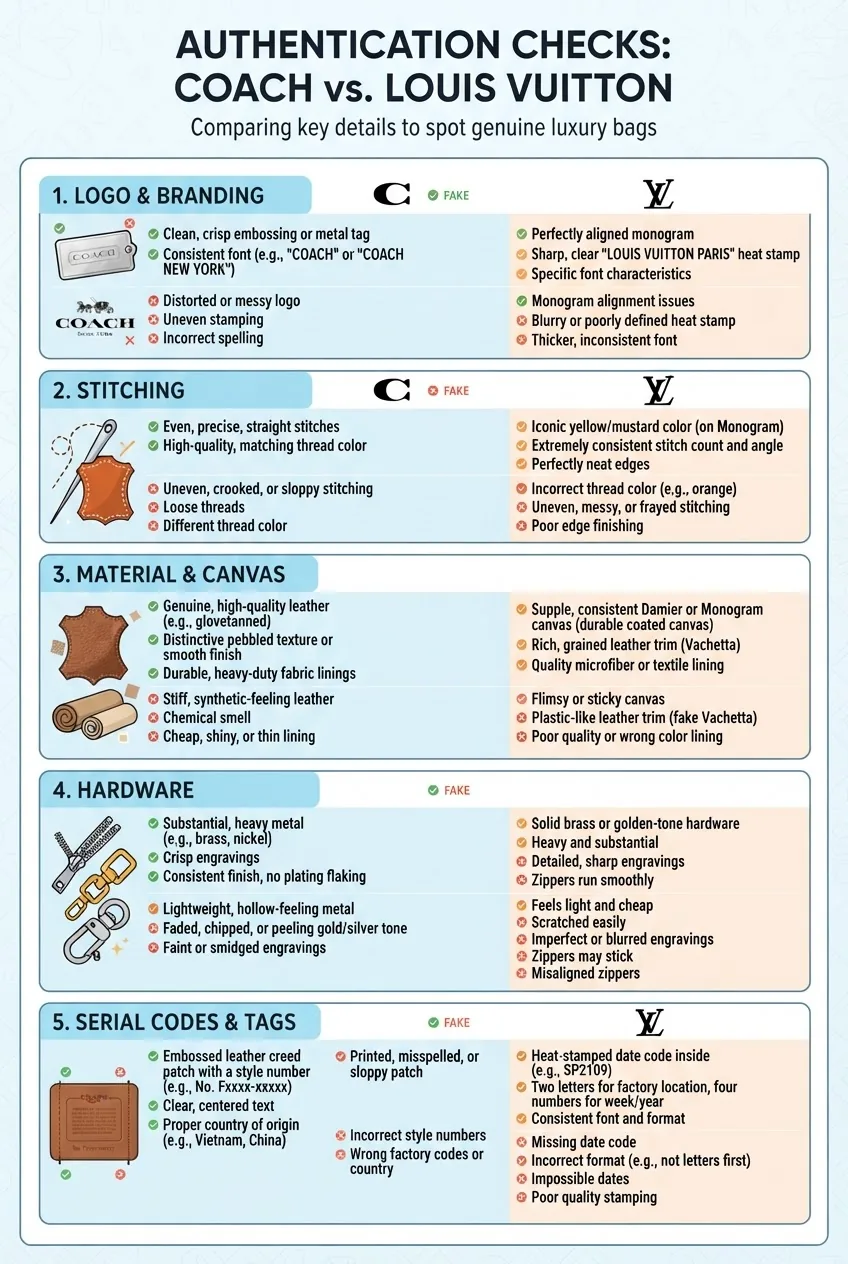
Below are comparison tables and step-by-step how-to checks you can run in sequence. Apply tests in order: logo & pattern → stitching → material feel → hardware → serial codes.
| Check | Coach (Real vs Fake) | Louis Vuitton (Real vs Fake) |
|---|---|---|
| Logo / Monogram | Even embossed wordmark; correct carriage logo; fake shows spacing errors. | Symmetric repeat; LV not cut in center; fake misaligned or off-colour prints. |
| Stitching | 8–12 stitches/inch, uniform; fake has varied spacing and loose threads. | Even stitching, tight corners; fake shows skipped stitches and glue residue. |
| Material Texture | Natural grain, glove-tanned feel; fake often smooth/consistent. | Stiff coated canvas; fake soft or plasticky with incorrect wax finish. |
| Hardware | Solid, heavy, crisp engraving; fake: light, flaking plating. | Durable zippers, clear stamps; fake: rough zips and shallow engravings. |
| Serial / Date Codes | Creed patch numbers consistent with product lines; fake numbers misformatted. | Date codes must match period and factory codes; fake: implausible codes or future dates. |
Step-by-step combined checks you can run in 10–20 minutes
- Surface check (2–3 minutes): Look for pattern alignment, logo clarity, and obvious glue marks.
- Stitch count test (3–5 minutes): Use a ruler and magnifier to count stitches in two seams; record counts.
- Material flex test (1–2 minutes): Fold a corner and note surface reaction; look for cracking or whitening.
- Hardware cycle test (2 minutes): Run zippers 10–20 times and operate clasps; feel weight and listen for clicks.
- Label and code scan (3–5 minutes): Photograph any serial/creed/date codes and compare to official references or use an app.
For a deeper hardware materials comparison consult the bag hardware quality guide. For smell and material grade details see the replica bag materials and factory grades guide.
Transition: Authentication isn’t purely technical—there are common mistakes and myths that cause false positives. Read on to avoid them.
Common Mistakes and Myths in Spotting Fake Bags
Below I list common errors buyers and novice authenticators make, followed by short corrections. I write these from field experience removing assumptions that lead to false conclusions.
- Myth: “One mismatch = fake.” — I once marked a seller’s bag fake because the date code format differed, but the model used an earlier code style; the correct approach is to combine at least three failed checks before concluding fake.
- Error: Relying solely on packaging. Some buyers assume correct boxes and dust bags guarantee authenticity; counterfeiters also replicate packaging. Always check the bag’s construction and codes as primary evidence.
- Myth: “New-looking leather is fake.” — Some genuine vintage restorations or little-used bags may appear new. Verify with stitching and hardware tests rather than age alone.
- Error: Over-trusting community forums. Photo-based opinions may be incorrect; use professional authentication if stakes are high. According to a 2024 industry report, image-only community checks had measurable false positive rates in complex cases (source type: 2024 industry report).
- Myth: “Date codes are proof.” — Date codes can be copied. Use them as corroboration, not sole evidence.
For a broader read on designer bag quality comparisons and to debunk more myths, see the real vs fake luxury bags guide.
Transition: Having avoided those pitfalls, here are practical tips when buying so you reduce counterfeit risk before you even inspect the bag.
Practical Tips for Purchasing Authentic Coach or Louis Vuitton Bags
Follow these actionable tips to increase your chance of a safe purchase. Each tip is followed by a measurable behaviour or threshold.
- Buy from authorised retailers whenever possible. Authorised stores provide receipts and return windows; ask for the original receipt and check retailer details against official brand retailers lists.
- When using marketplaces, prefer sellers with 2+ years of history and 98%+ positive feedback. Request extra photos and video of the bag being handled in real time before purchase.
- Ask exact model style number and compare to official product pages. If the seller cannot provide a style number within 24 hours, treat the listing as high risk.
- Request a 360° video of the bag, focusing on seams and serial patches. Video reduces the chance of edited or staged photos; review at 1x and 2x speeds to spot jumping details.
- Negotiate return terms and a short authentication window (e.g., 48–72 hours after receipt). Sellers who refuse any return on authenticity for used items are higher risk.
- Pay with traceable methods (card, PayPal goods & services). Avoid wire transfers or cash-only deals; they remove buyer protections.
- Use third-party escrow for high-value purchases above $1,000. Escrow holds funds until the buyer confirms the item’s condition.
- Keep documentation for at least 12 months. If fraud appears later, receipts and communication help with disputes.
Consumer protection reference: For legal guidance on counterfeit goods and buyer rights consult the Federal Trade Commission — Federal Trade Commission advice on counterfeit goods.
Transition: If a bag still seems suspicious after your checks, this section tells you how to escalate and what resources to use.
What To Do If You Suspect a Fake
If your checks raise concerns, act methodically. Below are step-by-step actions and resources to confirm and resolve the issue.
- Stop using the bag and preserve all packaging and communications. Photograph the bag and packaging from multiple angles and save transaction records.
- Ask the seller for proof of purchase and production details within 48 hours. Legitimate sellers should provide receipts and serial references promptly.
- Request a professional second opinion. Use a certified service or the guidance in our authentication services guide to select a service. Professional authentication typically costs $20–$150 depending on the service and bag value (typical market range; verify current pricing).
- Report the listing and seller to the platform and request a refund. Provide your collected evidence and reference platform policies; many marketplaces have counterfeit reporting workflows.
- If sold as authentic by a retailer and proven fake, escalate to your payment provider and consumer protection agency. For legal routes consult local consumer protection; in the U.S. contact the FTC at https://www.ftc.gov.
For professional authentication options and how to choose one, review our recommended authentication services guide. If you need machine-assisted authentication, consider Entrupy — a widely used service with photo-based and lab options: Entrupy.
Transition: Below are common practitioner mistakes and a checklist you can use to verify your work.
Common mistakes and how to avoid them (from my experience)
I once accepted a return without taking close-up photos—later the seller claimed the bag had been damaged in transit and removed the hardware. Now I always photograph the hardware and inner seams before shipping. I also used to over-weight a single mismatch (like a date code) and missed other faults; now I require three independent checks to fail before I conclude a fake.
Compact verification checklist
- Logo/monogram alignment checked and within 1–3 mm of official images
- Stitch count recorded on two seams (expected 6–12 stitches/inch depending on part)
- Material flex test: no cracking/whitening on fold
- Hardware cycle test: smooth zippers over 10–20 cycles
- Serial/creed/date code photographed and cross-checked
- Smell check: no strong solvent/plastic smell
- Packaging and receipts scanned and verified
When to call a professional
Call a professional if the bag is valued over $1,000, when two or more tests give mixed results, or if the seller refuses to provide provenance. Use accredited services in our authentication services guide to pick a verifier. Remember: visual checks are necessary but not always sufficient for near-perfect replicas.
Conclusion
Key takeaways: use a systematic multi-check approach—logo, stitching, materials, hardware and codes—and require at least three corroborating passes before declaring a bag genuine. Keep records, prefer traceable payment, and when in doubt use professional authentication. If you plan to buy, follow the purchasing checklist above and maintain a 48–72 hour authentication window.
Ready to verify a bag now? Start with the step-by-step checks in this guide, photograph every detail, and if you need a formal review consult a certified service through our authentication services guide.