Leather vs Faux Leather: How to Check and Care for Your Bag — by the end of this hands-on guide you will be able to reliably identify whether a bag is genuine leather or faux leather, run a practical at-home verification sequence, and follow a step-by-step care routine tailored to each material. Total realistic time: 45–120 minutes for full identification and an hour for a complete cleaning/conditioning session. Skill level: beginner to intermediate (no specialist tools required).
Before you start
- Tools: soft white cotton cloths (3), cotton swabs, dropper bottle with water, magnifying loupe (10x) or strong reading glass, small soft-bristled brush, leather cleaner, pH-neutral soap, dedicated leather conditioner (neatsfoot or mink oil alternatives), microfibre cloth, silicone-free waterproofing spray for faux leather.
- Materials: clean flat workspace, dry towel, paper and camera for documenting results, dust bag or pillowcase for storage.
- Safety: test any product on an interior/hidden panel for 24 hours, keep away from open flame, ventilate when using sprays.
Start by reading the “Understanding Leather and Faux Leather Bags” section to ground yourself in terms and finishes, then follow the numbered verification steps in “How to Check if a Bag Is Leather or Faux Leather.” After identification, follow the care regimens for the material you found.
Understanding Leather and Faux Leather Bags
This section explains what we mean by genuine leather and faux leather, the common finishes you’ll see, and the industry standards used to judge material quality. Use this as the reference for identification and care choices that follow.
What is genuine leather?
Genuine leather refers to animal hide that has been tanned to stop decomposition and to make the material workable. Key commercial grades include full‑grain (the top, most durable layer with natural grain), top‑grain (sanded/surfaced for uniformity), and bonded leather (scraps bound with polyurethane). Each grade behaves differently: full‑grain ages and patinas, top‑grain balances durability and finish, and bonded leather is thinner and less durable.
What is faux leather?
Faux leather is an umbrella term for man‑made leathers: PU leather (polyurethane coated), PVC-based synthetics, and newer plant- or polymer-based vegan leathers. PU leather typically has a fabric backing with a PU coat giving either a smooth or embossed pattern. Vegan leather can use cork, pineapple leaf (Piñatex) or other composites—each with unique wear and care needs.
Leather finishes and their care implications
Finishes alter both appearance and maintenance: aniline leather is dyed but not pigmented—highly breathable and needs gentle conditioning. Semi-aniline adds a thin protective pigment layer for stain resistance. Pigmented or corrected‑grain leathers are more uniform and easier to clean but show fewer natural traits. Patent leather has a glossy lacquer finish and needs different polish products.
Industry standards and environmental context
According to a 2024 industry report from the Leather Working Group, modern tanning and finishing practices vary widely by region and treatment method; the report outlines inspection criteria for grain, finish adhesion and chroming levels. For lifecycle and environmental comparisons, see analyses from circular-economy NGOs and lifecycle assessments that evaluate water, chemical use and end-of-life impacts.
For more detailed insights on designer backpack and wallet replicas, see our comprehensive Replica Backpacks and Wallets Guide for Designer and Messenger Bags.
Transition: With finishes and terms clear, move to the practical test sequence to verify a bag’s material using sensory checks and simple home tests.
How to Check if a Bag Is Leather or Faux Leather
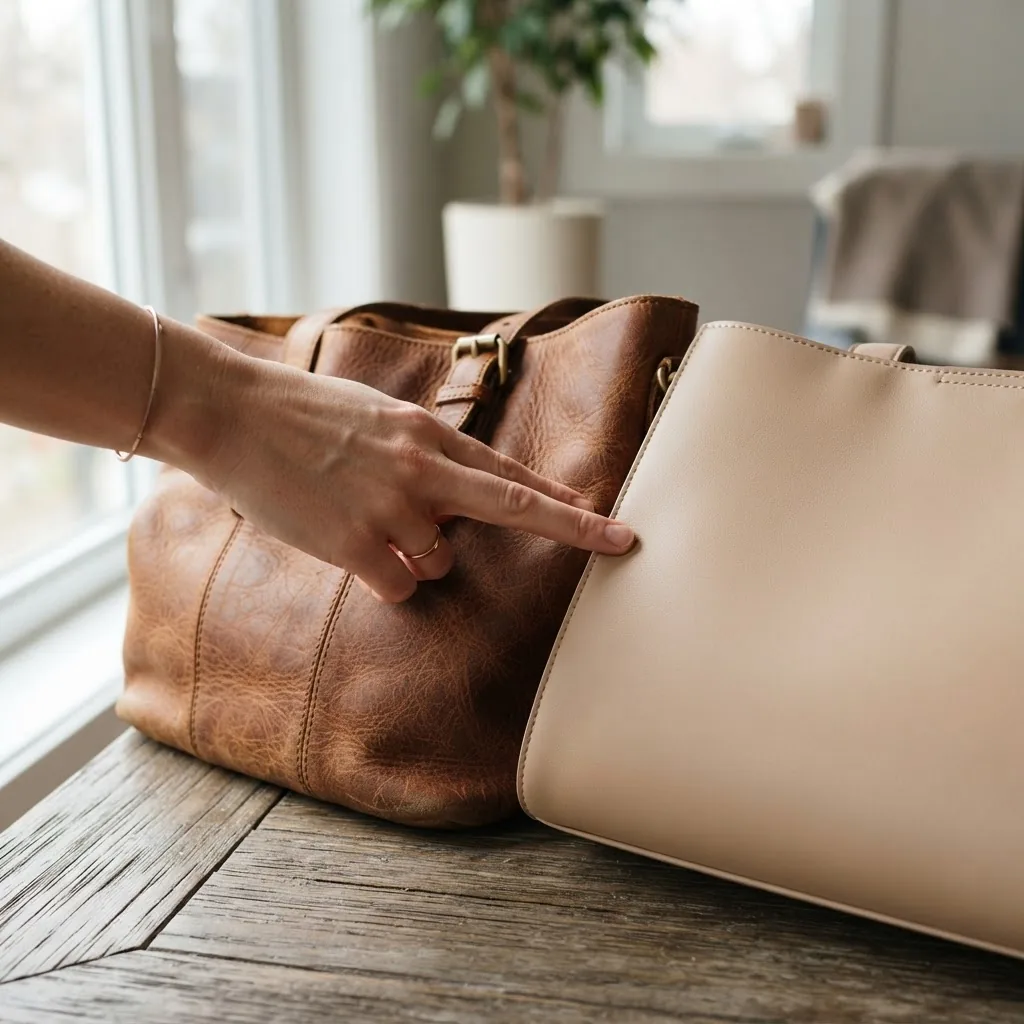
Below is a numbered, step-by-step checklist you can perform in-store, at a market, or at home when you acquire a second‑hand bag. Each step starts with the action in bold and includes what to look for, expected results for leather vs faux, and limitations. Use multiple steps — no single test is 100% definitive.
- Visual inspection — examine grain and pores: Use a 10× loupe or strong reading glass. Full‑grain leather shows irregular, natural pores and lines; top‑grain will have more uniformity but still show natural marks; faux leather (PU or PVC) often shows repeating, perfectly regular grain or a fabric weave at the edge. If you see a stamped pattern repeating exactly, that’s a red flag for synthetic.
- Touch test — press and feel: Gently squeeze a hidden area. Leather will feel warm and supple and will slightly stretch; faux leather often feels colder, less elastic and more plasticky. For thin bonded leather, it may feel plasticky on the surface but fibrous underneath. Note: coated aniline or waxed finishes can mask this sensation.
- Smell test — sniff seam allowances: Genuine leather has a distinctive organic, slightly fatty smell (think warm hide or saddle); faux leather often smells like chemicals, plastic, or acrylic. Smell the interior seam and under flaps — manufacturers often hide chemical smells under the lining. According to a 2023 material-science summary, smell is a reliable quick filter but not conclusive when heavy finishes are used.
- Edge inspection — check cut edges: Expose an edge (inside pocket or strap cutout). Genuine leather edge reveals fibrous, layered tissue; faux leather typically shows a textile backing with a solid polymer coating or a uniform plastic edge. Bonded leather may show layered paper fibers bonded together — a weaker structure.
- Water absorption test — one-drop method: Place a single droplet of water on an inconspicuous interior edge and observe for 10–20 seconds. Genuine leather will absorb or darken slightly (water absorbs into the hide); faux leather will bead and stay on the surface. Limitations: heavily pigmented/patent or finished leathers repel water similarly to synthetics.
- Heat test (touch, not flame): Warm a coin in your hand then briefly touch a hidden leather edge — real leather will warm slowly and retain heat briefly; plastic-based materials will feel cool or warm rapidly but not retain heat. Warning: never expose a bag to flame or prolonged heat; only use body-temperature contact.
- Stitch and hardware quality check: Inspect stitching density and thread type. Genuine leather bags from reputable makers typically use tighter, lock‑stitching and higher-grade metal hardware; faux leather or lower‑cost bags often use looser stitching and plated hardware. This is a contextual clue rather than material proof.
- Label and price clues: Read any tags — “genuine leather”, “PU”, “vegan leather”, or “man-made materials”. Price alone isn’t proof, but a very low price for what looks like high-end construction suggests synthetic covering. For exploring high-quality faux options, consider our best faux leather bags.
- Check the lining and inner labels: The inner lining often reveals backing material. If you find textile backing glued to a finish, it’s likely PU; if you find hide with natural suede flesh side visible, it’s leather. For brand-specific verification routines see our designer wallets fake vs real guide, and for Chanel-specific tips see our fake Chanel flap bag identification guide.
- Contextual checks for backpacks: Unpack hardware, straps and reinforcement points — durable leathers show thicker strap edges and reinforced stitching; faux backpacks may rely on glued reinforcements. For backpack-specific authenticity traits, read our fake designer backpack guide.
- Professional test for high-value items: If you’re verifying a high-value or collectible bag, stop after your home checks and seek professional assessment — accredited leather graders or brand authentication services use destructive and chemical tests you shouldn’t perform at home.
Practical example — second‑hand purchase: I once bought a brown satchel that looked full‑grain; the water drop test left the surface untouched. The smell test hinted at plastic; the edge showed textile backing — using these combined steps saved me from a mistaken purchase. Remember, combine at least three tests for a reliable conclusion.
Transition: After you know which material you have, use the specific care routine below. The two materials age and fail differently, so treatment must differ.
Comparison of Leather vs Faux Leather: Durability, Appearance, and Cost
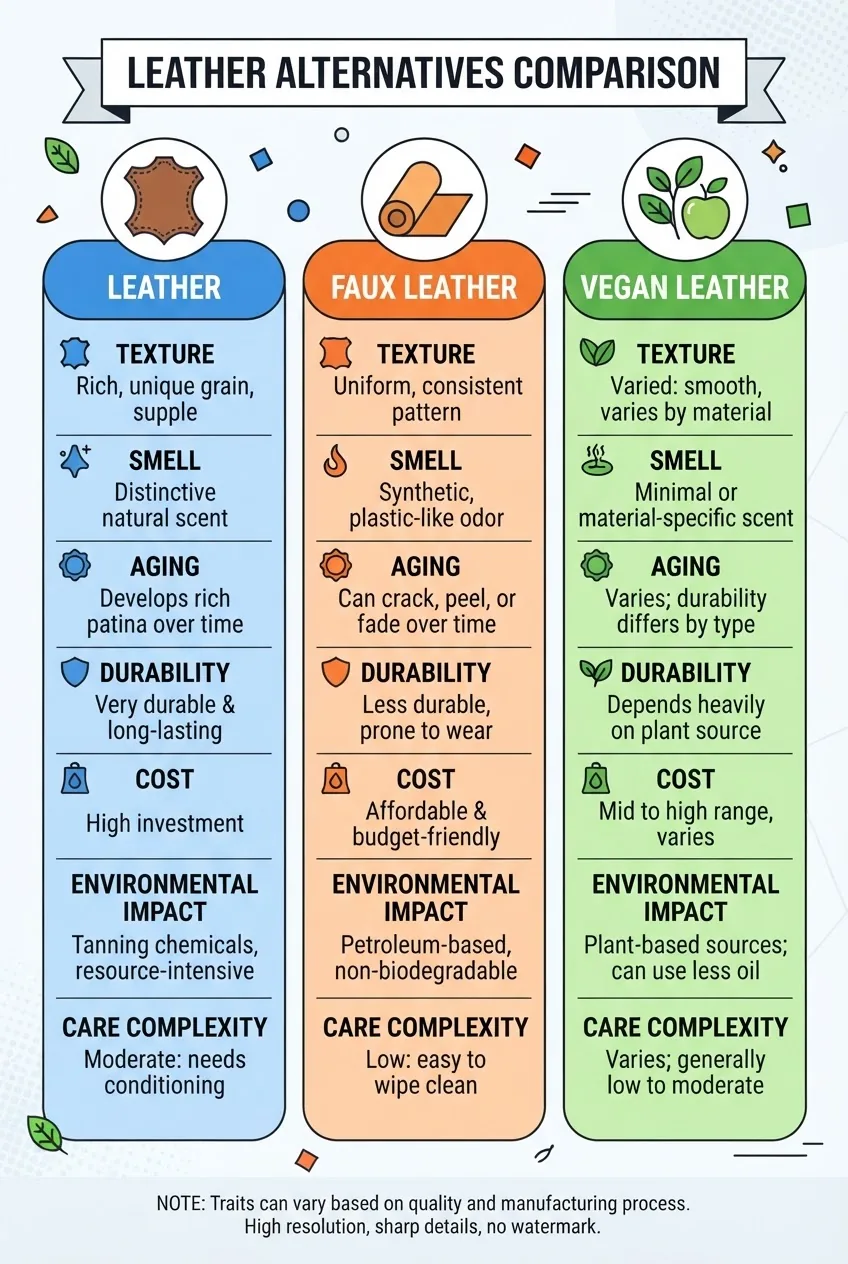
| Trait | Leather | Faux Leather (PU/PVC) | Vegan Leather (bio‑based) |
|---|---|---|---|
| Texture & Grain | Natural, irregular grain; develops patina | Uniform or patterned; can feel plasticky | Varies by material (cork, Piñatex); often textured |
| Smell | Distinct organic hide scent | Chemical/plastic odor | Mild plant/fabric smell |
| Aging | Patinas, can look richer with age | Tends to crack/peel over time | Depends—some durable, some degrade faster |
| Durability | High for full‑grain/top‑grain; repairable | Lower; surface damage often irreversible | Varies; some outperform PU, others do not |
| Cost (purchase & maintenance) | Higher initial and moderate maintenance cost | Lower initial cost; less expensive repairs | Mid to high depending on brand and material |
| Environmental impact | Animal-based, water and chemical-intensive tanning | Fossil-fuel based polymers; microplastics concern | Can be lower impact if sustainably sourced |
| Care complexity | Requires regular cleaning/conditioning | Simple cleaning; avoid heat and cracking | Depends—follow manufacturer guidelines |
Explanatory notes: Leather’s fiber structure—collagen fibers in hide—gives it strength and the ability to stretch and patina; synthetics rely on polymer coatings which lack the natural fiber mesh, so when the coating fails, the underlying fabric shows through. According to a 2022 lifecycle assessment from a sustainability NGO, trade-offs exist: leather’s biogenic carbon content and durability can offset production impacts if maintained and used for many years, whereas PU leather’s lower initial impact may be offset by shorter lifespan and microplastic shedding.
For related styles, see our leather-look bags guide.
Transition: Now that you understand how these materials compare, the next sections give precise cleaning, conditioning and repair routines for each material type, including product names, frequencies and quantities.
How to Care for Genuine Leather Bags
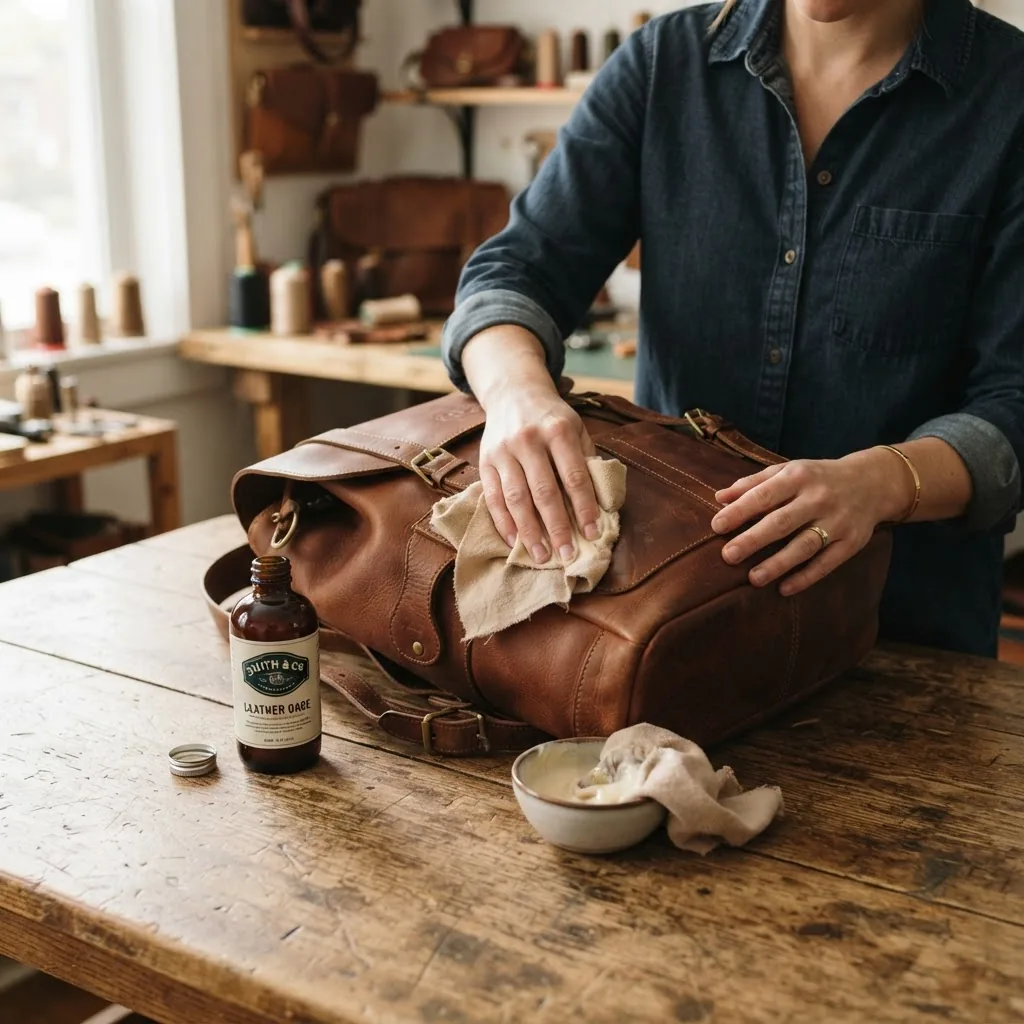
This section gives a step-by-step cleaning and conditioning routine for full‑grain and top‑grain leather, followed by do’s and don’ts, recommended products, and a weekly/monthly/yearly schedule.
- Remove contents and dust loose dirt (10 minutes): Empty the bag, unzip pockets. Use a soft-bristled brush and a dry cotton cloth to dust seams and zippers. Quantity: 1 soft brush, 2 microfiber cloths.
- Surface clean with pH-neutral cleaner (15–20 minutes): Mix 1 drop of pH‑neutral leather cleaner or mild soap per 250ml of water. Dip a soft cloth, wring to damp (not wet), and wipe small sections (10cm x 10cm). Work across the bag systematically. Test: always test on inside panel for 24 hours before full application.
- Dry naturally (30–60 minutes): Air-dry away from direct sunlight and heaters. Threshold: leather should never exceed 35°C during drying. If still damp after 60 minutes, blot with a dry microfiber cloth and allow extra time.
- Condition with a dedicated leather conditioner (10–15 minutes): Use 1–2 pea-sized drops per 10cm² on a cloth, not directly on leather. Apply in circular motions, cover entire panel. Product examples: neutral leather conditioner with neatsfoot alternatives (avoid silicones and alcohol). Frequency: every 3–6 months for regular use; every 6–12 months for infrequent items. According to a 2021 materials-safety overview, choose products free of harsh solvents to reduce leather drying and allergen risk — consult dermatological sources if you have sensitive skin (material safety studies).
- Polish (if pigmented or patent) (5–10 minutes): For pigmented leathers, use a micro-amount of neutral cream polish — buff immediately. For patent, use a patent-specific cleaner and a silicone-free shine cloth.
- Treat scuffs and scratches (variable): For minor surface scratches on aniline or top‑grain, apply minimal conditioner and buff toward the scratch. For deeper cuts, consider professional repair: leather fillers and colorants need exact matching.
- Protect with breathable cover and regular inspections: Store in a dust bag with a silica packet; inspect seams, edges and hardware every 3 months. Keep humidity between 40–60% and temperature 10–21°C to avoid mold or drying.
Do’s and don’ts
- Do use gentle, pH‑neutral products and cotton/microfiber cloths.
- Do condition leather every 3–6 months for daily bags; every 6–12 months if stored.
- Don’t use household cleaners containing alcohol, bleach, or acetone — they strip oils and damage finish.
- Don’t expose leather to direct heat or prolonged sunlight; avoid sitting on backpacks that compress stitching and structure.
Tools and product recommendations
- Soft cotton cloths (3), microfibre cloth for buffing.
- pH-neutral leather cleaner (20–50ml bottles). Example product types rather than brands: water-based leather cleaner with lanolin alternatives.
- Leather conditioner (50–100ml). Use small pea-sized amounts per 10cm².
- Soft-bristled brush, small suede brush for suede panels, dedicated colorant for major repairs (professional use).
Walkthrough example (first-person): I recently restored a 7-year-old brown full‑grain backpack. After my cleaning routine (20 minutes) and a conditioning session (applied ~1.5ml per panel), the bag regained suppleness and the edge wear blended in. I conditioned again after 3 months — the stitching remained firm, proving the value of scheduled maintenance.
Transition: If you have a faux leather bag, many steps are similar, but the products, temperatures and frequencies differ to avoid cracking and delamination.
How to Care for Faux Leather Bags
Faux leather care focuses on cleaning without drying the polymer coating, avoiding heat, and preventing surface cracking. Below is a routine tailored to PU/PVC and guidance for newer vegan materials.
- Remove debris and dust (5–10 minutes): Wipe with a soft dry cloth; use a soft brush for seams.
- Clean with mild soap solution (10–15 minutes): Mix 1 drop of mild dish soap per 250ml of water. Use a damp cloth to clean panels. Rinse cloth and wipe again to remove residue. For stubborn marks, a diluted 70:30 water:isopropyl alcohol solution can be used sparingly — test first in hidden area.
- Dry immediately (5–10 minutes): Wipe dry with microfiber; do not air-dry in sunlight. Faux leather adheres and delaminates if repeatedly saturated.
- Apply silicone-free dressing for flexibility (optional, 5 minutes): For older PU that’s starting to stiffen, use a small amount of glycerin-based dressing (follow manufacturer). Avoid oils that attract dirt. Frequency: every 6–12 months for problem pieces.
- Waterproofing and protection (spray, 30 seconds): Use a silicone‑free waterproofing designed for synthetics; spray 20–30cm away and wipe excess. Test first.
- Avoid heat and prolonged folding: Do not leave faux leather in temperatures above 40°C (car interiors can exceed this). Avoid storing folded for long periods — store flat or lightly stuffed.
Specifics for PU and synthetic varieties
PU and PVC require gentle cleaning and no oil-based conditioners. For detailed care techniques for PU and synthetic leathers, see our PU and synthetic leather bags care guide. For broader style and gender-specific care tips, check our faux leather bags guide for men and women.
Case study — improper care and correction
Example: I once inherited a faux-leather tote that had cracked along fold lines from years in a hot attic and repeated oily dressings. Correction steps I took: removed surface oils with diluted soap, applied a polymer-compatible flexibilizer (manufacturer product), and stored the bag flat with humidity control. The bag did not fully regain original suppleness; the takeaway: prevention (avoid heat and oily products) is far cheaper than repair.
Do’s and don’ts for faux leather
- Do clean spills immediately with damp cloths.
- Do avoid oil-based conditioners and household solvents.
- Don’t use heat or leave bags in hot cars; temperatures above 40°C accelerate cracking.
- Don’t fold or compress bags for long-term storage; use light stuffing instead.
Transition: Both materials share some damage types and prevention strategies. The next section covers common problems and practical fixes for each.
Common Problems and How to Fix or Prevent Them
Below is a troubleshooting guide listing common cause/effects and specific actionable solutions for leather and faux leather. I include quantities, timings and, where relevant, when repair must be professional.
- Scratches (Leather): Cause — surface abrasion. Fix — apply conditioner (0.5–1ml per 10cm²), buff gently for 1–2 minutes. For deeper cuts, use color-matched leather filler and sealant (professional recommended). Prevention — avoid contact with sharp zippers and rough surfaces; use edge guards.
- Peeling/pebbling (Faux leather): Cause — polymer breakdown from UV, heat or low-grade coatings. Fix — surface consolidation with a polymer repair kit (follow kit instructions, typically 30–60 minutes cure). Prevention — avoid heat, use a cover and proper storage.
- Delamination: Cause — glue failure between backing and top coat (common in some synthetics). Fix — professional adhesive re-bonding; home glues are unreliable. Prevention — avoid saturation and extreme temperature swings.
- Mold and mildew: Cause — storage in high humidity. Fix — for leather, wipe with 70:30 water:vinegar solution on a cloth, dry immediately and condition after 24 hours; for faux leather, wipe with mild soap and dry. Threshold: if spread across >30% surface or into seams, consult professional leather restoration.
- Color transfer and staining: Cause — dye migration from clothing or pens. Fix — for pigmented leathers, use a color remover and re-dye by a pro; for faux leather, mild solvent wipe (isopropyl) may work in small areas. Prevention — apply protective layers, be cautious with dark denim and new garments.
- Hardware corrosion: Cause — salt, sweat and humidity. Fix — clean hardware with a soft cloth and metal polish; replace irreparably corroded hardware. Prevention — regular cleaning and avoid contact with chemicals.
Common mistakes and how to avoid them (first-person practitioner notes):
Common mistakes and how to avoid them
- I’ve overwritten cleaning labels — I once used a solvent-based cleaner on aniline leather and removed its natural oils; to avoid this, I always test in a hidden spot and prefer pH-neutral cleaners.
- I used oil-based products on PU — the bag looked shinier but later attracted dirt and hardened; don’t use oils on synthetics.
- I stored a leather backpack folded — stitching creased and cracked; now I stuff bags with acid-free paper and use dust bags.
Repair thresholds — when DIY is not enough
If damage covers more than 20–30% of the surface, or structural elements (straps, lining seams) are compromised, seek a professional restorer. For high-value designer items, always consult a certified authenticator before any invasive repair.
Transition: Proper storage prevents many of these problems — the next section lists best practices for both materials.
Best Storage Practices for Leather and Faux Leather Bags
Store bags to control humidity, maintain shape and prevent UV damage. Follow this mini-checklist and expanded tips below.
Mini checklist
- Clean and dry bag before storing.
- Stuff with acid-free tissue to maintain shape (do not overstuff).
- Place in a breathable dust bag or cotton pillowcase; avoid plastic for long-term storage.
- Store flat or upright on a shelf — avoid hanging straps for long periods to prevent stretching.
- Maintain environment: 40–60% relative humidity, 10–21°C temperature.
Detailed tips:
- Humidity control: Use silica gel packets (one packet per 2–3L bag volume) to keep moisture stable. For very humid climates, consider a small dehumidifier in the closet.
- Light protection: Keep off direct sunlight; UV will fade and dry both leather and synthetic finishes.
- Rotation: For a collection, rotate bags every 3–6 months to avoid prolonged compression and uneven fading.
- Handling straps and handles: Lay flat or stuff handles with soft cloth to reduce stress on attachment points.
When to call in a professional
Call a professional restorer for structural repairs, significant color restoration, or when the item is a high-value designer piece. Professional services have access to color matching systems, heat presses and fillers that are not safe for amateur use.
Final checklist to verify your work
- Identification: Performed at least three tests (visual, touch, water/drop test) and documented findings.
- Cleaning: Completed mild cleaning and hidden-area patch test passed (24 hours).
- Conditioning/Protection: Applied correct conditioner or protective spray for the material and recorded product and amount used.
- Storage: Bag stuffed appropriately, placed in breathable cover and stored at recommended humidity and temperature.
Before finishing, a final trust note: no home test is 100% conclusive, particularly for heavily finished or hybrid materials; for expensive or collectible items, err on the side of professional authentication and conservation. According to a 2024 industry report, accredited graders and authenticated services remain the gold standard for high-value assessments (Leather Working Group report).
Environmental considerations summary: The environmental trade-offs between leather and faux leather depend on production methods and lifespan. For lifecycle perspectives and circular-economy strategies, consult analyses by sustainability NGOs and lifecycle studies (Ellen MacArthur Foundation; UN Environment Programme).
Final transition: Use the checklist above before you store or resell a bag — this preserves value and extends usable life.
Resources and further reading: For broader faux-leather shopping and brand guides, visit related articles listed throughout this guide.