How to Spot a Fake Chanel Flap Bag — by the end of this hands-on guide you will be able to inspect any Chanel Flap bag (Classic, Boy, Caviar, Double Flap, Mini, Jumbo) and make a confident authenticity call in 20–60 minutes depending on how many checks you run. Skill level: beginner to intermediate; tools required are basic (loupe, scale, light) and clearly listed below.
Before you start
- Loupe or 10x magnifier (one unit)
- Digital pocket scale (50–500 g range, precision ±1 g)
- Bright LED flashlight or daylight lamp
- Microfiber cloth and a small soft brush
- Clean surface, notebook and camera/phone for photos
- Access to the bag’s serial number and any included card or box
Introduction to Chanel Flap Bags and the Importance of Authenticity
The Chanel Flap bag is a defining luxury piece: recognizable diamond quilting, the interlocking CC, and a chain strap integrated into couture design. Authenticity affects not only style credibility but resale value and long-term durability; counterfeit Chanel goods flood secondary markets and often mimic surface details while failing on construction and materials.
Why authenticity matters: a genuine Chanel Flap bag—whether a Classic, Boy, or Double Flap—is crafted with precise stitch counts, premium leathers (notably lambskin and caviar grain), plated hardware, and a serial-number system tied to production years. Counterfeits can look convincing from afar but typically reveal telltale signs under close inspection.
According to a 2024 industry report on the counterfeit luxury goods market, imitation designer handbags still account for a large portion of seizures and online fraud complaints; this means buyers must rely on physical inspection plus verification with reputable authentication services. For the hands-on inspector, learning the pattern of real-vs-fake markers—stitching, leather texture, hardware weight, serial stickers, brand stamps, chain construction, and packaging—will reduce the chance of being duped.
This guide breaks those markers down by style (Classic Flap, Boy, Caviar, Double Flap, Mini, Jumbo), offers step-by-step inspection steps, includes a mini case study of a Classic Flap authentication, and explains real-world tools and thresholds for judgments like chain weight and stitch count. Use this guide at listings, markets, private sales, or when receiving a second-hand shipment.
Transition: Now that you know what’s at stake, we move into the exact features to inspect on every Chanel Flap bag, beginning with universal markers that apply across styles.
Key Authenticity Features to Spot a Fake Chanel Flap Bag
- Check the stitching quality first. Use a loupe and count stitches across the top of a single diamond—authentic Chanel pieces typically have tight, even stitches with no loose threads. For Classic and Double Flap styles expect at least 9–11 stitches per diamond row on medium sizes; fewer than 8 often indicates a lower-grade production. Stitching should align perfectly across seams so quilting patterns continue uninterrupted.
- Examine the leather texture and smell. Lambskin (soft, buttery, slightly oily) and caviar leather (pebbled, grained) are two hallmark Chanel materials. Genuine lambskin has a smooth, almost satiny surface that develops a soft patina; caviar shows consistent grain with slight sheen. Fake leathers often feel plasticky, overly stiff, and have an artificial chemical smell. For additional reading on material differences, see the leather-look bags guide and the leather vs faux leather bags guide.
- Feel and weigh the hardware. Chanel hardware is solid and heavy for its size because of quality plating (gold or rhodium) over brass. Use a pocket scale: a medium Classic chain (single strap) should register in the 80–130 g range per strap segment depending on size; Boy bag chunky chains often exceed 150 g. Lighter, hollow-feeling chains or alloy flaking are red flags. For method details on hardware testing I recommend placing the chain on the scale and recording three measurements; a variance greater than ±3% indicates poor metallurgy.
- Inspect the chain strap construction. Authentic interwoven leather in the strap sits snugly with no gaps and shows even edge finishing. The leather should not slide freely within the chain links; instead it’s tensioned. Check the chain connectors: seam lines are crisp, and screws (if present) are evenly torqued, not stamped or rough.
- Analyze the CC lock and logo details. The CC lock has precise spacing: the right C overlaps the left C at the top (on Classic styles), and the finish is uniform. Fonts are crisp—look for the Chanel font on hardware backs and inside brand stamps. Counterfeits often use slightly off-letter spacing and incorrect serif shapes. Use a loupe to compare the engraving depth and font consistency with authenticated reference images.
- Find and read the serial number and hologram sticker. Modern Chanel bags include a hologram sticker with a serial number that corresponds with the authenticity card. Numbers for contemporary pieces are usually 7–8 digits (varies by era). The sticker sits in a specific interior location (lower corner) and has a small clear overlay; peeled, misaligned, or fuzzy holograms suggest counterfeit. Walkthrough of matching serials is below in the Case Study and the serial number section.
- Check brand fonts and leather stamps. The interior stamp—”CHANEL” and “Made in France/Italy”—uses a precise font, even spacing, and deeply impressed letters on genuine pieces. Lettering too shallow, uneven, or smudged often indicates a fake. Also note the alignment: the stamp typically sits centered and horizontally straight in the interior pocket area.
- Inspect interior lining materials and tags. Authentic linings are high-quality leather or fabric with tight stitching and no bubbling. The lining color should match known production runs for the style/year. Interior tags for Double Flap or Classic models are sewn flat, with edges finished; loose adhesive or glued tags are suspect.
- Review packaging, authenticity card, and dust bag. Chanel authenticity cards have a matching serial number and specific fonts with a gold edge. Dust bags are thick cotton with a precise logo. Packaging inconsistencies—thin dust bags, missing care booklets, low-quality boxes—are common counterfeit giveaways. Retain photos of all packaging when buying second-hand.
- Look for replica patterns and common counterfeit traits. Common fakes will attempt correct external geometry but fail at micro-details: uneven quilting alignment across flaps, mismatched stitch counts, incorrect chain weight, and poor engraving on the CC lock. Cross-check multiple markers—no single sign is definitive.
Transition: With universal markers covered, now follow a focused, style-specific inspection for the Classic Flap.
How to Spot a Fake Chanel Classic Flap Bag
The Classic Flap (long associated with Coco Chanel and Karl Lagerfeld) demands attention to quilting, flap alignment, and the iconic CC lock. Below are sequential how-to checks you can run in 10–20 minutes.
- Open the bag fully: The Classic’s flap should lift smoothly; interior leather under the flap should align precisely with the exterior quilting.
- Check diamond quilting alignment: Quilting pattern must line up across the flap and body; misaligned diamonds at seam junctions indicate poor construction.
- Count stitches per diamond: Using your loupe, count the top row of stitches in one diamond—authentic Classic Flaps usually show 9–11 stitches on medium sizes; very low or highly variable counts suggest a replica.
- Examine the CC lock: The CC should rotate smoothly and lock with a precise click; check the plate on the back for model codes and crisp embossing.
- Inspect the interior serial sticker: Locate the hologram sticker in the interior corner and photograph it; the digits should match the authenticity card. According to authentication professionals’ standards, contemporary Classic Flap serials are 7–8 digits—mismatched digits or poorly printed holograms are immediate red flags (see the serial walkthrough below).
- Verify chain and leather feel: The chain should have no wobble; leather threaded through the links will be flush and finished on edges. Weigh the strap segment and confirm it falls within expected ranges for the bag size (see hardware weighing method in Tools section above).
- Confirm brand stamps: The interior ‘CHANEL’ stamp should be perfectly centered, in all-caps, with ‘Made in France’ or ‘Made in Italy’ below. Shallow, blurred, or misaligned stamps suggest counterfeit.
- Look at the back pocket curve: The back exterior pocket on a Classic Flap should sit flush and be functional; overly shallow or glued pockets are a sign of cost-cutting in fakes.
- Assess edge finishing and piping: Edges should be painted cleanly with no excess glue; piping is smooth and continuous around the bag perimeter.
- Compare with authenticated photos: If possible, match every detail—stitch spacing, logo size, quilting depth—against a verified real reference image from a trusted resale platform or Chanel’s official site.
Mini case study: Classic Flap verification
I bought a “pre-loved” medium Classic Flap in 2023; the listing showed correct exterior geometry. In-person checks revealed 6 stitches per diamond (below the 9–11 expected threshold), a lightweight chain (measured 95 g for a strap segment where 120 g was expected), and a serial sticker with slightly misaligned hologram printing. Matching the card number failed—the card had a different last digit. These three combined indicators led me to decline the purchase. This case demonstrates why multiple checks matter.
Transition: Next, the Boy bag uses different cues: chunkier chains, a bold CC logo, and metal finishes that counterfeiters try to imitate. Use the table below for a side-by-side comparison.
How to Spot a Fake Chanel Boy Bag

| Feature | Real Boy Bag | Common Fake Traits |
|---|---|---|
| Chain & Weight | Chunky, solid links; often heavier than Classic chains; leather interwoven tightly. | Hollow links, noticeably lighter, loose leather weave. |
| CC Logo | Bold, squared CC with crisp edges and deep engraving on the clasp back. | Rounded or thin CC with shallow engraving and uneven finish. |
| Leather Finish | Usually grained or smooth lambskin with uniform texture; matte or subtle sheen. | Plastic-like shine, inconsistent grain, or cheap coating that flakes. |
| Interior Lining | High-quality fabric/leather with precise stitching; serial sticker in corner. | Loose fabric, glue marks, or sticker placed off-center. |
| Hardware Finish | Even plating that resists flaking; screw heads neatly finished. | Uneven plating, discoloration, visible base metals at edges. |
Transition: The textured caviar leather has its own authenticity markers—grain consistency and stamping clarity matter most.
How to Spot a Fake Chanel Caviar Flap Bag
The caviar leather finish is prized for durability and a pebbled grain. Counterfeiters sometimes simulate the look but fail under close inspection. Use these numbered subpoints to evaluate caviar leather quality.
- Inspect the grain pattern closely. Authentic caviar displays a consistent pebble size and natural variation in beveling; fakes either show repeating patterns (photoprint) or irregular, flattened beads.
- Test pliability and abrasion resistance. Gently press a pebble with your fingernail—real caviar compresses slightly and rebounds; coated synthetics may show cracking or retain an indent. For a sample test, press for 3 seconds and observe rebound time: authentic leather rebounds within 1–2 seconds.
- Check stamping clarity and color integrity. Stamped logos and interior fonts on caviar pieces should be sharp and uniformly colored; discoloration or blurred stamps indicate a low-quality stamping process common in replicas.
- Compare edge finishing and piping. Caviar edge paint should be smooth with no flaking. Run a magnified pass along the piping—uneven paint or glue evidence suggests counterfeit production shortcuts.
- Consider synthetic lookalikes and alternatives. Many replicas use polyurethane or coated canvases that mimic caviar texture. For background on synthetic alternatives and their typical defects, read the PU and synthetic leather bags guide and the vegan leather bags guide.
- Color consistency and sheen check. Authentic caviar keeps consistent color across panels; fakes show batch differences or overly glossy topcoats that wear off quickly.
Transition: Next we’ll dissect the Double Flap construction, where alignment and interior structure are critical.
How to Spot a Fake Chanel Double Flap Bag
The Double Flap features two interior flaps for added structure and brand-specific hardware orientation. Follow this ordered step-by-step inspection to verify construction integrity.
- Open and inspect both flaps. The outer flap and inner flap should align when closed; quilting patterns must continue from outer body to the inner flap edge. Misalignment here is a frequent indicator of counterfeit cutting.
- Examine the interior compartment layout. Authentic Double Flaps have a specific pocket arrangement: an inner zip pocket opposite the main compartment and flat slip pockets with tight stitching. Run your fingers along seams to feel for glue lumps—these suggest low-quality assembly.
- Check flap alignment from the top-down view. Close the bag and view it straight-on; the outer flap edge should sit level with the body and the inner flap should not protrude unevenly. A deviation greater than 3 mm on medium bags is suspicious.
- Inspect stitch precision on the inner flap. Internal stitching is just as neat as the exterior on genuine pieces; count stitches and look for even spacing. Authentic inner flap stitches generally match the exterior stitch density.
- Verify hardware mounting points. The rivets and screws that hold hardware must be neatly set with consistent torque marks; loose rivets or mismatched screw heads are signs of a replica.
- Confirm serial sticker placement and authenticity card match. Double Flap bags always include a serial sticker and an authenticity card for most recent production runs. Ensure numbers match exactly and that sticker overlays (holographic elements) are intact.
- Listen for the tactile snap of the CC lock. Genuine lock mechanisms close with a firm, low-pitch click; cheap mechanisms can be spongy or high-pitched, and may not secure fully.
Transition: Size variants such as Mini and Jumbo introduce proportional differences—review quick tips next, with photo references you can request from sellers.
Additional Chanel Flap Models: Mini and Jumbo Identification Tips
- Mini flap sizing cues: Proportionally smaller quilting diamonds; stitch counts are slightly lower but still consistent across panels. Request front and top photos to confirm diamond proportions relative to the CC lock.
- Jumbo flap stitching and proportion: Larger diamonds and more quilting depth—stitch counts per diamond typically increase due to scaled panels. Ask for a full frontal image to compare diamond repeat count between top and bottom; mismatch is a red flag.
- Hardware variation by size: Minis can have smaller CC locks and lighter chains; Jumbos use heavier chains and thicker hardware. Request a scale photo (chain laid beside a ruler or coin) for verification.
- Proportion differences to confirm authenticity: Measure bag height to width; known model dimensions (from official listings) should match within ±5 mm.
- Photo requests sellers should provide: Close-ups of quilting intersections, interior serial sticker, authenticity card edge, chain connection points, CC lock backplate with engraving, and dust bag logo.
- Reference guides: For faux-material alternatives or if you’re considering non-authentic options, see the best faux leather bags guide.
Transition: Understanding common replica behavior helps you spot likely fakes fast; the next section lays out frequent counterfeit strategies and scenarios.
Common Replica Flap Bags and How They Differ from Authentic Chanel Flaps
Replica makers target high-demand models—Classic Flap, Boy, and Double Flap—using correct silhouettes but cutting corners on detail areas such as stitch count, hardware plating, and interior construction. Below are realistic buying scenarios and how to evaluate them.
Scenario 1 — Attractive online listing, low price: If a Classic Flap is priced well below market, ask for high-resolution images of the serial sticker, CC lock backplate, and interior stamp. A common fake trait is a glossy exterior coating and inconsistent stitching. Cross-check the bag’s serial pattern against era expectations; if the seller cannot provide clear serial photos, decline.
Scenario 2 — In-person market sale: Use the loupe to inspect stitching and hardware screws. I have seen sellers present bags with correct-looking dust bags but with mismatched authenticity cards—this signals a likely fake; insist on matching serial numbers. For matched-card scams, check hologram clarity and font depth.
Scenario 3 — Bundle sales (bag + wallet): Replica vendors often pair counterfeit wallets with fake bags. For wallet verification see the designer wallets fake vs real guide. If the wallet fails checks, the bag likely has the same production source.
Other resources to broaden your counterfeit education include guides about fake backpacks and related styles; these broaden pattern recognition when fakes reuse production lines: how to spot a fake designer backpack guide, replica and fake backpacks guide, replica hobo and bucket bags guide, and replica messenger bags guide.
Transition: After spotting common replica tactics, apply these final practical tips and service recommendations when you need extra certainty.
Final Tips for Confirming Authenticity and Avoiding Fakes
Actionable checklist to reduce risk when buying a Chanel Flap bag:
- Use an independent authentication service. When in doubt, purchase a professional authentication from a reputable provider; fees vary but expect $20–$150 depending on service depth. According to luxury resale marketplaces’ disclosed policies, in-depth authenticated listings reduce fraudulent transfers significantly.
- Validate packaging and authenticity card. Confirm the card number matches the bag’s serial sticker and request photos of the card’s gold edge and rear hologram if applicable.
- Ask for live video inspection. Request a short live video showing the chain weight, CC lock operation, and interior sticker—this prevents sellers from switching items after sending photos.
- Trust verified sellers and marketplaces. Prefer platforms with money-back authentication guarantees. For broader context on replica goods beyond Flap bags refer to the Replica Backpacks and Wallets Guide for Designer and Messenger Bags.
- Preserve provenance. Keep receipts, original invoices, and seller contact info. These documents increase resale value and traceability if authenticity questions arise.
- When negotiating, avoid rushed exchanges. Rapid sales at public meets are higher risk; insist on inspection time of at least 20 minutes and an itemized photoset prior to payment.
- Use the external authorities below for verification context: Chanel’s official statements on counterfeit prevention are useful for brand-specific guidelines: Chanel official site. For legal anti-counterfeit frameworks see the U.S. Patent and Trademark Office: US Patent & Trademark Office. For authentication standards used by major resale platforms, consult industry authentication pages like The RealReal.
Transition: Below are common mistakes I see and how to avoid them during hands-on inspections.
Common mistakes and how to avoid them
I once relied solely on exterior photos and missed a mismatched serial card; later inspection revealed a fake hologram on the sticker. Now I always verify serials live and weigh hardware. I also used to accept dusty interiors as normal wear—now I check smell and stitching because odor and frayed lining often reveal poor materials.
Another frequent error: trusting a matching authenticity card without comparing hologram depth and card edge color. I now photograph both the card and hologram under similar lighting to compare with authenticated references.
When to call a professional
- If serial numbers are partially obscured or numbers are from an uncertain era, pay for an expert authentication.
- If the seller refuses live video or multiple clear photos of the same features, consider it a red flag and seek professional help.
- For high-value purchases (over $3,000), professional third-party authentication is recommended even when initial checks pass.
Summary and Takeaway Checklist to Spot Fake Chanel Flap Bags
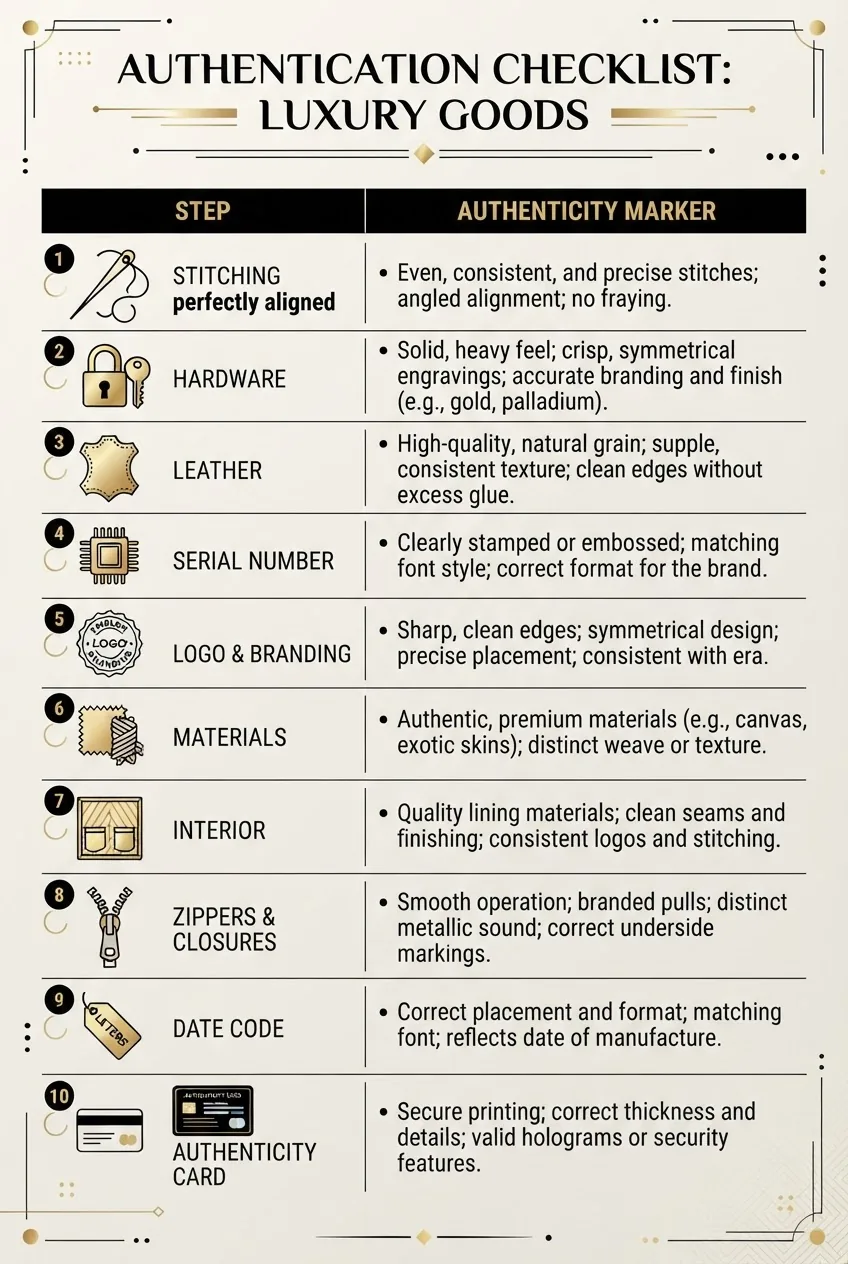
- Stitching: Even, tight stitches; expect 9–11 stitches per diamond on medium Classic Flaps.
- Leather: Lambskin is soft with slight sheen; caviar is grained and durable—no plasticky feel.
- Hardware: Solid weight, consistent plating; measure chain segments and compare to expected ranges.
- Chain construction: Leather interwoven snugly; no sliding or loose leather in links.
- CC lock & logo: Precise spacing and deep, crisp engraving.
- Serial sticker & card: Matching numbers, clean hologram, appropriate digit count for era.
- Brand stamps: Centered, clear “CHANEL” and “Made in” stamp; consistent font.
- Interior lining: Quality leather or fabric with clean seams and no glue residues.
- Packaging: Dust bag, box, and card quality should match brand standards.
- Cross-check multiple markers: No single pass/fail; combine at least three independent checks before deciding.
Final takeaway: Use this checklist to run quick pre-purchase verifications and escalate to a professional when any key marker is ambiguous. If you keep records, photos, and insist on live video for high-value buys, you significantly lower the risk of purchasing a counterfeit.
Closing CTA: If you’re preparing to buy, use the checklist above, request the photos listed in the “Mini and Jumbo” section, and consult a professional authenticator when uncertain. For a broader view of replicas across categories consult the pillar guide linked in the final tips.