Is It Legal to Sell or Buy Designer-Inspired and Replica Bags? Short answer: in Australia you can buy and sell designer-inspired bags that do not infringe intellectual property or misrepresent origin, but selling replicas or counterfeits that use protected trademarks, logos or are passed off as genuine is unlawful and carries civil and criminal risks.
What are designer-inspired and replica bags from a legal perspective?
Answer: Designer-inspired bags are lawful if they do not copy protected trademarks or intentionally imitate branding; replicas and counterfeit bags cross legal lines when they reproduce protected marks, designs or are sold as genuine. Below is a focused legal explanation and practical points for buyers and sellers in Australia.
Term: Trademark infringement — using a mark likely to cause consumer confusion with a registered trademark.
Intellectual property law governs where the line sits between lawful inspiration and infringement. Trademark law protects brand identifiers like logos, monograms and trade dress (the look-and-feel of a product that identifies its source). Copyright can protect artistic elements (prints, unique stitch patterns) in some circumstances, though not every bag design is copyrightable. Consumer protection laws—principally the Australian Consumer Law (ACL)—also prohibit misleading representations that a product is “authentic” when it is not.
Practical takeaway: avoid using brand names, logos, hallmark features or photographs of genuine products to imply authenticity; describe items accurately (e.g., “inspired design” without referencing a trademarked brand) and maintain provenance documents where possible.
For background on brand origins and how historical designs inform modern “inspired” styles, see our resource on designer handbag brands and trends.
How are replica, inspired, counterfeit, and knockoff bags defined legally?
Answer: Legally, a “counterfeit” is an unauthorised copy using protected trademarks or logos to pass off as genuine; a “replica” often reproduces design closely and may be illegal if it uses protected marks; “inspired” means design influence without copying protected IP; “knockoff” is a colloquial term that spans replicas and inspired items.
Term: Counterfeit — an item that intentionally imitates a protected trademark or brand identifier so consumers believe it is the genuine product.
| Category | Key features | Typical legal status |
|---|---|---|
| Authentic | Produced/authorized by brand; genuine marks, serials, provenance. | Fully lawful resale when provenance is real. |
| Inspired | Design elements resemble a style but avoid protected logos, labels or exact trade dress. | Generally lawful if no trademark/copyright is infringed and not misrepresented. |
| Replica | Close visual copy; may or may not include brand marks; often manufactured to mimic originals. | Risky—illegal if it uses protected marks or is sold as genuine. |
| Counterfeit/Knockoff | Uses logos, signatures, or serials to deliberately confuse consumers. | Illegal: civil and criminal penalties possible under trade mark and criminal laws. |
Practical difference: the legal test often asks whether an ordinary consumer would be confused about the product’s origin—if yes, it leans toward infringement. For buying-focused comparisons by brand or style, see our brand-specific designer replicas and style guide for designer-inspired bags.
Which Australian laws are relevant to selling and buying designer-inspired bags?
Answer: The main legal frameworks in Australia are trademark law, copyright law, and the Australian Consumer Law (ACL), plus customs and import controls enforced by Australian Border Force; these regulate IP rights, misleading conduct and border interception of counterfeits.
Term: Australian Consumer Law (ACL) — a statutory scheme protecting consumers from misleading conduct and ensuring product guarantees and fair trading.
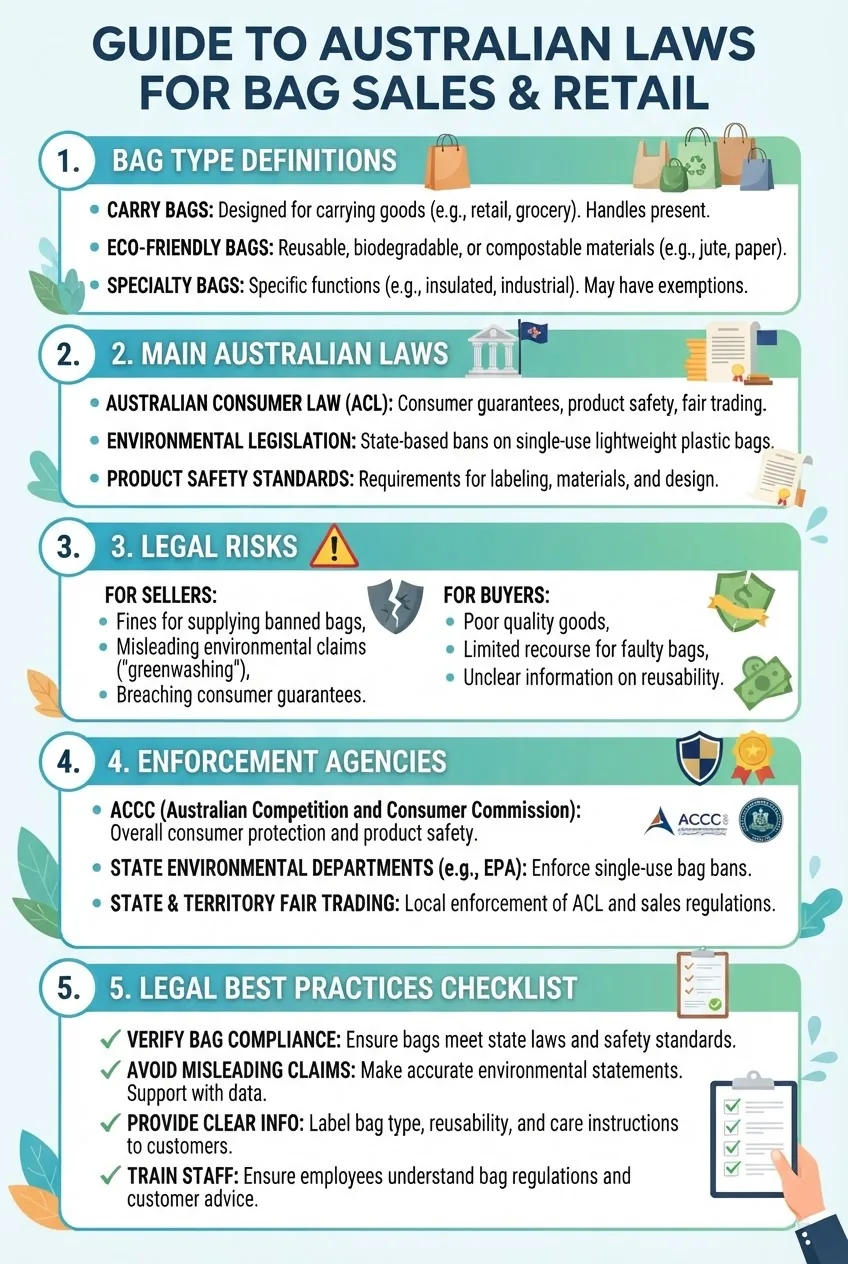
- Trademark law — protects registered marks and unregistered reputation (passing off); enforcement through Federal Court and remedies include injunctions, damages and account of profits.
- Copyright law — can protect original artistic elements of a bag (prints, motifs) where originality threshold met.
- Australian Consumer Law (ACL) — prohibits false or misleading representations (e.g., advertising a replica as “authentic”); civil penalties and enforcement by the ACCC and state agencies.
- Customs & import control — Australian Border Force (ABF) can seize imported counterfeit goods; importers face seizure, forfeiture and potential prosecution.
- Platform-specific obligations — resale platforms impose rules that can result in account suspensions or delisting for IP or trust-and-safety violations.
Key legal points you must know:
- Do not use protected brand names, logos, hallmark features or copyrighted imagery in listings unless you have permission.
- Avoid representations suggesting the item is genuine. The ACL’s misleading conduct provisions apply to both sellers and platform listings.
- Importing products labeled with another brand’s trademark without authorization risks seizure by the ABF and criminal prosecution.
- Proof of provenance and accurate descriptions reduce buyer disputes and ACL risks—keep invoices, receipts and authenticity paperwork.
- Even private second-hand sellers can face significant civil liability if knowingly selling counterfeit goods.
Authoritative resources: guidance from IP Australia explains trade mark rights and registration; the ACCC publishes ACL enforcement guidance; the Australian Border Force issues updates on seizures and import controls.
Legal examples and enforcement signals: public ABF press releases from 2021–2023 document seizures of counterfeit luxury goods including handbags; the ACCC has pursued enforcement for misleading consumer representations related to authenticity in online marketplaces (see ACCC reports for 2022–2023 for trends and enforcement priorities).
Replica Designer Bags Complete Buying Guide in Australia is a recommended deep dive on buying risks and compliance specific to the Australian market.
Can you sell designer-inspired bags on Poshmark, eBay, and Amazon and what are the platform rules?
Answer: You can list designer-inspired bags if you comply with each platform’s IP policies and avoid using trademarks, logos or claims of authenticity; platforms maintain distinct rules, takedown procedures and seller penalties that you must follow.
Below are practical how-to steps and platform-specific bullet points.
How to list legally (general steps)
- Describe the item honestly—use “inspired” or “style” language and avoid brand names unless selling genuine items.
- Don’t use trademarked logos or brand photos—use your own product photos and neutral descriptions.
- Keep provenance documents and be ready to respond to IP complaints.
- Review each platform’s seller agreement and IP policy monthly for updates.
Poshmark
- Poshmark permits selling authentic items and has strict rules against counterfeit listings; they require accurate brand tagging and may delist accounts for repeated IP complaints.
- Avoid listing photos or copy that imply an item is authentic if it is not; use clear disclaimers when selling inspired goods.
- If you ask “can you sell designer inspired bags on poshmark,” the answer is yes with compliance: read Poshmark’s counterfeit policy and respond promptly to takedowns.
eBay
- eBay enforces strict IP and counterfeit policies; sellers must follow eBay Authenticity Guarantee for high-value luxury items where applicable.
- Listing non-branded inspired designs is generally allowed; using trademarked terms to attract searches risks suspension.
- Keep seller documentation and be ready for Verified Rights Owner (VeRO) notices.
Amazon
- Amazon’s policies prohibit counterfeit sales and allow rights owners to enroll in Brand Registry and request takedowns.
- Amazon can suspend seller accounts on receipt of multiple IP complaints—maintain careful inventory controls and listing transparency.
For a broader comparison of how major marketplaces treat dupes and replicas see our designer dupes guide for major platforms and for platform-specific selling rules see designer dupes buying guide in Australia.
What are the risks and penalties for illegal sale or purchase of designer-inspired and replica bags?
Answer: Risks include civil liability for trademark infringement, ACL penalties for misleading conduct, criminal sanctions for counterfeiting, customs seizure, account suspensions on marketplaces, reputational harm and buyer scams; penalties vary by severity and context.
Civil remedies can include injunctions, damages and account of profits; criminal penalties—where intentional counterfeiting or organised commercial scale operations are proven—may attract fines and imprisonment. Platform penalties include listing removal, seller suspensions and withheld funds.
Illustrative enforcement examples (Australia): public ABF enforcement actions have involved seizures and import detentions of counterfeit handbags, while ACCC investigations have targeted misleading online authenticity claims in marketplace listings—these are documented in agency reports and press statements from 2021–2024.
Hypothetical case:
- Seller scenario: A seller imports 200 bags bearing a luxury brand’s stitched monogram, lists them as “replica” but posts photos with the brand name prominent. Brand owner obtains an injunction; ABF seizes shipments; seller faces civil damages and platform suspension.
- Buyer scenario: A buyer purchases an apparent “authentic” bag with fake authentication paperwork; on discovery of counterfeit status, the buyer may be entitled to refund and consumer protections under the ACL, while the seller faces legal exposure.
Fraud and scams are common: fake authentication services and doctored receipts are used to launder counterfeit sales—see our practical checklist in the “How to spot fake handbags” resource to reduce exposure.
how to spot fake handbags is essential reading for buyers and sellers to reduce fraud risk.
What are the best legal practices for sellers and buyers to stay compliant and ethical?
Answer: Follow clear steps: accurate descriptions, no use of protected marks, retain provenance, disclose materials honestly, monitor platform policy updates, and adopt ethical buying/selling practices to reduce legal and reputational risk.
Term: Provenance — documentation proving an item’s origin, ownership history or authenticity (receipts, certificates, serial numbers).
- Use clear disclaimers: state “inspired by” or “style of” without naming trademarked brands in titles; provide full product detail in descriptions.
- Disclose materials and origin: list materials, country of manufacture and supply chain transparency where possible.
- Keep provenance records: maintain invoices, purchase receipts, authenticity certificates and serial numbers for high-value items.
- Avoid brand imagery: use original product photography and avoid images that reproduce protected labels or logos.
- Monitor IP complaints: have a process to respond to takedown notices and disputes quickly; preserve communications and evidence.
- Adopt ethical sourcing: prefer legitimate manufacturers and avoid supply chains associated with counterfeiting.
Complementary guides: for buyers seeking lawful budget options, consider our affordable designer bags with best value picks and best faux luxury handbags buying guide. For full online shopping steps see the complete buying guide for designer-inspired bags online.
affordable designer bags with best value picks and best faux luxury handbags buying guide are practical alternatives with lower IP risk.
How can I verify legality, and what common legal questions do buyers and sellers ask?
Answer: Verification involves checking for trademarked identifiers, confirming provenance, reviewing platform rules, and, where necessary, seeking legal advice; below are concise legal FAQs and direct answers addressing common concerns.
Use this FAQ as quick reference; each answer is self-contained for featured-snippet optimisation.