How to Spot Fake Handbags: Replica vs Authentic Checklist — by the end of this hands-on guide you will confidently identify common and advanced telltale signs of fake handbags, complete a 15‑point inspection in 20–40 minutes, and know when to call an expert. Skill level: beginner to intermediate—no professional tools required for 75% of checks.
Introduction to Spotting Fake Handbags
This guide shows you, step by step, how to inspect a handbag and separate authentic designer pieces from replicas and counterfeits. You’ll learn a universal replica checklist applicable across brands, plus brand-specific cues for Gucci, Brighton and Guess. Expect practical tests you can perform at home: stitch counts, logo spacing, hardware weight, serial-number formats, and functional checks like zipper smoothness.
Why this matters: buying a fake when you intended to buy authentic can mean losing hundreds or thousands of dollars, risk of legal or customs trouble, and reduced resale value. Conversely, understanding how to spot fake handbags helps you avoid scams and choose acceptable faux alternatives when budget or ethics require them.
For readers wanting a deeper, Australia-focused buying strategy and market context, consult the comprehensive pillar: Replica Designer Bags Complete Buying Guide in Australia.
Transition: now that you know what you’ll gain and where to find broader guidance, move on to the core differences you must spot first.
Key Differences Between Authentic and Replica Handbags
- Materials quality and scent — Authentic designer handbags use full‑grain or top‑grain leather, luxury textiles, and metal alloys that feel heavy and cool; replicas often use corrected grain, PU, or bonded leather. Smell matters: genuine leather has a deep, organic scent while faux leather smells plastic or chemical. When in doubt, the material should not flake or peel within light flex tests.
- Construction and stitching — Designers use even, tight stitching with consistent thread colour and no loose ends; stitch length typically measures 3–4 mm on visible seams for many high‑end brands. Replicas show uneven stitch length, loose threads, and skipped stitches. Think of stitching quality as the bag’s fingerprint: unique and consistent on a real piece.
- Logo execution and typography — Authentic logos have precise spacing, proportions, and font weight. Examine letter spacing (kerning), alignment, and accent marks. Replicas often display blurred embossing, incorrect fonts, or misaligned logos; metal badges may be hollow or stamped poorly.
- Hardware weight and finishing — Real hardware is plated over heavy base metals, resists scratching, and uses secure fastenings; zippers move smoothly. Replica hardware often feels light, shows flaking plating after minimal wear, or has poor die stamps on buckles and studs.
- Serial numbers, date codes and authenticity cards — Genuine items use consistent serial formats per brand and clear fonts; authenticity cards and dust bags match brand standards. Replicas can include fake serials but with incorrect formats. Always verify serials against brand guides or with a trusted authentication service.
- Pattern alignment and symmetry — For patterned canvases (e.g., GG monogram), designers align patterns symmetrically at seams and centerlines. Many replicas ignore alignment to save material, so mismatched or off‑center logos are a red flag.
- Interior finishing and linings — Original interiors use branded linings, stamped leather tags, and clean edge finishing. Replicas cut corners: raw seam edges, glue marks, or cheap lining fabrics indicate inauthenticity.
- Functional hardware and fittings — Test zippers, clasps, and shoulder straps. Authentic zippers (e.g., Lampo, YKK high‑grade, Riri) glide under light pressure; replica zippers snag or separate after stress tests.
- Price and market value signals — A too‑good‑to‑be‑true price is a top indicator of a fake. Compare with typical market value drops: according to a 2024 industry report, popular pre‑owned luxury handbags retain 45–85% of retail value in the first two years; items offered at 10–30% of genuine resale value warrant deeper scrutiny.
- Seller credibility and proof of provenance — Reputable sellers provide detailed receipts, original packaging, and clear, time‑stamped provenance. Sellers on anonymous marketplaces or accounts with only a few reviews increase risk; always ask for additional photos, serial close‑ups, and purchase history.
Transition: with these differences understood, follow the next section’s stepwise checklist that structures these checks into a repeatable process.
Detailed Replica Handbag Checklist: Step-by-Step Guide
Before you start, gather these tools and materials to run reliable checks:
- Bright continuous LED lamp or daylight lamp (5,000–6,500K)
- 10–20× jeweller’s loupe or magnifier
- Small digital kitchen scale (±1 g accuracy)
- Magnet (for testing metal weight and ferrous content)
- White paper towel and cotton swab for scent and rub tests
- Smartphone with high‑resolution camera and internet access
- Microfiber cloth and soft brush
- Start with high‑resolution comparison photos.
- Obtain at least three clear photos of the alleged authentic model from the brand’s official site and a reputable reseller: front, side, interior.
- Open a side‑by‑side comparison in full screen and zoom to 200% to inspect logo spacing, pattern alignment, and stitch placement.
- Inspect the exterior material and scent.
- Visual: Check grain consistency—full‑grain shows natural, irregular pores; corrected grain appears uniform.
- Scent: Hold the bag near your nose 5–10 cm; genuine leather emits a deep, slightly sweet earthy smell. If it smells like plastic or chemicals, mark as suspicious.
- Touch: Apply light pressure over seams and flex—real leather wrinkles naturally and does not peel; faux may show surface cracking.
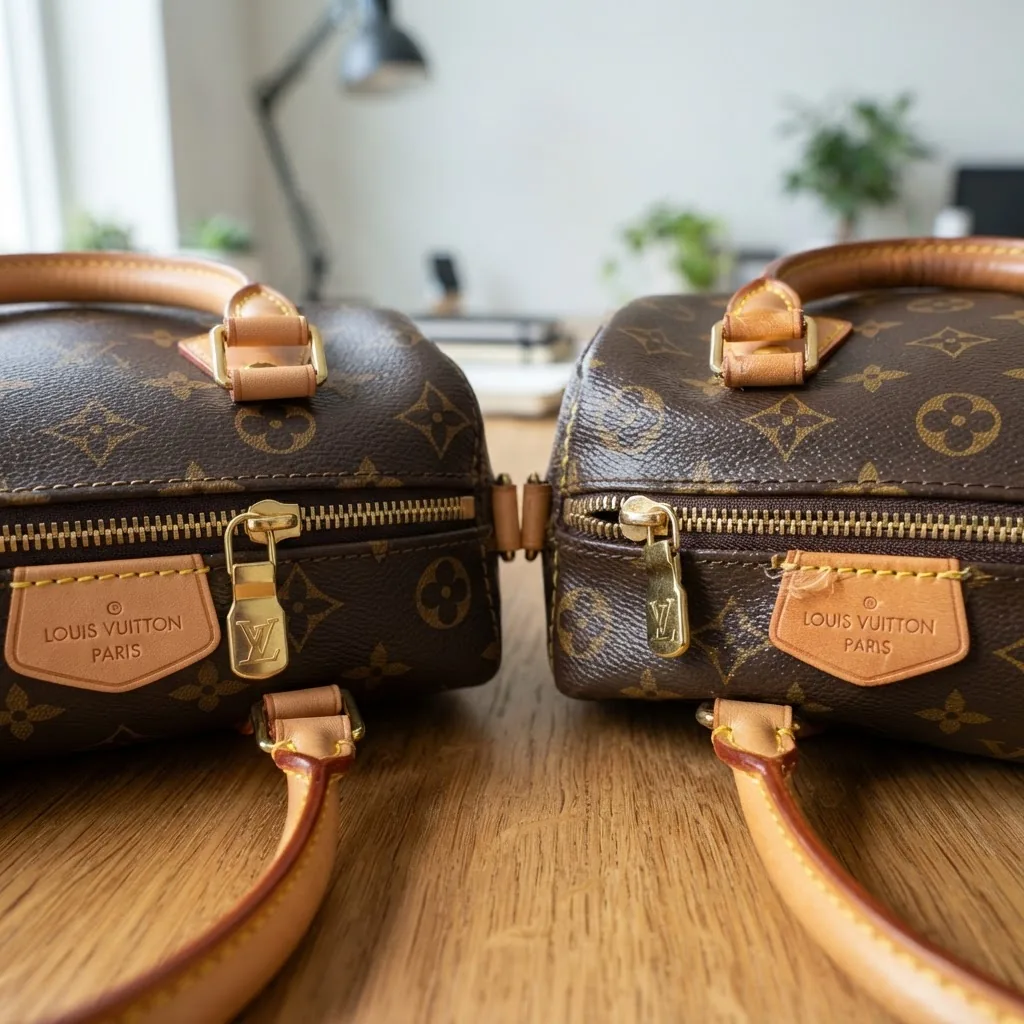
- Examine stitching and seam construction.
- Use a loupe to measure stitch length in millimetres; authentic visible seams often use 3–4 mm stitch length—record the average from three points.
- Count stitches per inch on a main seam; inconsistent counts indicate replica shortcuts.
- Look for backstitching and reinforced corners; missing reinforcement is a red flag.
- Assess logos, embossing and typography.
- Compare letter shapes, spacing and accent marks against brand images. Letterform errors (e.g., rounded vs sharp R) are common on fakes.
- Measure logo placement relative to a seam or zipper: authentic placement is consistent within ±2 mm across production runs.
- Check hardware weight, finish and stamps.
- Weigh a removable metal piece (if safe) on your scale; many authentic clasps weigh 20–40 g depending on size—document and compare with brand guides.
- Use a magnet: authentic base metals are often non‑magnetic nickel alloys; strong magnets attracting hardware indicate cheap steel cores.
- Inspect engravings and stamps: crisp, centered, with correct spelling; poor engraving depth signals replicas.
- Open the bag and test interior finishing.
- Look for branded lining patterns and clean edge transfers. Glue residue, raw edges, or loose canvas backing are indicators of replicas.
- Check pocket orientation; authentic pockets are functional and aligned, replicas sometimes sew them closed or misplace them.
- Validate serial numbers, date codes and authenticity cards.
- Document the serial format and compare to documented brand formats: spacing, alpha/numeric patterns and font size matter. For example, many Gucci serials are two sets of 6 numbers; variations are a red flag.
- Search the serial on trusted databases, or use a professional authentication service for verification.
- If an authenticity card is included, check paper weight and printing quality; cheap cardstock or incorrect laminates suggest a fake.
- Test zippers, closures and strap attachments.
- Open/close each zipper 10×. Authentic high‑grade zippers operate smoothly with a light, consistent pull force (~0.5–1.5 kgf). Snagging or jamming within 10 cycles is suspect.
- Attach and detach straps, checking rivet integrity and stitching at anchor points for pull‑through or fraying.
- Measure hardware alignment and pattern symmetry.
- Patterned goods: fold the bag along centerlines and check monogram alignment across seams; misalignment greater than 5 mm is uncommon on authentic pieces.
- Check that hardware pairs (buckles, feet) match in finish and weight—manufacturers use matched sets.
- Weigh the bag and compare to known authentic weights.
- Use the scale to measure the empty bag; note weight to nearest gram. Many authentic medium totes weigh 600–1200 g empty depending on materials—document differences.
- Cross‑reference with official specifications when available; significant variance (>15%) is suspect.
- Inspect packaging, dust bag and tags.
- Genuine dust bags use branded fabrics and printed logos with high print definition; cheap cotton or flimsily printed logos often accompany replicas.
- Box stamps, tissue paper prints and adhesive labels should match brand standards; mismatched barcodes or SKU numbers are red flags.
- Run provenance and seller verification checks.
- Request original purchase receipt with date, store and payment redactions as needed. Verify store name and transaction format for authenticity.
- Check seller’s marketplace history: accounts older than 12 months with consistent sales history and positive feedback are lower risk.
- Search for micro differences: font weight, stitch color and hardware plating underneath.
- Use magnification to compare thread colour under bright light; mismatched threads on facing panels often indicate replacements or poor manufacturing.
- Inspect hardware edges and inner faces for base metal colour—flaking plating with contrasting base metal shows poor plating quality.
- Use an authentication service when uncertain.
- For high‑value items (over AUD 800 / USD 500), send high‑resolution photos or use a certified courier to a recognized authenticator; fees usually range AUD 30–150 depending on service and turnaround.
- Document the service provider and keep receipts for dispute resolution.
Case study: In 2022 a buyer suspected a Gucci shoulder bag; by following steps 2–6 and using a professional photo‑authenticator, the bag was confirmed fake though its serial looked plausible. The photographer highlighted incorrect stitch gauge (2.2 mm vs authentic 3–3.5 mm) and lightweight plated hardware.
- Final cross‑check: price, market context and instinct test.
- Verify final price against current retail and standard resale ranges. If the price is 40–60% lower than recent resale comparables for the same model, escalate checks.
- Trust your documented anomalies: three or more independent minor anomalies usually indicate a replica.
Transition: after completing the checklist above, use the brand‑focused section next to apply these checks to Gucci, Brighton and Guess models where serial formats and build expectations differ.
Brand-Focused Tips: How to Spot Fake Gucci, Brighton & Guess Handbags
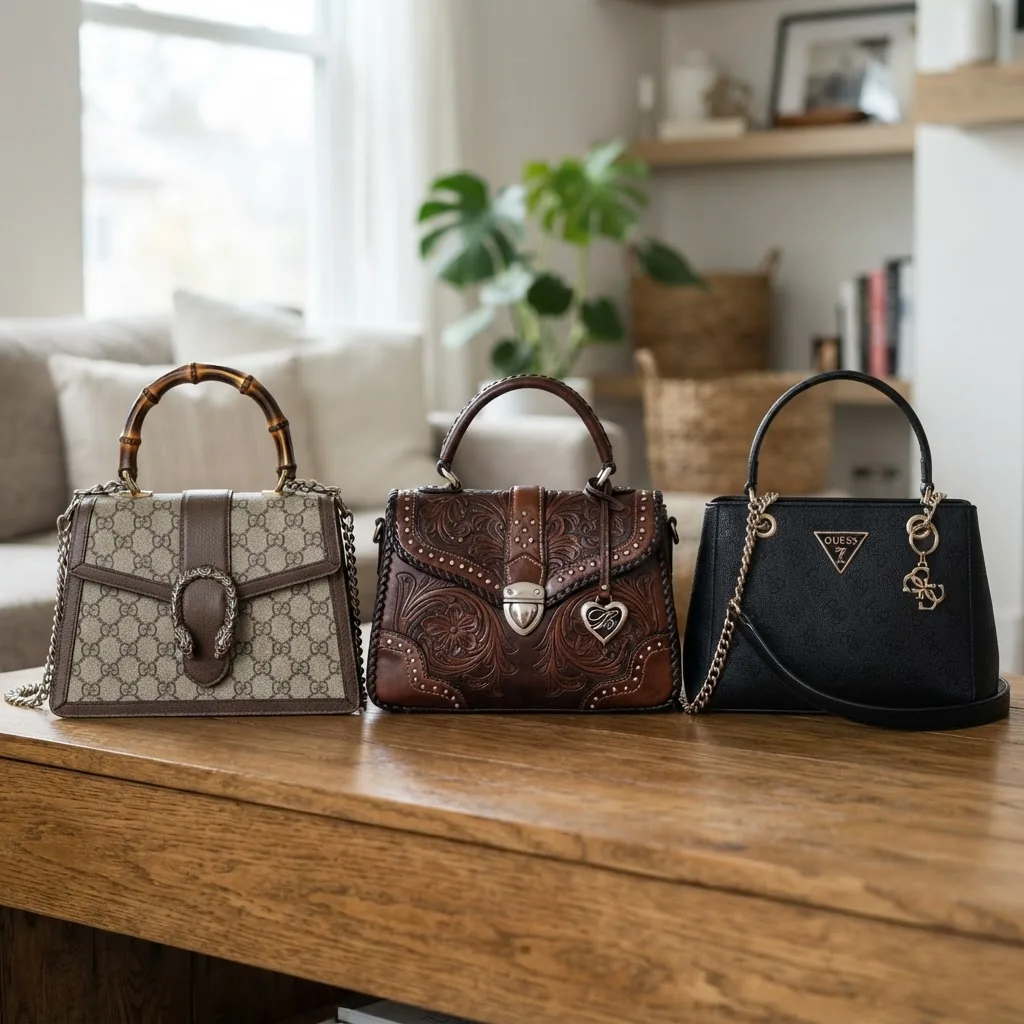
Below are focused, high‑impact checks for each brand. Use the general checklist above first, then apply these brand‑specific tests.
Gucci: high-risk models and quick checks
- Serial / style card format: Older Gucci bags often show a two‑line serial with 10–12 digits (e.g., 112345 0000). If the serial is a single long line or contains letters where numbers should be, flag it.
- GG monogram canvas: Logos must be evenly spaced and aligned across seams. The G should have a specific oval shape; distorted G shapes signal replicas.
- Web stripe and hardware: Authentic green/red/green webbing is tightly woven and centered; cheap webbing colors bleed and are loosely woven.
- Leather trim: Gucci uses high-quality calfskin; edges should be painted smoothly with no glue marks.
- Microstitch detail: Gucci uses consistent stitch counts—measure 3–4 mm per stitch on visible seams.
- For deeper rules and model variations see brand-specific designer replica bags buying guide and the brand evolution context in designer handbag brands and trends history guide.
Brighton: artisan details to verify
- Hardware and engraving: Brighton often uses signature heart or stud engraving; uneven engraving depth or off‑centre icons are suspect.
- Conchos and studs: Authentic Brighton studs are solid and well‑finished; loose or hollow studs indicate low‑grade replicas.
- Leather tooling: Brighton’s tooling is precise and consistent—blurry tooling patterns or off‑set stamped motifs are a red flag.
- Brightness of print: Brighton’s printed logos on hardware or leather are matte and crisp; glossy or smudged prints often mark fakes.
- Mini case study: a buyer in 2021 received a Brighton bag where hardware plating peeled within two weeks; inspection revealed a magnetic attraction and visible base‑steel—clear counterfeit manufacturing shortcuts.
Guess: mass-market cues and common replica tricks
- Metal plate logos: Guess often uses small metal plates; check attachment rivets for consistency and centered drilling.
- Patent finishes: Guess patent leather should have an even, glossy finish; bubbling, peeling or inconsistent gloss points to imitation coating.
- Logo fonts: Guess’s “G” and “U” spacing is consistent; look for compressed or stretched letters on printed fabrics.
- Price sensitivity: Because Guess targets a lower price tier, very cheap prices remain possible, but sudden “luxury” grade claims with lightweight hardware are suspect.
Transition: understanding brand differences helps detect higher‑quality replicas; next we define what “super fake” means and how it differs from knockoffs or standard replicas.
Recognizing the “Super Fake” and Knockoff Handbags
Definitions up front: a replica is an item made to closely imitate a specific model without permission; a knockoff borrows general design cues but avoids direct trademark copying; a counterfeit is an illegal copy sold as genuine. A super fake is a high‑quality replica engineered to mimic fine details and often deceives casual inspection.
| Type | Definition | Key distinguishing features | Typical price range (USD) |
|---|---|---|---|
| Replica | Close visual copy of a specific model | Good logos, medium hardware, visible stitching issues | $50–$300 |
| Super Fake | Very high fidelity imitation intended to pass casual checks | Correct serial format sometimes, high grade canvas/leather feel, accurate hardware plating | $200–$1,000+ |
| Knockoff | Design inspired item avoiding trademark names/logos | Different logos, altered patterns, lower legal risk | $20–$200 |
| Counterfeit | Illegally sold as the genuine brand | Often identical branding, intent to deceive, illegal resale | Varies widely |
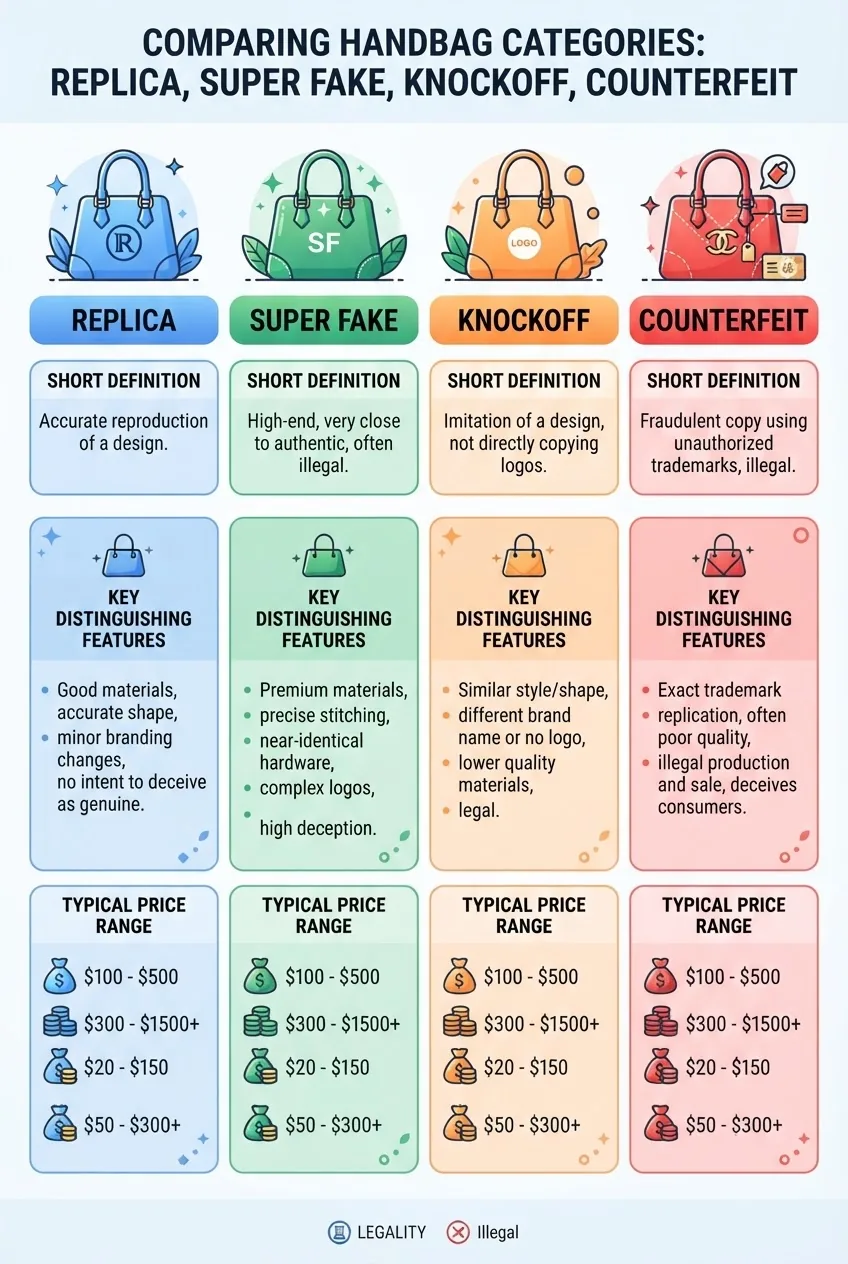
Super fakes often require a layered inspection: serial verification, microscopic stitching checks, hardware magnet testing, and sometimes lab analysis of leather. For more on market terminology and how Australian buyers might see these terms, see designer dupes explained in Australia and the comparative guides look-alike and knockoff designer bags buying guide and replica vs knockoff vs counterfeit bags explained.
For acceptable faux alternatives, consider the curated suggestions in the best faux luxury handbags buying guide.
Transition: knowing product categories and limits, next learn where to buy and how to verify sellers safely.
Practical Tips for Buyers: Where and How to Buy Authentic or High-Quality Replicas Safely
Buying safely requires verification at three stages: pre‑purchase (research), purchase (transaction safety), and post‑purchase (authentication and returns). Below are practical actions, legal flags and trusted external resources.
- Pre‑purchase research: Use reverse image search and model SKU checks. Ask for serial close‑ups and purchase receipts. Confirm seller history and ask why the item is being sold.
- Transaction safety: Prefer platforms with buyer protection—escrow or in‑platform payments. Avoid wire transfers to unknown sellers.
- Post‑purchase validation: Authenticate within 7–14 days and document condition on arrival with timestamped photos for disputes.
External resources and authorities to consult:
- ACCC Australia — consumer rights and counterfeit goods guidance from a national consumer protection agency (useful for Australian buyers seeking legal context).
- Entrupy — independent authentication tech and services that analyze images and materials for a fee.
- International Trademark Association (INTA) — trade organisation resources on intellectual property and anti‑counterfeiting standards.
Marketplace recommendations and cautions:
- For curated, authenticated second‑hand goods, prefer established consignment platforms with in‑house authentication.
- On open marketplaces (Amazon, eBay, Poshmark, Shein): vet sellers through reviews, request serial photos, and use secure payment methods. See our cautionary marketplace guide designer dupes on Amazon, Shein, eBay, and Poshmark.
- When targeting budget designer buys, compare options from the affordable designer bags guide before risking private sales.
Helpful internal resources for related buyer needs:
- designer-inspired bags style guide
- complete buying guide for designer-inspired bags online
- designer-inspired bags for travel and specialty use
- legal guide for buying and selling designer-inspired bags
- copy designer bags guide for crossbody, tote & satchel
Legal highlights: According to a 2023 consumer protection report, selling items presented as genuine when they are counterfeit can lead to consumer compensation and seizure by authorities—documented receipts and good faith seller communications help your case in disputes.
Transition: with safe buyer practices in place, finish by reviewing mistakes I’ve seen and a compact verification checklist you can use immediately.
Conclusion and Final Replica Spotting Reminders
Work through the checklist methodically: material & scent, stitching, logos, hardware, serials, and seller provenance. If three or more checks fail, assume inauthenticity. When in doubt for high‑value items, use professional authentication. Your action plan: document evidence, verify serials, and escalate to an authenticator or consumer protection body for contested purchases.
Common mistakes and how to avoid them
I once accepted a convincing set of photos without asking for interior shots—when the bag arrived the lining was wrong and repairs were evident. Now I always request interior and serial close‑ups before paying. I also sometimes relied too much on price: a low price alone is not proof of authenticity, but combined with poor details, it confirms risk.
Compact verification checklist
- Material smell and touch: genuine leather smell, no peeling.
- Stitch count and alignment: consistent 3–4 mm stitch length on visible seams.
- Logo typography and placement: exact match with brand images.
- Hardware weight and engraving: non‑magnetic, heavy, clean engravings.
- Serial number format: matches known brand format; verified by authenticator if needed.
- Functionality: zippers glide for 10 cycles without snagging.
- Seller provenance: receipt, original packaging, and credible seller history.
When to call a professional
Call an authenticator when the bag’s retail or resale value exceeds AUD 800 (≈USD 500) or when three or more anomalies exist that you can’t verify yourself. For legal disputes or suspected counterfeit sales, contact a consumer protection agency or intellectual property lawyer.